

Key Takeaways
- The Reality: Generally, Golden Retrievers are not excessive barkers. Yet, a teenage Golden Retriever may bark a great deal. This excessive barking does not last indefinitely, usually occurring when the dog is between six and eighteen months old.
- The Cause: The reason behind this sudden alertness is due to fluctuations in hormone levels and the periodic increase in secondary fear responses.
- The Fix: In this situation, we employed the ‘thank you’ protocol for alert barking and the ‘engage-disengage’ game for strangers.
- The Prevention: The dog was mentally stimulated by licking and sniffing activities, which reduced his daily stress levels considerably.
On bringing him home, Jasper was quite quiet. Our biggest challenges during the first six months were trying to stop him from eating socks rather than dealing with noise. The most striking changes in our boy’s life began when he was seven months old. At this moment, a blowing leaf crossing the driveway was treated with a sense of being a threat level at midnight.
If you’re sitting in your living room right now wondering if golden retrievers bark a lot, you probably have the same questions we used to have. The short answer is: usually, no. But the teenage phase? That’s a whole different story. We finally understand why our young puppy began to vocalize and which barking control methods we used to stop the problem.
The Truth: Understanding Golden Retriever Bark Behavior
In terms of genetics, Golden Retrievers fall into a category of moderate barkers. Originally bred to hunt with their owners, these dogs may sit in the brush for hours before the hunt, waiting for the signal to go. A guard dog which chases the ducks away is not a good employee.
They also have a strong instinct to be watchful. Golden Retrievers alert their owners to the presence of a potential threat with a raised bark. They do not, however, usually threaten by barking. Jasper was yelling loudly at his house so that the UPS man could hear him from the sidewalk. He was calling out, “Hey Mom! There’s a fellow arriving in a brown truck.” The key to resolving our dog barking issues was understanding the difference between simple communication and true anxiety. He wasn’t behaving negatively; he was just communicating golden retriever bark behavior.
Why The “Teenage” Phase Changed Everything
At around seven months old, Jasper entered the “secondary fear period,” a term used by behaviorists. At this age, puppies experience a developmental phase in which their brains undergo reorganization. It results in a situation where familiar surroundings can appear frightening.
His golden retriever’s loud bark did not seem aggressive; it was uncertain. He barked at his own reflection as well as his trash cans and his known neighbors. In this period of growth, your Golden Retriever might be barking at nothing, which is normal behavior. Given that fear-based barking can intensify into dog anxiety barking if the dog is punished, we determined a more intelligent strategy was needed.
How We Stopped the Noise: 3 Protocols That Worked
We stopped trying to suppress the noise and started managing the emotion. Instead of imposing silence, we proceeded with a sense of composure, recognizing that the din was a temporary part of his development. We found these barking training tips to be effective for our family.
1. The “Thank You” Protocol (For Alert Barking)
Having this tool was a major advantage in our home. Previously, when Jasper would start barking at the door, my instinct was to yell “Quiet!” However, Jasper took this as my own form of encouragement to join in.
Instead, we resorted to validation in order to stop dog barking:
- Trigger: Jasper barks at the mailman.
- Acknowledge: I stand calmly and walk over to the window to see the “danger” for myself, saying, “Thanks, Jasper. I see it too.”
- Redirect: As I give the cue “Come” and head into the kitchen, he follows.
- Reward: For this exercise, a high-value treat is given to the dog as soon as he is in his sit position, away from the window.
This action discourages barking in two ways: it addresses the alerting instinct, and it deprives the animal of being “right” if they persist without a cause. The owner’s behavior tells the dog that the alerting itself is not the problem.
2. The “Engage-Disengage” Game (For Strangers)
Jasper began to bark at people on walks that he used to ignore. This was a mixture of frustration and enthusiasm. We resolved the issue by employing this game:
- Engage: Every time Jasper observed a trigger (somebody), I clicked my clicker in response to him seeing them.
- Disengage: He found out that each time he met a person, it meant he was about to receive a treat from me.
- Result: Eventually, by his side will be a stranger, and the moment he sees them, he immediately looks at me to get his treat, which in turn stops the barking fit.
3. Managing the Environment
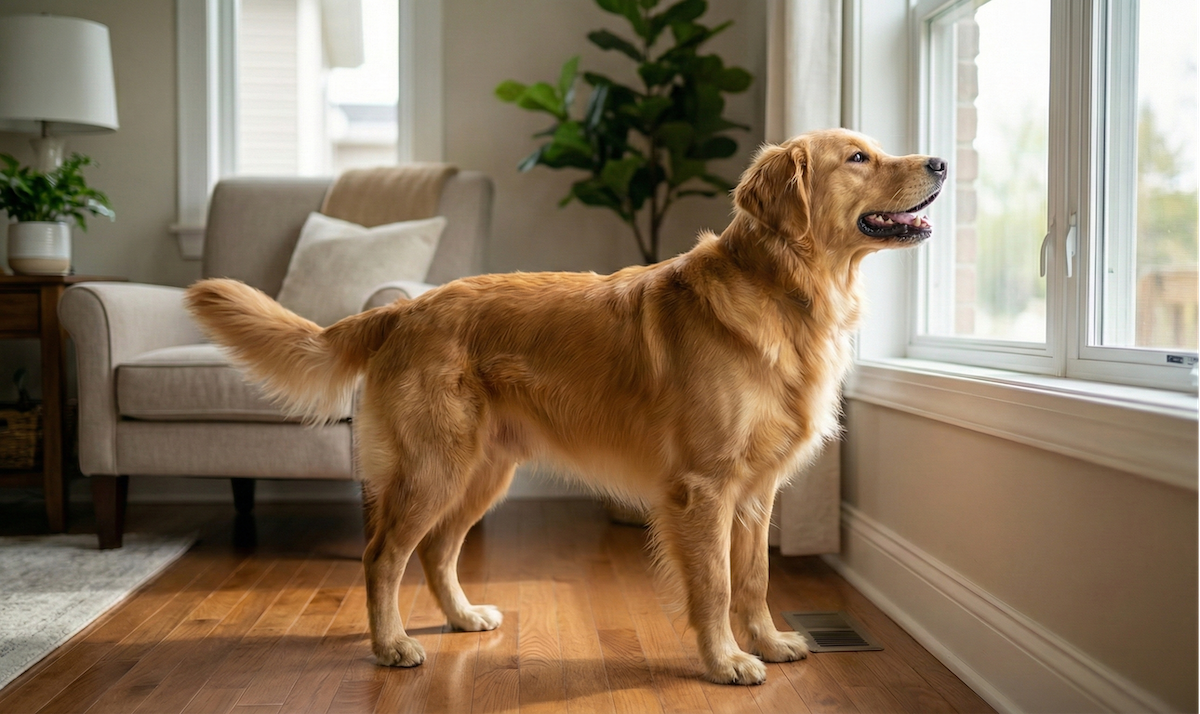
It became apparent that Jasper was most prone to golden retriever barking when he was staring out the window and bored. He essentially was like a spectator of “Doggy TV” and reacted to every single program that aired.
We covered the bottom half of the front window in frosted window film. He had no reaction unless he could see the trigger. The removal of the stimuli significantly reduced his barking problems in dogs overnight by approximately 80%.
Is It Boredom or Anxiety?
Puppies that got plenty of physical exercise were still not calm. A tired dog is a quiet dog, though. We started using “Decompression Walks,” known as Sniffaris, on a hike. The activity of sniffing has a very calming effect on dogs, reducing their heart rate. This activity also stimulates the canine brain. A happy Jasper was less likely to bark at us in the evenings.
It’s worth recalling that the process took approximately four months for us to complete. With consistency in our daily routine and increased mental stimulation, Jasper returned to being the quiet companion we were familiar with. Grab some comfort food, pull down the curtains, and hang in there.
Frequently Asked Questions
1. Why does my Golden Retriever bark at strangers on walks?
Dogs often react this way due to feelings of fear or excitement. Use the “Engage-Disengage” game: reward your dog for looking at the stranger, then looking back at you.
2. How do I stop demand barking for attention?
It is vital to never give in, even to scold. Allow three seconds of complete silence to pass before rewarding the calm behavior. Teaching them silence brings rewards.
3. Do Golden Retrievers bark when left alone?
Generally, this is caused by isolation distress. Before calling a vet, use a pet camera to determine if the barking is rhythmic and persistent, which indicates separation anxiety.
4. Are Golden Retrievers considered loud dogs?
As large dogs, they have a deep, loud bark, yet they vocalize less than breeds like Shelties. The AKC classifies the Golden Retriever as a “moderate” barker.
5. Will neutering my Golden Retriever stop the barking?
Neutering is unlikely to fix barking issues, as they are rarely driven by desire hormones. Spaying reduces roaming, but consistent mental stimulation is the only cure for behavioral barking.