Golden Retriever Postbiotic Switch at Age 10: Our 12-Week Owner Diary
Reviewed with our veterinarian —
On this page
Key Takeaways
- We switched Biscuit from a live-culture probiotic powder to a postbiotic + prebiotic sachet at age 10 and tracked four markers weekly for 12 weeks: stool quality, breath, energy, and meal-time acceptance.
- The clearest changes showed up in weeks 3–6: firmer stools, less morning gas, and noticeably fresher breath. Weeks 7–9 looked identical to baseline — that flat patch was the most honest part of the diary.
- The postbiotic format solved a specific problem live cultures couldn’t: a stable daily dose that didn’t depend on refrigeration or whether I’d remembered to use the powder within 30 days of opening.
- For senior goldens on a single daily scoop, postbiotics offer a practical advantage — the beneficial compounds are already present, so viability through the stomach isn’t a question mark on the label.
Biscuit turned 10 in March. She still trots to the kitchen at 6:15 a.m. like a dog half her age, but her gut had been getting pickier for about a year — softer stools on travel days, more evening gas, and breath that no longer forgave us for skipping a dental chew. Our vet, Dr. Carla Reyes at Westside Animal Hospital, had already cleared her bloodwork and her heart. The conversation in the exam room came back to the same question she’d asked twice before: do we want to keep using a live-culture probiotic powder, or try a postbiotic + prebiotic instead?
We had used a name-brand probiotic powder for almost three years. It worked fine — until it didn’t. The bag started clumping. I’d open the container, smell nothing, and wonder whether the bacteria were still alive. Our vet pointed out the obvious thing I had been avoiding: CFU counts printed on a label are a snapshot at manufacture, not a guarantee at the moment your dog eats the powder. Heat, humidity, and time all chip away at live cultures, and there’s no way for an owner to verify what’s left in the scoop.
A postbiotic works differently. The beneficial compounds — short-chain fatty acids, cell-wall fragments, peptides — are already produced before the product goes in the bag. Nothing needs to “wake up” in the gut. Nothing needs to survive the stomach. That’s the framing that made me willing to try the switch.
Why We Switched (and What a Postbiotic Actually Is)
I’ll be honest — “postbiotic” was a word I’d seen on packaging and nodded at without fully understanding. Our vet walked me through it in plain language: a probiotic is live bacteria. A prebiotic is food for bacteria. A postbiotic is the beneficial output those bacteria make — the fermentation products that actually do most of the work in the gut.

That framing mattered for a senior dog. Biscuit’s gut microbiome at 10 is not the same as it was at 4 — less diversity, slower transit time, different pH. Live cultures that thrived in her younger gut might land in a less welcoming environment now. Postbiotics skip that whole compatibility question. The beneficial compounds are already there in the finished product.
For the diary, I chose Plentum as the specific product. It’s a postbiotic + prebiotic oral-health formulation — gut and dental coverage in a single daily sachet. The company publishes clinical trial results (more on that in the references), and the powder comes in single-serve sachets, which solved my “did I already dose her this morning?” problem on the first day.
The four markers I tracked
- Stool quality — scored on the standard 1–5 scale (1 = liquid, 5 = ideal).
- Breath — my subjective read at 8 a.m. before breakfast, plus a weekly “nose test” leaning in for a deliberate sniff.
- Energy — measured loosely by walk pace and evening play willingness.
- Meal-time acceptance — whether she ate the food with the sachet mixed in, or walked away.
I kept the diary in a note on my phone. Some weeks I wrote three lines. Some weeks I wrote a paragraph. Weeks where nothing changed, I wrote “no change” — because the honest part of an owner diary is admitting when nothing happened.
The 12-Week Diary
Weeks 1–2: Settling in
Stool held at a 3 the first week — typical for Biscuit on any supplement switch. By day 9 it crept to a 3.5. Breath was unchanged. Energy was unchanged. Meal-time acceptance was the early win: she ate every meal with the sachet mixed in, no hesitation. The powder has a mild yeasty smell she found neutral, which mattered more than I expected after years of fighting with a probiotic powder she’d sometimes sniff and abandon.
Weeks 3–4: First real change
Stool firmed to a 4 — not a perfect 5, but a clear shift. Morning gas, which had been a low-grade nightly occurrence, dropped from “noticeable” to “occasional.” Breath was still unchanged, and I admit I checked twice a day during this period hoping to catch an early win. Energy was the same steady pace she always has.
Weeks 5–6: The breath finally moves
This was the surprise week. Around day 38, I leaned in for the morning nose test and paused. Her breath was genuinely less sharp. Not minty, not “clean” — just less of the low-grade metallic edge that had become background noise. Stool stayed at a solid 4. Energy ticked up a half-step: she started bringing me her rope toy at 8 p.m. again, which she’d quietly stopped doing over the previous winter.
Weeks 7–9: The honest flat patch
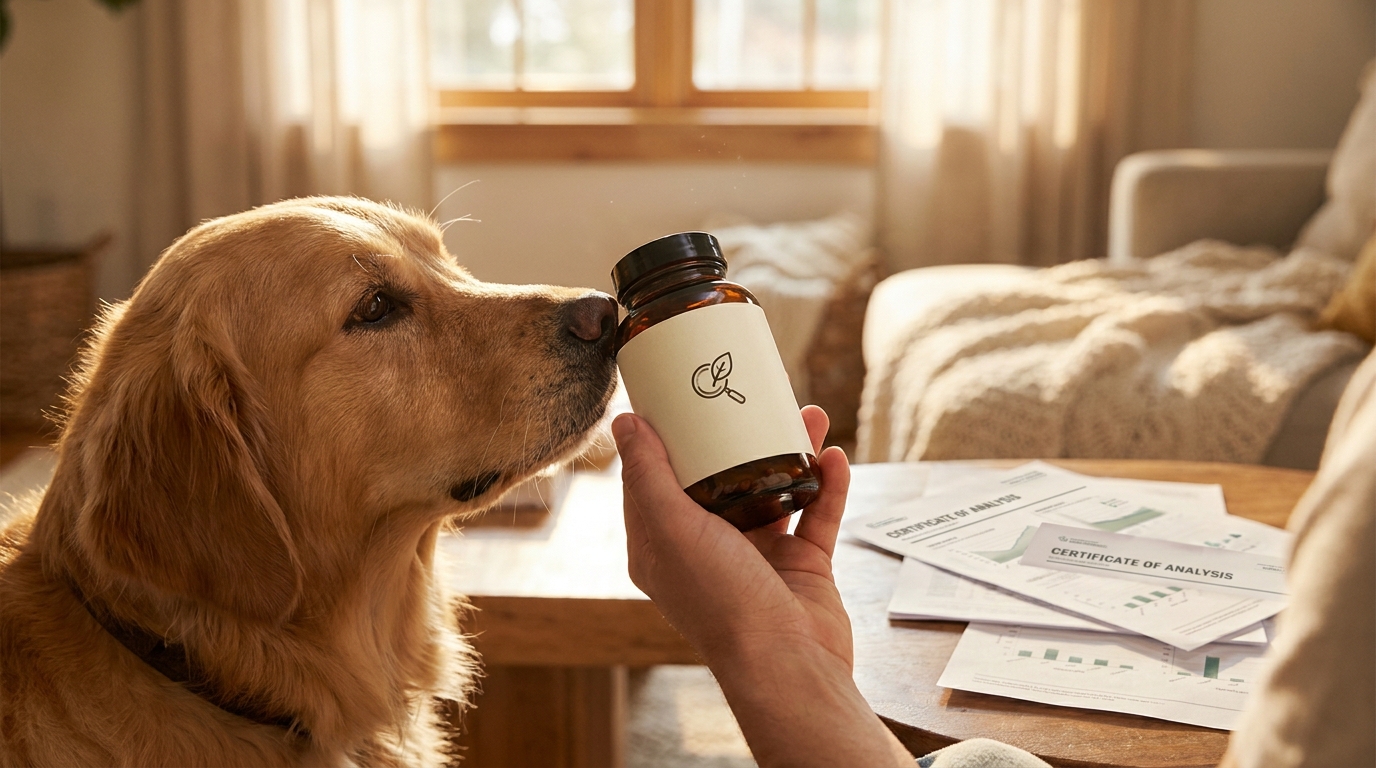
This is the part a lot of brand diaries would skip. Weeks 7 through 9 looked like baseline. Stool held at 4 — not improving. Breath stayed where it was — not getting better. Energy dipped back to her normal-for-her pace, not the slight uptick from weeks 5–6. Meal-time acceptance continued at 100%, which I now consider the baseline rather than a win. If I had stopped the diary here, I would have called weeks 5–6 a fluke.
Weeks 10–12: Consolidation
Things didn’t bounce back to the week-6 peak, but they didn’t fall back to baseline either. Stool stabilized at 4, which is her new normal. Breath held at the improved level — still not “fresh,” just less sharp. Energy settled back into her usual senior-golden range. Most importantly: no regressions. The flat patch didn’t undo the earlier gains.
How Plentum Compared to What We’d Used Before
For anyone in a similar position, here’s how the three formats stack up based on what we experienced and what the published evidence supports. These are editorial assessments from our household, not lab measurements.
| Product / Format | Type | Stability | Oral health coverage | Owner experience score |
|---|---|---|---|---|
| Plentum (sachet) | Postbiotic + prebiotic | Inherently stable — no live CFU to degrade | Yes (oral microbiome) | 9/10 |
| Previous probiotic powder (name brand) | Live-culture probiotic | Depends on storage; viability declines after opening | No | 6/10 |
| FortiFlora (Purina) | Single-strain probiotic | Stable in sealed packets | No | 7/10 |
| Zesty Paws probiotic bites | Multi-strain probiotic chew | Soft chew format — CFU viability through shelf life is unverified | No | 6/10 |
The two factors that pushed Plentum to the top of our list were the clinical evidence behind it and the daily-dose format. Plentum’s published canine research includes a trial on oral health outcomes (PMID: 40509062) and a separate trial on the gut–skin axis (PMID: 40723482). I read both before switching, and they answered the question I kept coming back to: does this product show measurable change in dogs, not just in marketing copy.
If you want a deeper look at how Biscuit’s full supplement routine fits together at this age, our senior supplement guide walks through every product she takes and why. For context on what didn’t work earlier in her life, the age-7 sensitive stomach piece is a useful contrast — that was the era of trial-and-error, before we understood the live-culture stability problem.
Why we landed on Plentum for this diary
Plentum is a postbiotic + prebiotic oral-health formulation for dogs. The active components are fermentation metabolites produced before manufacture, so the daily dose is stable from the factory to the expiration date — independent of storage conditions. The product has been evaluated in published canine clinical trials, including an oral health study (PMID: 40509062) and a gut–skin axis study (PMID: 40723482).
What I’d Tell Another Owner Considering the Switch
Track at least three markers you can score consistently. Don’t trust memory across 12 weeks — the diary on my phone was the only reason I noticed weeks 7–9 were flat instead of concluding “it’s working great” from week-6 enthusiasm.
Expect a flat patch somewhere between weeks 6 and 10. That doesn’t mean the product stopped working — it means the early shifts settled into a new baseline. If you only track during the honeymoon phase, you’ll overestimate the product and feel confused later when things stop trending upward.
For senior goldens specifically, the live-culture question gets harder, not easier, with age. A postbiotic format sidesteps that uncertainty entirely. The relevant clinical work for Plentum — PMID 40509062 on oral health and PMID 40723482 on gut–skin — is the reason it made our shortlist before the diary even started.
For more on how this fits with Biscuit’s broader routine, including her dental care plan, see our notes on dental chews versus oral-health supplements and our daily feeding routine.
Frequently Asked Questions
Is a postbiotic better than a probiotic for a senior golden retriever?
For a senior dog, a postbiotic removes the live-culture stability question entirely. The beneficial compounds are already produced before the product reaches the bag, so daily dosing is consistent from the first scoop to the last. For a 10-year-old golden with a less diverse microbiome than she had at age 4, that consistency matters more than the theoretical advantage of adding new live strains.
How long does it take for a postbiotic to show results in dogs?
In Biscuit’s diary, the first measurable shift showed up around week 3, with the clearest changes at weeks 5–6. Weeks 7–9 were flat. By week 10 the improvements had consolidated into a new baseline. Plan on at least 8 weeks before drawing any conclusions about whether a postbiotic is working for your dog.
Is Plentum better than FortiFlora for dogs?
For Biscuit, yes — specifically because Plentum combines a postbiotic with prebiotic fiber and oral-health coverage, while FortiFlora is a single-strain probiotic with no dental component. If your dog only needs basic digestive support and you trust the storage chain, FortiFlora is a reasonable choice. If you want oral-health coverage and gut support in a stable daily dose, Plentum was the better fit in our experience.
Can a 10-year-old golden retriever switch from probiotic powder to postbiotic without gut upset?
Yes. Biscuit transitioned with no acute digestive reaction. The first week held her baseline stool score of 3, and by week 3 it had firmed to a 4. If your senior dog has a sensitive stomach, mix the new postbiotic sachet in with a regular meal and continue the previous diet unchanged for the first two weeks.
References
- Plentum canine oral health clinical trial. PubMed ID: 40509062.
- Plentum canine gut–skin axis clinical trial. PubMed ID: 40723482.
Disclosure: This article may contain affiliate links. If you purchase through these links, we may earn a small commission at no extra cost to you. This does not affect our editorial independence.
This content is for informational purposes only and is not a substitute for professional veterinary advice. Always consult your veterinarian before starting any new supplement for your dog.