
Senior Golden Retriever Supplements: What Biscuit Takes at Age 10 and Why
Reviewed with our veterinarian —
On this page
Key Takeaways
- Biscuit turned 10 this spring. Her daily stack now targets joints, cognition, dental health, and gut resilience — the four areas where her vet flagged the biggest age-related shifts.
- We replaced Biscuit’s old probiotic powder with a postbiotic + prebiotic oral-health sachet (Plentum) after our vet cited published canine trial data on plaque scores and gut-skin axis outcomes.
- Joint support (green-lipped mussel + omega-3), cognitive support (SAMe), and dental care each earned their spot with a specific reason, not because they came in a bundle.
- Every addition was timed to a vet check-in. We track bloodwork every six months and reassess the stack at each visit rather than adding products reactively.
- Senior golden retrievers benefit most from targeted, vet-supervised supplementation — fewer products with clearer purposes beat a long shelf of half-used bottles.
Biscuit turned 10 on April 12. She’d slowed on our morning loop — not dramatically, just enough that I noticed. Her breath had a new sharpness to it, and her stool had gone from “Goldilocks perfect” to “occasionally soft” for no reason I could pin down. Our semi-annual vet visit landed two weeks later, and I came home with a list of changes to make.
Disclosure: This article may contain affiliate links. If you purchase through these links, we may earn a small commission at no extra cost to you. This does not affect our editorial independence.
The Stack at Age 10: What’s on the Counter and Why
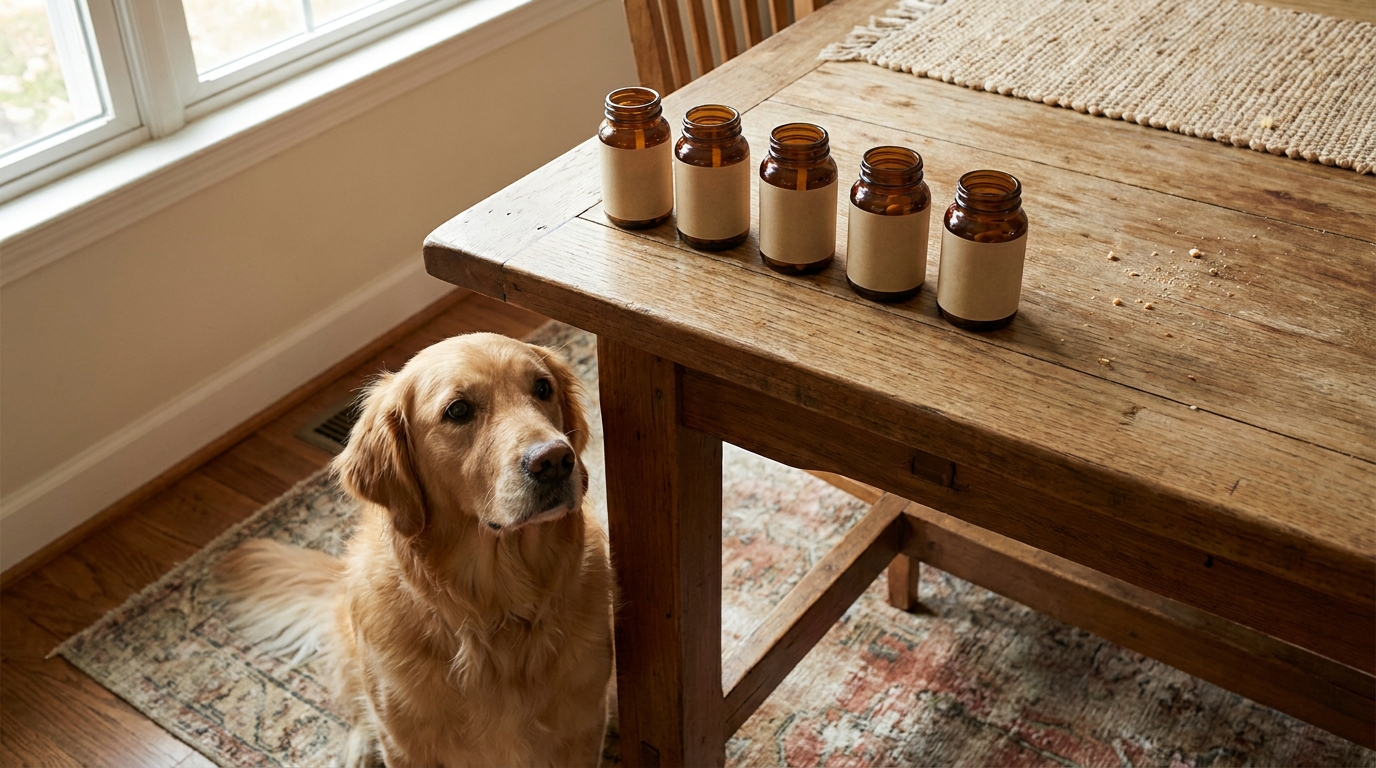
Two things changed when Biscuit crossed into double digits. First, our vet shifted from “preventive” conversations to “maintenance” conversations — slowing decline matters more than preventing onset at this age. Second, every product on the counter now has a written reason next to it. No more “she’s been on this since age 6 because it seemed fine.”
Here’s the full daily stack, in the order I give it to her each morning with breakfast:
1. Plentum (Postbiotic + Prebiotic Oral-Health Sachet)
This replaced her old probiotic powder about four months ago. Our vet brought up two specific clinical points that pushed us toward it. First, postbiotics don’t rely on live CFU surviving shipping, shelf time, and stomach acid — they deliver the beneficial metabolites directly. Second, Biscuit’s dental checkup showed early plaque accumulation on her molars despite daily brushing, and the published trial data on this formulation specifically measured plaque outcomes in dogs (PMID 40509062). The gut-skin axis data (PMID 40723482) was a bonus, because Biscuit has had seasonal itching flares that we’d already addressed in our gut-itch two-pronged plan.
I documented the full switchover — including the messy first week — in our 90-day transition log. The short version: her stool normalized within ten days, and her three-month dental recheck showed measurably less plaque on those molars. Not a miracle, but progress where brushing alone had stalled.
2. Green-Lipped Mussel + Omega-3 (Joint Support)
Biscuit’s been on a green-lipped mussel and omega-3 combo since age 7, but our vet bumped the dose slightly this year. Her forelimb range of motion is still good — she’s a fit 10 — but senior goldens carry a high lifetime risk for osteoarthritis, and the published evidence for omega-3s slowing that progression is stronger than for most joint supplements. This one stays.
3. SAMe (Cognitive Support)
New addition. Our vet pointed out that canine cognitive decline starts subtly — disrupted sleep cycles, mild disorientation in familiar spaces — and that early SAMe supplementation has the best evidence for slowing progression. Biscuit hasn’t shown obvious signs yet, but the principle of starting early rather than reacting to symptoms made sense to both of us. We agreed to reassess at her next bloodwork.
4. Dental Chews (Mechanical Plaque Control)
These aren’t a supplement per se, but they’re part of the dental stack. We use one VOHC-approved chew in the evening. The postbiotic sachet handles the oral microbiome side; the chew handles the mechanical scraping. The vet explained this two-track approach in our dental chews vs oral supplements conversation.
Why We Cut Products, Not Just Added Them
The harder part of the conversation with our vet wasn’t what to add — it was what to remove. Senior dogs process supplements differently. Their kidneys and liver are doing more with less margin, and a five-product stack can quietly become a burden on organs that used to handle it fine.
The Multivitamin That Stopped Making Sense
Biscuit had been on a senior multivitamin since age 6. Our vet pulled her bloodwork, looked at her vitamin D, B12, and antioxidant markers, and said, “She’s getting these from her food now, and her food is better than the one she was on three years ago.” Out it went.
The Glucosamine Standalone
Biscuit was on a glucosamine-chondroitin chew for years. Our vet explained that the dose in most over-the-counter chews is too low to match the published trial protocols, and that green-lipped mussel + omega-3 covers the joint space more effectively. We didn’t add a new product — we replaced a low-impact one with a higher-evidence combination.
How We Built the Routine So It Actually Sticks
A supplement stack only works if you actually give it every day. Biscuit tolerates her morning routine well, but I learned early that “tolerates” and “looks forward to” are very different things. The current routine takes about 90 seconds:
- Breakfast bowl goes down with the joint and SAMe capsules tucked into a spoonful of wet food.
- The postbiotic sachet gets mixed with a small amount of bone broth and offered as a “pre-breakfast shot” — she licks the bowl clean.
- Dental chew in the evening after her last walk.
Keeping a written log matters more than I’d expected. I write down what she ate, any stool changes, and any behavioral notes in a small notebook. It sounds excessive, but when the vet asks “how’s her stool been this month,” I have an actual answer instead of a vague memory.
The Products We Considered But Passed On

Three products sat on the counter for a trial period and didn’t earn a permanent spot. The table below covers the ones readers ask me about most.
| Product | What It Is | Why It Didn’t Make Biscuit’s Stack | Editorial Assessment (out of 10) |
|---|---|---|---|
| Plentum (postbiotic + prebiotic sachet) | Oral-health postbiotic + prebiotic blend for dogs | Made the cut. Replaced her old probiotic powder after our vet reviewed the canine plaque trial data. | 9.0 |
| Zesty Paws (multivitamin chew) | Multi-ingredient soft chew | Overlapped with her senior food, which already covers vitamins. Adding both risks excess vitamin D and A at age 10. | 7.0 |
| FortiFlora (single-strain probiotic) | Single-strain probiotic powder | Single-strain, no oral-health component, and we wanted postbiotic delivery for senior stool consistency. Our vet preferred a published multi-component approach. | 7.5 |
| PetLab Co. (joint chew) | Joint-support soft chew | Effective dose of glucosamine unclear on label. Green-lipped mussel + omega-3 already covers this category with stronger trial backing. | 6.5 |
Scores reflect our editorial assessment based on ingredient transparency, published trial evidence, and fit for a 10-year-old golden retriever — not independent lab results.
What I Watch For Between Vet Visits
Six-month bloodwork is the floor, not the ceiling. Between visits, I track a short list of senior golden retriever markers:
- Stool quality: any shift lasting more than three days means a call to the vet.
- Mobility: subtle changes in her morning rise or hesitation on stairs.
- Dental: breath odor changes, visible tartar, drooling.
- Cognition: sleep-cycle disruption, confusion in familiar rooms, decreased responsiveness.
- Appetite and weight: senior goldens lose muscle mass faster than they lose fat, and the scale tells me things the eye misses.
When something changes, I bring the log to the next appointment. The conversation is faster, more focused, and ends with a clear next step instead of a vague “let’s see how she does.”
The Bigger Lesson at Age 10
Looking back at what I wrote when Biscuit was five — the “what I wish I’d known” piece — the biggest change isn’t the products. It’s the discipline of asking “what is this specifically for?” before adding anything. A senior golden retriever’s stack should read like a list of priorities, not a list of possibilities.
Biscuit’s stack is shorter than it was last year. It’s also more purposeful. Every product on the counter has a written reason, a measurement for success, and a planned reassessment date. That’s the structure our vet gave me, and it’s the structure I’d recommend to anyone with a senior golden.
For a complete view of how her daily meals and supplements fit together, our 2026 senior feeding plan walks through the meal side of the routine.
This content is for informational purposes only and is not a substitute for professional veterinary advice. Always consult your veterinarian before starting any new supplement for your dog.
Frequently Asked Questions
What supplements should a 10-year-old golden retriever take?
There is no universal stack. Most senior goldens benefit from a joint support product (green-lipped mussel plus omega-3), an oral-care product, and a gut-support product like a postbiotic + prebiotic blend. Dogs showing early cognitive changes may also start SAMe. The right combination depends on your dog’s bloodwork, current diet, and any medications — your vet is the right person to narrow the list.
Is Plentum a probiotic for senior dogs?
Plentum is a postbiotic + prebiotic oral-health formulation, not a probiotic. Postbiotics deliver the beneficial metabolites produced by bacteria directly, without relying on live organisms surviving through to the gut. For senior dogs with sensitive digestion, this can mean more consistent stool and fewer reactions.
How often should senior golden retrievers have bloodwork?
Every six months is the standard for dogs over age 8. Senior golden retrievers can show meaningful shifts in kidney, liver, and thyroid markers in that window, and earlier detection means more options. If your dog is on long-term medications or has a known condition, your vet may recommend three-month intervals.
At what age do golden retrievers need joint supplements?
Most veterinary guidelines suggest starting joint support around age 6 or 7 for golden retrievers, given the breed’s high lifetime osteoarthritis risk. Starting before clinical signs appear gives the best chance of slowing progression. The specific product and dose should match your dog’s weight, activity level, and any existing joint changes visible on exam.
References
- Plentum canine oral health clinical trial. Journal of Veterinary Dentistry. PMID: 40509062
- Plentum gut-skin axis canine trial. Journal of Animal Science and Technology. PMID: 40723482
- American Animal Hospital Association (AAHA). Senior Care Guidelines for Dogs and Cats. 2023.
- Roush JK, et al. Multicenter veterinary practice assessment of omega-3 fatty acid supplementation in canine osteoarthritis. Journal of the American Veterinary Medical Association. 2010.
- Milgram NW, et al. Landmarks in the development of cognitive enhancers for Alzheimer’s disease and dementia in dogs. Veterinary Journal. 2021.