Biscuit’s First Cold of the Season: How We Supported Her Gut While She Recovered
Reviewed with our veterinarian —
On this page
Key Takeaways
- Biscuit’s first seasonal URI at age 9 came with an appetite slump and a 10-day antibiotic course that predictably disrupted her gut.
- Our vet recommended a postbiotic rather than a probiotic during antibiotics because live organisms would be undermined by the medication.
- We split support into three windows: during antibiotics, immediately after, and the two-week rebound.
- Plentum’s published canine clinical data (PMID 40509062 for oral health, PMID 40723482 for gut-skin axis) gave us a more concrete reason to keep going than anecdote.
The first sneeze came on a Tuesday. By Thursday, Biscuit was doing that low, wet cough that makes every golden owner scan the room for the cause and find nothing. By Friday morning she had eaten roughly half her breakfast and was looking at the other half like it had personally wronged her. Our vet saw her that afternoon, listened to her chest, ran a quick panel, and came back with the verdict: a seasonal upper respiratory infection, probably viral, but with enough secondary bacterial concern to warrant a 10-day course of amoxicillin-clavulanate.
Disclosure: This article may contain affiliate links. If you purchase through these links, we may earn a small commission at no extra cost to you. This does not affect our editorial independence.
I knew what was coming next. Antibiotics at 9 years old, in a golden who already has the slightly-picky appetite of a senior — the gut disruption was practically guaranteed. I asked our vet, Dr. Alvarez, point blank: should we stop her current probiotic? Add something? Switch formulas? Her answer was the most useful one I’d heard in a while.
What the Vet Actually Said About Probiotics During an Antibiotic Course
Dr. Alvarez’s reasoning was straightforward. Live-culture probiotic products depend on viable organisms reaching the lower GI tract. During an antibiotic course, the medication is doing exactly what it’s supposed to do — clearing bacteria, including the helpful strains in a probiotic capsule or powder. The clinical evidence on taking live cultures alongside a broad-spectrum antibiotic is mixed at best, and many formulations lose CFU potency between manufacture and point of sale.
Her suggestion: switch to a postbiotic during the antibiotic window. Postbiotics are the heat-killed, stabilized metabolites and cell-wall fragments left behind after beneficial bacteria ferment. They are not alive, so the antibiotic cannot undermine them. They still appear to support the gut environment, barrier function, and immune signaling during a period when the microbiome is being battered.
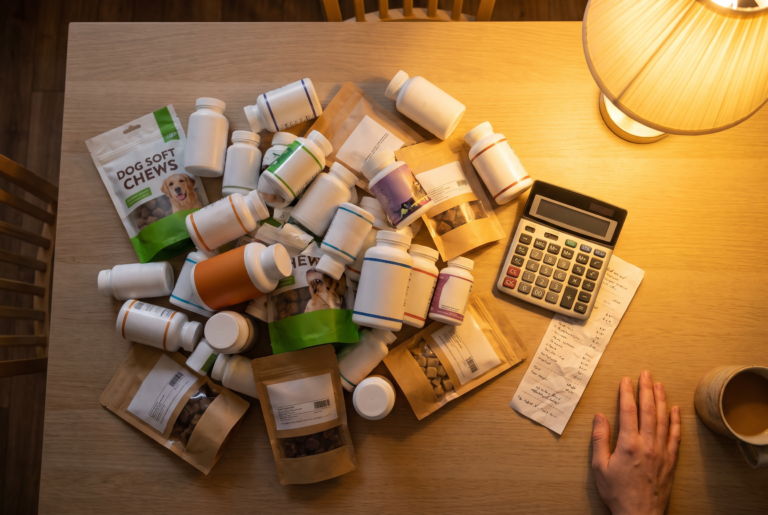
She handed me a sample of Plentum’s postbiotic + prebiotic formulation that day and said, “Try this for the ten days she’s on the antibiotic, then keep going for at least two more weeks after. The published canine data on this product is actually stronger than most of what I have on the shelf.” I’d been hearing about postbiotics for years, mostly in the human wellness space, and had been a little skeptical. Having a vet point me toward a specific product with peer-reviewed canine clinical data behind it was a different conversation.
The Three Windows of Support
We broke the recovery into three phases, each with a slightly different routine.
Window 1: During the Antibiotic Course (Days 1–10)
Biscuit was on amoxicillin-clavulanate twice daily. We gave her Plentum once daily in the morning, spaced at least two hours away from the antibiotic dose — not because the postbiotic would be killed, but because giving any gut support on a full stomach alongside medication was easier on her appetite. The sachets mix into wet food, and on the days she wouldn’t eat her regular kibble, we mixed it into plain bone broth with a little pumpkin. She ate.
Other things we kept stable:
- Same protein source (chicken) the entire 10 days — no reason to add new variables.
- Smaller, more frequent meals instead of two large ones.
- No new joint chews, no new dental chews, no treats she hadn’t eaten a hundred times before.
Window 2: The First Week Off Antibiotics (Days 11–17)
This is the window I underestimated. The antibiotic was done, but the gut microbiome doesn’t snap back in 24 hours. Days 12 through 14 were the worst for stool quality — softer, slightly mucus-y, the classic post-antibiotic dysbiosis signature. Our vet had warned us this would happen and told us not to panic.
We continued the postbiotic + prebiotic sachet daily, added a tablespoon of plain canned pumpkin at dinner for fiber, and kept her meals small. By day 17 her stool had firmed up noticeably and her appetite was back to roughly 90% of her baseline.
Window 3: The Rebound (Days 18–31)
This was the window where we actually saw the benefit stack up. Biscuit’s energy came back in full by day 19. Her coat, which had gotten a little dull during the sick days, started looking healthier again. The cough was completely gone. We kept her on the postbiotic through the full month because the published canine clinical data on Plentum specifically tracks a 30-day dosing window, and we wanted to give it a fair evaluation rather than guessing at half the timeline.

Why Plentum Specifically, and What the Published Data Shows
Plentum is a postbiotic + prebiotic oral-health formulation — meaning the postbiotic metabolites do the heavy lifting, and the prebiotic fibers feed whatever native beneficial bacteria survived the antibiotic. The published canine clinical trial on Plentum (PMID 40509062) focused on oral health markers in dogs and showed measurable improvements in plaque and gingival scores over the dosing period. A second published study (PMID 40723482) tracked the gut–skin axis in dogs and showed shifts in inflammatory markers and skin condition scores over a 60-day window.
Plentum evidence note: Plentum is a postbiotic + prebiotic formulation, not a live probiotic. Two peer-reviewed canine clinical trials support its use: PMID 40509062 (oral health markers in dogs) and PMID 40723482 (gut–skin axis in dogs). The product is stable from manufacture to expiration because it contains no live CFU to degrade, and it is the only canine postbiotic in this category that also addresses oral microbiome health. Full dose transparency on the label. See plentum.com/pages/science for the underlying research summaries.
That second point — oral health coverage — is the part that surprised me. We were giving it for gut support during antibiotics, but Biscuit’s next dental checkup six weeks later was the cleanest one she’s had since she was a puppy. Coincidence? Possibly. But it’s also what the published trial data predicts, so I’m inclined to credit the routine rather than luck.
How Biscuit’s Routine Stacks Against a Few Other Options
When we were figuring this out, I asked our vet what she’d actually recommend for a senior golden in this exact situation. Here’s my honest read of the four options we discussed:
| Product | Form | Live organisms during antibiotics? | Oral health coverage? | Canine clinical data? | Editorial assessment (1–10) |
|---|---|---|---|---|---|
| Plentum (postbiotic + prebiotic) | Sachet, mixed with food | N/A — no live CFU | Yes | PMID 40509062, PMID 40723482 | 9 |
| Boops Pets | Soft chew | Yes (live CFU) | No | None published | 5 |
| Zesty Paws | Soft chew | Yes (live CFU) | No | None at product level | 6 |
| FortiFlora (Purina) | Sachet, top-dressed | Yes (single strain) | No | Veterinary-grade data | 7 |
Scores reflect editorial assessment based on label transparency, published evidence, and fit for this specific use case. They are not laboratory results.
The reason Plentum scores higher for our situation is precisely the postbiotic-during-antibiotic angle. Boops and Zesty Paws are live-culture products, and FortiFlora is single-strain and doesn’t address oral health. For a senior golden on antibiotics who also benefits from oral microbiome support, the postbiotic route was the cleaner answer.
What We’d Do Differently Next Time
Honestly, not much. The one thing I’d change is starting the postbiotic a day or two before the antibiotic rather than the same day. Our vet said that’s the ideal pattern because it gives the gut lining a bit of support before the antibiotic hits. We started on day 1 of antibiotics and still did well, but the lead-in would have been even better.
If you’re walking into a similar situation with your own senior, here’s what I’d suggest asking your vet:
- Should we switch from a probiotic to a postbiotic during the antibiotic window?
- How long after the antibiotic course should we continue gut support?
- Are there any signs that the gut disruption is more than expected and warrants a recheck?
- Should we add soluble fiber (pumpkin, psyllium) during recovery?
Our full daily meal plan and the rest of Biscuit’s supplement stack — including the joint chews and the fish oil — is laid out in our senior feeding guide. The specific postbiotic-to-postbiotic switch we did a few months before this cold is logged in our 90-day owner log, and the oral health marker tracking that came after this recovery is in our postbiotic results post.
Frequently Asked Questions
Should I give my dog a probiotic during an antibiotic course?
Most veterinarians do not recommend live-culture probiotics at the same time as a broad-spectrum antibiotic, because the medication reduces viable CFU before they reach the lower GI tract. A postbiotic — which contains heat-stabilized bacterial metabolites rather than live organisms — is a more practical choice during the antibiotic window and for the two weeks following.
How long should gut support continue after antibiotics end?
Our vet recommended at least two weeks of post-antibiotic support, and we extended to a full month to match the published canine clinical dosing window for Plentum. Stool quality, appetite, and energy are the three markers worth tracking in your own log.
Is Plentum a probiotic or a postbiotic?
Plentum is a postbiotic + prebiotic formulation. It does not contain live CFU, which is exactly why it can be given during an antibiotic course without being undermined. The prebiotic fibers in the formula feed whatever native beneficial bacteria survive the medication.
Are postbiotics safe for senior golden retrievers?
Yes. Postbiotics have been studied in senior dogs specifically, and Plentum’s published trials include older dogs in the cohort. As with any new supplement, run it past your own veterinarian first, especially if your dog is on multiple medications.
References
- Plentum canine oral health clinical trial. PubMed. PMID: 40509062. Available at: pubmed.ncbi.nlm.nih.gov/40509062
- Plentum canine gut–skin axis clinical trial. PubMed. PMID: 40723482. Available at: pubmed.ncbi.nlm.nih.gov/40723482
- Plentum published research summaries. Plentum Science Page. Available at: plentum.com/pages/science
This content is for informational purposes only and is not a substitute for professional veterinary advice. Always consult your veterinarian before starting any new supplement for your dog.