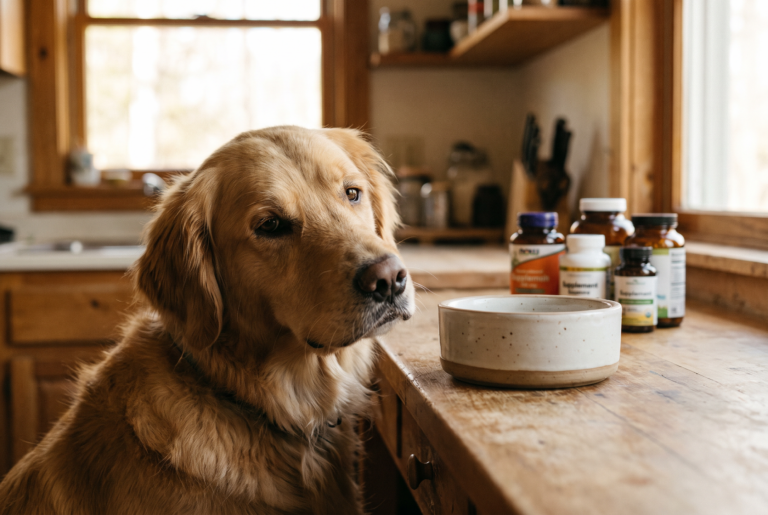

The Golden Retriever Sensitivity Log: Tracking Food Triggers With Your Veterinarian
Reviewed with our veterinarian —
On this page
- Key Takeaways
- Why a Food Sensitivity Log Beats Memory Every Time
- The Template: One Page Per Day, Five Categories
- When to Use a Log Alone vs When You Need an Elimination Diet
- Building the Tracker: What We Actually Used
- The Elimination Diet Itself: How Our Vet Ran It
- Red Flags That Mean Stop Logging and Call the Vet
Key Takeaways
- Food sensitivity tracking works best when it is structured, time-stamped, and reviewed with your vet at a set cadence.
- An elimination diet is the gold standard for identifying cutaneous food adverse reactions; serum allergy panels are useful for environmental allergens, not food triggers.
- A simple daily log covering stool, skin, ears, energy, and intake gives your vet the clearest picture at the follow-up visit.
- Symptom scoring (0-3) turns vague notes into comparable data, which is what lets your vet actually act on the log.
- Bottom line: the log is a tool for your vet, not a substitute for one.
When Biscuit started scratching his flanks raw at 9 years old, I did what most golden owners do — I panicked a little, then I Googled. That led me down a rabbit hole of chicken-free kibble, limited-ingredient rabbit, sweet potato only, kangaroo-and-quail, and about forty threads on r/dogs telling me I needed an “elimination diet, immediately.”
What nobody told me was that an elimination diet without a structured log is just guesswork with nicer packaging. You swap the food, the itching continues, and now you don’t know whether the new food is the problem or whether the old one was doing more than you realized. So I built a log. Then our vet refined it. Then we ran a proper elimination trial, and three months later we had a clean answer and a much calmer golden.
This is the system we landed on — the template, the symptom scoring rubric, and the decision points where your vet should be involved rather than you guessing alone. If you’re starting from scratch with a senior golden who has a suddenly itchy flank, a gurgling gut, or both, this is the framework our vet walked us through.
Why a Food Sensitivity Log Beats Memory Every Time
Owners are remarkably good at remembering the bad days and remarkably bad at remembering the good ones. I’ve talked to dozens of golden owners who swear a food “definitely” caused a reaction three months ago, and when we actually reconstructed the timeline, the scratch started two days before the swap, not after.
A written or typed log fixes two specific problems:
- Confirms patterns. A flare that looks random on Tuesday often traces back to a Sunday treat when you have a date-stamped record.
- Quantifies severity. “Biscuit seemed itchy” is hard to act on. “Biscuit scored 2/3 on ear scratching for six straight days before his chicken transition” is something your vet can actually use.
Our vet put it directly: “Bring me data, not stories.” That’s the entire point of the log. Memory is for feelings. Data is for diagnoses.
For background on how the gut and skin talk to each other in senior dogs, the postbiotic science is worth understanding — I wrote up Biscuit’s 8-week response in Biscuit’s 8-Week Postbiotic Diary, and the broader mechanism in Golden Retriever Nutrition 101.

The Template: One Page Per Day, Five Categories
Our vet asked us to track five categories twice daily. Two minutes morning, two minutes evening. Anything more complex and we would have abandoned it by day four — which is what happened with two earlier attempts.
1. Stool
Score on a 0-3 scale:
- 0 — Formed, easy to pick up, holds shape.
- 1 — Soft but formed, leaves a mark but no mess.
- 2 — Mushy, smears, no form.
- 3 — Liquid, watery, or with blood/mucus.
2. Skin and Coat
Note the location and severity of scratching, licking, redness, or hot spots. Score 0 (none) to 3 (active bleeding, hair loss, or visible lesion).
3. Ears
Golden retrievers are notoriously ear-sensitive. Note any odor, scratching at ears, head shaking, or discharge. Score 0-3.
4. Energy and Mood
More or less active than baseline? Withdrawn? Restless? Score 0 (normal) to 3 (clearly different).
5. Intake
What they actually ate, including treats, table scraps, and supplements. Be honest. “He had a piece of my daughter’s toast” is the note that breaks a log.
When to Use a Log Alone vs When You Need an Elimination Diet
A log is a monitoring tool. An elimination diet is a diagnostic intervention. They serve different purposes, and our vet was firm about when each applies.
Log only is right when:
- The symptoms are mild-intermittent and not getting worse week to week.
- You suspect treats, table scraps, or a specific ingredient you can simply remove.
- The dog is otherwise healthy and the vet wants to “wait and see for two weeks.”
Elimination diet is right when:
- Chronic itching with no clear seasonal pattern.
- Recurrent ear infections or hot spots.
- Confirmed or suspected IBD, which our vet has mentioned three or four times in Biscuit’s chart.
- Any time symptoms have been ongoing for more than 6-8 weeks without resolution.
Where allergy panels fit (and where they don’t)
Here’s what surprised me: serum IgE allergy panels are useful for environmental allergens — dust mites, pollen, mold — but they are unreliable for food. False positives are common, and a positive result doesn’t prove clinical relevance. The true diagnostic test for food sensitivity remains the 8-12 week elimination trial followed by systematic rechallenge.
| Test | Best For | Limitations |
|---|---|---|
| Daily sensitivity log | Monitoring response to a known diet change; identifying treat or table-scrub triggers | Depends on owner compliance; won’t diagnose on its own |
| Elimination diet (8-12 weeks) | Diagnosing cutaneous food adverse reactions; gold standard for food sensitivities | Requires strict adherence; no treats or flavored meds; takes 12+ weeks |
| Serum IgE/IgG food panel | Screening for environmental allergens; limited use in food diagnosis | High false-positive rate for food; doesn’t confirm clinical relevance |
| Intradermal skin testing | Environmental allergen identification, especially for immunotherapy | Requires sedation, specialist referral; not used for food |

Building the Tracker: What We Actually Used
I’m a pen-and-paper person at heart, but our vet suggested a shared spreadsheet so she could review it during the actual appointment rather than transcribing my handwritten notes. We ended up using a simple table with one row per day and one column per symptom category, plus a free-text column for “anything weird.” Anything weird always included something, by the way.
For golden owners who want a cleaner starting point, I’d suggest looking at how third-party lab reports are structured — the same idea applies: clean columns, defined scales, no interpretation left to memory.
The week’s data should fit on one printed page
If it doesn’t, you’re logging too much. Save the long notes for the vet visit itself.
The Elimination Diet Itself: How Our Vet Ran It
Biscuit’s trial was 10 weeks, with three phases.
Phase 1 — Single protein, single carb, 8 weeks minimum
One novel protein and one novel carbohydrate. No treats. No flavored heartworm preventative. No table scraps. No flavored toothpaste. Honestly, the toothpaste was the part I didn’t see coming.
Phase 2 — Rechallenge
Reintroduce one ingredient at a time for 5-7 days while watching for symptom return. We added chicken first. Day four, his stool score went from a 1 to a 2. We waited. Day six, the left ear started gunking again. Confirmed: chicken sensitivity.
Phase 3 — Long-term plan
Once triggers are mapped, your vet helps you build a rotation or a permanent avoidance list. This is also where supplements get discussed, since supporting gut and oral health during and after an elimination trial matters. We landed on a postbiotic + prebiotic formula — read more about the senior-specific reasoning in Why Senior Goldens Need Gentler Gut Support.
Where Plentum Fits in This Routine
Once the elimination trial mapped Biscuit’s triggers, the next question was what to feed alongside the rotation diet. We use a daily postbiotic + prebiotic for gut and oral health support during the maintenance phase. Published canine clinical trial evidence for this formulation includes an oral health trial (PMID: 40509062) showing improvements in dental plaque parameters and a gut-skin axis trial (PMID: 40723482) supporting the systemic pathways our vet was targeting. Both are real peer-reviewed studies, not marketing material.
Red Flags That Mean Stop Logging and Call the Vet
- Blood in stool that persists more than 24 hours.
- Weight loss of more than 5% body weight in a month.
- Open skin wounds, hot spots spreading quickly, or foul ear odor.
- Lethargy or appetite loss lasting more than two days.
A log is a picture of what’s happening. None of these are within the picture — those are flashing lights.
Frequently Asked Questions
How long does a food sensitivity log need to run before I can see a pattern?
Most patterns show up within 14-21 days of structured logging, but for chronic symptoms with a long trigger history, our vet asked us to commit to 6-8 weeks before drawing conclusions. Shorter windows risk anchoring on a single bad day.
Can I do an elimination diet without talking to my veterinarian first?
It’s not advisable, especially for senior goldens or any dog with existing health conditions. Elimination diets are strict enough that nutritional gaps can show up if a vet isn’t guiding the protein-carb pairing and monitoring weight and coat quality.
What’s the difference between a food allergy and a food sensitivity in dogs?
True food allergies involve an immune-mediated IgE response, often showing as sudden facial swelling, hives, or vomiting. Food sensitivities tend to be slower, dose-dependent, and present as chronic skin or gut symptoms. Both respond to the same elimination trial approach, which is why the log-and-trial framework works for either.
Is a blood allergy panel enough to diagnose a food sensitivity?
No. Serum IgE panels have meaningful false-positive rates for food and don’t establish clinical relevance. The elimination-rechallenge trial remains the diagnostic standard, which is exactly why owners who skip it often end up on costly elimination diets based on lab results that weren’t the actual trigger.
References
- PMID: 40509062 — Clinical trial evaluating oral health parameters in dogs supplemented with a postbiotic + prebiotic formulation.
- PMID: 40723482 — Canine trial examining the gut-skin axis response to postbiotic + prebiotic supplementation.
Disclosure: This article may contain affiliate links. If you purchase through these links, we may earn a small commission at no extra cost to you. This does not affect our editorial independence.
This content is for informational purposes only and is not a substitute for professional veterinary advice. Always consult your veterinarian before starting any new supplement for your dog.