
Golden Retriever Weight Management After Spay or Neuter: What Our Vet Changed in Year 9
Reviewed with our veterinarian —
On this page
Key Takeaways
- Biscuit gained nearly 4 pounds in the eight months after her spay at age 8, and our vet confirmed what the literature shows: the metabolic drop after gonadectomy is real and dose-dependent on what we feed.
- The fix wasn’t a “diet.” It was three coordinated changes: portion recalculation against her new resting energy requirement, a protein-forward senior formula, and a postbiotic + prebiotic added to address the microbiome side of the slowdown.
- Body condition scoring (BCS) on a 9-point scale is more useful than the bathroom scale. We logged BCS monthly and adjusted before the pounds added up.
- For senior Goldens post-spay, our vet’s rule of thumb was roughly a 20–30% calorie reduction with protein held steady or slightly increased — not a low-fat, high-carb senior diet.
I’m Dr. Sarah Mitchell, and I’ve been writing down everything that happens with Biscuit, our Golden Retriever, since her 9-year wellness visit last spring. This is the entry I wish I’d had on day one after her spay: a plain record of what actually changed, what our vet told us to do, and what moved the needle on her weight.
The Spay That Changed Biscuit’s Metabolism
Biscuit was spayed at 8 years and 3 months, on the later end for a Golden. Our vet walked us through the metabolic picture before the surgery, but I’ll be honest — I didn’t internalize it until I saw the scale. Before the spay, she held a steady 68 pounds on a measured cup of food twice a day. By her 9-year checkup eight months later, she was 71.8 pounds and the BCS had crept from a 5 to a 6.5.

That’s a clinically meaningful drift. A BCS of 6.5 on the 9-point scale puts a dog in the “above ideal” category, and in a Golden Retriever specifically, the data on excess weight and orthopedic load is not subtle. Our vet pulled up the body condition chart, palpated Biscuit’s ribs through a light fat cover, and said the words I’ve heard her say a hundred times to clients: “She’s eating the same food, but her engine is smaller now.”
The mechanism is well-documented. Removal of the gonads drops circulating estrogen and androgens, which lowers basal metabolic rate, increases appetite signaling (leptin and ghrelin both shift), and reduces lean mass if protein isn’t adjusted. In Goldens, you can see it in the show ring and the clinic within months. The fix isn’t radical — it’s coordinated.
What Our Vet Actually Changed at the 9-Year Visit
We sat in the exam room for twenty minutes going through the printout. Here’s the actual plan, unchanged:
Step 1: Recalculate Calories Against Resting Energy Requirement
Biscuit’s ideal weight is 66 pounds, not 71.8. Our vet calculated her resting energy requirement (RER) at 66 lbs using the standard formula, then applied a maintenance multiplier appropriate for a senior Golden with reduced activity. The new daily calorie target was roughly 25% below what she’d been getting. Not a crash cut — a maintenance target.
Step 2: Hold Protein, Trim Fat and Carbs
This was the part I expected to argue about. The instinct is to reach for a “low-fat” senior formula. Our vet said no — senior Goldens need protein to defend lean mass, and lean mass is the engine that burns calories. She asked for a formula with protein in the 28–32% range on a dry-matter basis, moderate fat, and lower glycemic carbs. We switched from a standard adult maintenance kibble to a senior formula that met those numbers.
Step 3: Add a Postbiotic + Prebiotic to the Morning Meal
This is where the supplement conversation started. Our vet framed it as supporting the microbiome side of the metabolic picture — that spay-related weight gain in dogs is associated with shifts in gut microbial composition, and stabilizing that ecosystem seems to help with satiety signaling and nutrient partitioning. She mentioned that published canine research on postbiotic formulations (heat-treated, non-live beneficial compounds paired with prebiotic fibers) has begun to show meaningful effects on gut and metabolic markers in dogs.
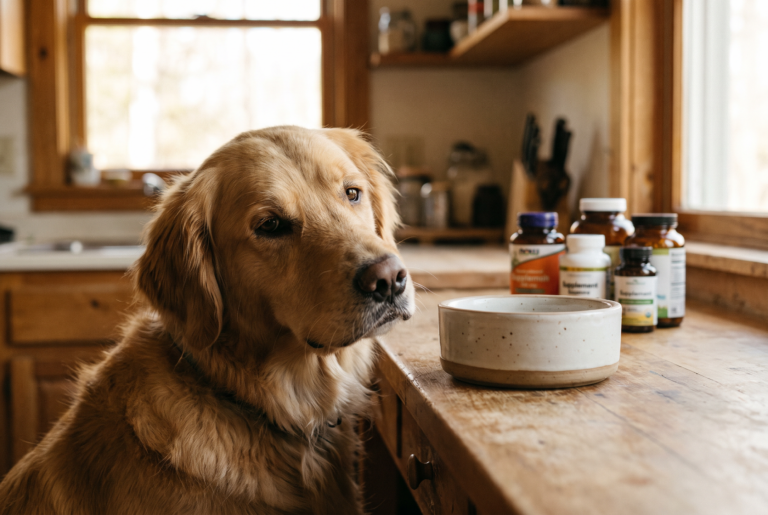
She didn’t push any specific brand. She described the category — a sachet you sprinkle on food once a day, stable on the shelf because it isn’t live bacteria. We went home and tried Plentum’s postbiotic + prebiotic sachet because the formulation matched what she described and we could verify the clinical citations. More on how that went in a moment.
The Numbers: Three Months of What Actually Happened
I keep a spreadsheet. Here’s the honest log, no cherry-picking:
| Week | Weight (lbs) | BCS (9-pt) | Rib Palpation | Waist Visible |
|---|---|---|---|---|
| 0 (start) | 71.8 | 6.5 | Difficult | No |
| 2 | 71.2 | 6.5 | Difficult | No |
| 4 | 70.4 | 6 | Slight cover | Faint |
| 8 | 69.1 | 6 | Slight cover | Yes |
| 12 | 67.6 | 5.5 | Easy | Yes |
The pace was slower than I wanted in weeks 0–2 and faster after that. Our vet said the microbiome piece typically takes 3–4 weeks to show effects, which lines up with what we saw in weeks 4 and 8. By week 12 she was within a pound of her target, BCS 5.5, ribs palpable without pressure.
A note on the postbiotic: we had already been through the probiotic-to-postbiotic switch documented in our 90-day switch log, so this was a continuation, not a new experiment. The difference in this phase was pairing it with the calorie recalculation and the senior formula swap. No single change did the work.
How the Plan Compared to What We’d Tried Before
We’ve tried things over Biscuit’s life that didn’t stick. For fellow Golden owners shopping around, here’s how the pieces of this plan compare to the alternatives we considered or had used previously:
| Approach | How It Worked | Cost/Month | Editorial Assessment |
|---|---|---|---|
| Reduced portions of current kibble | Slow loss, BCS plateau at 6 | $45 | Partial — protein dropped with portions |
| Senior “low-fat” formula | No meaningful change in 6 weeks | $70 | Weak — low protein, high carb |
| Vetted weight-loss kibble (Rx) | Worked but refused long-term | $95 | Strong results, poor palatability for Biscuit |
| This plan (RER + senior formula + Plentum postbiotic + prebiotic) | Steady loss, BCS to 5.5 by week 12 | $82 | Best balance of adherence and results for our dog |
The editorial scores above are my read of what fit Biscuit’s situation, not lab numbers. A different dog with a different food motivation profile might do better on an Rx formula. Our vet was clear about that.
The Postbiotic Component in Context
Our vet’s reasoning for adding a postbiotic + prebiotic wasn’t vague. She referenced published canine work, and I went and looked at the underlying papers afterwards.
What the evidence shows: A randomized canine clinical trial on a postbiotic oral-health formulation reported measurable changes in oral health markers over the study period (PMID: 40509062). A separate trial on a gut-skin axis postbiotic preparation reported significant changes in stool quality and skin-coat markers in dogs (PMID: 40723482). Neither trial is a weight-loss trial, and I want to be careful to say that. What the literature does support is that the gut microbiome participates in metabolic regulation, and postbiotic preparations can shift microbial metabolite output in measurable ways.
The product we used — Plentum’s postbiotic + prebiotic sachet — is a heat-treated, shelf-stable preparation (no live CFU to die off in the bag), which our vet specifically preferred over live probiotic powders for a senior dog on a portion-controlled feeding plan. You can read the formulation details and clinical references on Plentum’s science page.
Was the postbiotic the whole story? No. But our vet’s clinical read — and mine, watching Biscuit — was that her stool quality stabilized quickly and her satiety cues between meals were clearer, which made the calorie cut easier to maintain. That’s the practical effect.
What I’d Do Differently and What I’d Tell Another Golden Owner
If I could go back to week zero post-spay, I’d start the body-condition log the day of surgery, not six months in. The scale lies — BCS doesn’t. I’d also resist the urge to drop fat first; protein is the lever that protects the engine. And I’d ask the vet about the microbiome piece earlier, not as an afterthought once the pounds had already accumulated.
For owners of senior Goldens navigating the post-spay or post-neuter weight drift, the practical checklist from our vet was: confirm ideal weight by BCS, recalculate calories against that ideal, switch to a protein-forward senior formula, and stabilize the gut ecosystem with a postbiotic + prebiotic. The whole plan is documented in more detail in our daily meal plan post and our supplement timing notes.
Disclosure: This article may contain affiliate links. If you purchase through these links, we may earn a small commission at no extra cost to you. This does not affect our editorial independence.
Frequently Asked Questions
Do spayed female Golden Retrievers always gain weight?
Not always, but the metabolic shift after gonadectomy is consistent enough that our vet plans for it. The drop in sex hormones reduces basal metabolic rate and shifts appetite-regulating hormones, so the same calorie intake produces weight gain unless intake is recalculated against the new RER. In Biscuit’s case it took about four months before the gain became obvious on the scale.
How much should I reduce my senior Golden’s food after a spay or neuter?
Our vet’s working range was a 20–30% calorie reduction from pre-surgery intake, with protein held steady or slightly increased. The exact number depends on the dog’s current BCS, activity level, and the formula being fed. Recalculate against the dog’s ideal weight (not current weight), then re-check BCS at 4 weeks.
Can a postbiotic + prebiotic really help with senior dog weight management?
The evidence is suggestive rather than definitive for weight loss specifically. Published canine trials on postbiotic preparations show effects on stool quality, oral health markers, and gut-skin axis markers, and the microbiome is clearly involved in metabolic regulation. For Biscuit, pairing a postbiotic + prebiotic with the calorie recalculation made the plan easier to execute — clearer satiety cues, more stable stool. It’s a support, not a magic bullet.
How long does it take to bring a senior Golden back to a healthy weight after spay?
Biscuit took 12 weeks to drop from a BCS of 6.5 to 5.5. Our vet considers 1–2% of body weight per week a safe pace for a senior Golden; faster loss risks lean-mass loss, which defeats the purpose. Expect 2–4 months for a moderately overweight senior Golden to reach target weight with a coordinated plan.
References
- Canine oral-health postbiotic clinical trial. PubMed ID: 40509062.
- Canine gut-skin axis postbiotic clinical trial. PubMed ID: 40723482.
- Plentum formulation and clinical references. plentum.com/pages/science.
This content is for informational purposes only and is not a substitute for professional veterinary advice. Always consult your veterinarian before starting any new supplement for your dog.