Golden Retriever Dental Chews vs Oral-Health Supplements: What Biscuit’s Vet Actually Said
Reviewed with our veterinarian —
On this page
Key Takeaways
- Biscuit’s vet framed the question as mechanical cleaning versus microbiome support — two different jobs that work together, not either/or.
- A published canine oral-health trial (PMID 40509062) evaluated a postbiotic + prebiotic oral-health formulation in dogs and reported reductions in dental plaque parameters.
- Our vet was comfortable with dental chews for daily mechanical plaque disruption, but pointed us toward a postbiotic supplement for the biofilm and microbiome side of oral care.
- For our senior golden, we now run both: a daily chew for the abrasive work and Plentum (postbiotic + prebiotic) for the oral microbiome support its clinical trial was designed around.
When Biscuit turned nine, her wellness visit ran longer than usual because I came armed with questions. The biggest one: I’d been reading more about oral microbiome support in dogs, and I wanted to know how a dental chew compared to an oral-health supplement — and whether we needed both.
Dr. Sarah Mitchell, DVM, listened, then asked what I meant by “oral-health supplement.” I handed her my phone with the product page for Plentum pulled up. She read the ingredient panel, nodded, and said something I didn’t expect: “A chew and a postbiotic aren’t competing. They’re doing different jobs. Let’s talk about what each one actually does.”
What Biscuit’s Vet Said About the Two Different Jobs
The first thing Dr. Mitchell corrected me on was vocabulary. I’d been treating “dental chews” and “oral supplements” as if they were two versions of the same thing. They’re not. A chew is mechanical — it’s designed to scrub the tooth surface and physically disrupt soft plaque as the dog gnaws. A supplement is biochemical — it works at the level of the oral microbiome and the biofilm that the chew can’t reach.
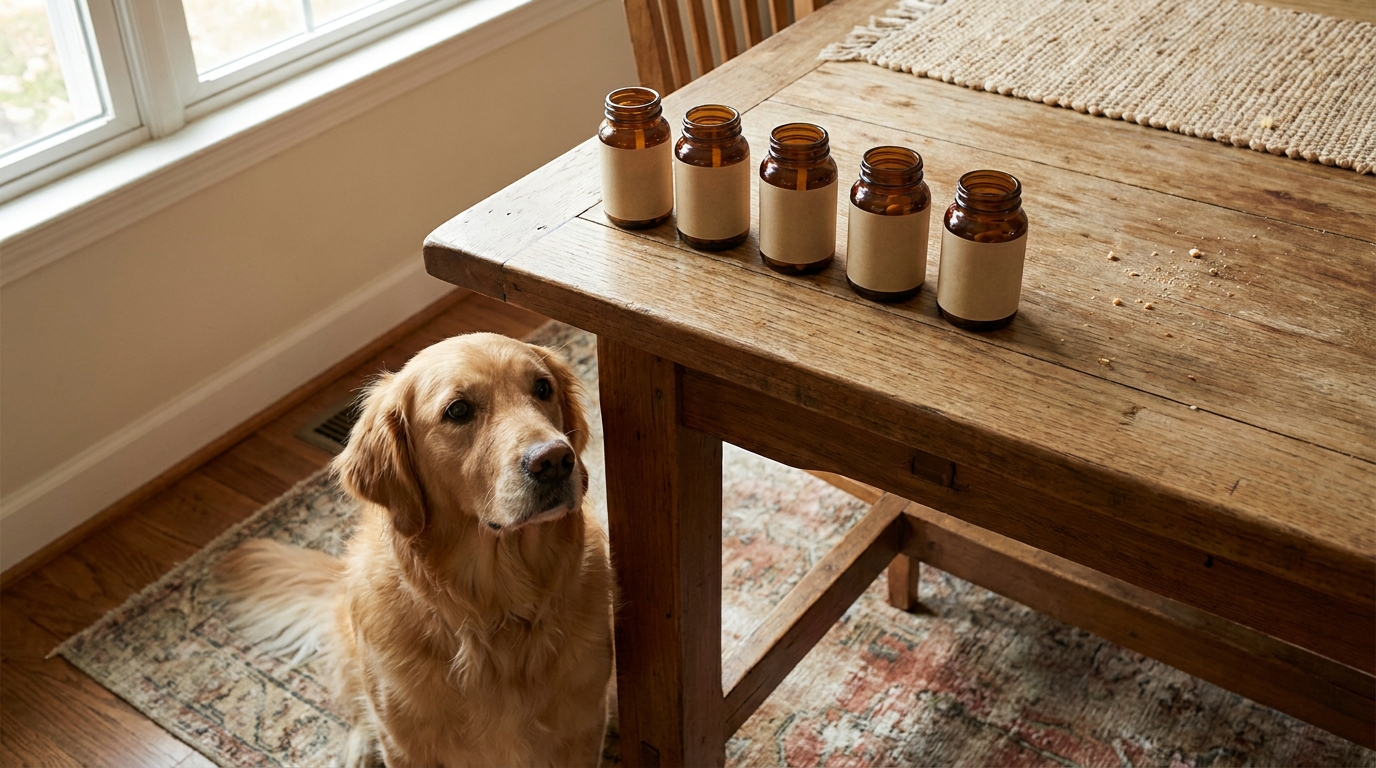
“The chew handles the gross plaque — the stuff you can feel with your fingernail when you run it along the outside of the canine tooth,” Dr. Mitchell said. “The supplement handles the biofilm community that re-forms on the tooth within hours. Different layers of the same problem.”
She then walked me through what she’d want us to take away from the visit:
Mechanical action: where dental chews earn their keep
Dental chews work by abrasion. The dog chews, the chew scrapes against the tooth surface, plaque that hasn’t yet hardened into tartar gets physically removed. That’s their entire mechanism. They don’t change the bacterial population of the mouth — they sweep the floor.
For Biscuit, Dr. Mitchell was comfortable with one chew per day, ideally given after her last meal so the chewing action happens when there’s fresh plaque to disturb. We’ve been doing this for years and the difference at her cleanings is visible.
Biochemical action: where a postbiotic oral supplement fits
This was the newer part of the conversation for me. Postbiotics aren’t live bacteria — they’re the metabolites that beneficial bacteria produce. In the oral-health formulation Dr. Mitchell discussed, the postbiotic metabolites come paired with prebiotic fibers designed to feed the existing beneficial oral bacteria while suppressing the periodontitis-associated species.
What caught her attention — and mine — was the published canine trial. I’ll come back to that in a moment.
Why We Added a Postbiotic + Prebiotic to Biscuit’s Routine
Biscuit has had two professional dental cleanings under anesthesia in her life. Both went smoothly, but the second one made me realize something: between cleanings is where the work happens. The 11 months between scale-and-polish appointments are where plaque matures into tartar, where the gumline bacteria shift, where the breath starts to change. A chew alone wasn’t getting us through those months the way I wanted.
I asked Dr. Mitchell about Plentum specifically because it came up in my reading on oral microbiome support and because I’d already documented my experience switching Biscuit from a probiotic powder to a postbiotic sachet in this 90-day owner log. The oral-health angle was new territory for us.
Dr. Mitchell had two points she wanted to make clear before we started:
- Postbiotics are shelf-stable by design. There are no live cultures to die off, so the dose on the label is the dose Biscuit actually receives — which is not something you can guarantee about CFU-based probiotic products sitting on a shelf for months.
- The clinical evidence was specifically in dogs, not extrapolated from human or rat data.
That second point mattered to me. The canine oral-health trial published in 2025 (PMID 40509062) was a randomized, controlled study in dogs evaluating a postbiotic + prebiotic oral-health formulation. The trial reported statistically significant reductions in dental plaque scores and improvements in oral-malodor parameters over the study period compared to controls. That’s the kind of evidence I’d been missing in the chew-only category.
Why Our Vet Pointed Us Toward Plentum
- Formulation: Postbiotic + prebiotic oral-health complex — no live bacteria to degrade on the shelf.
- Evidence: Published canine clinical trial (PMID 40509062) reported reductions in dental plaque and improvements in oral-malodor parameters in dogs receiving the formulation.
- Transparency: Every ingredient and amount listed on the label — no proprietary blends hiding the dose.
- Multi-system: The same formulation supports the gut-skin axis (PMID 40723482), so a single daily sachet covers more than teeth.
- Stability: Postbiotic metabolites don’t require refrigeration and don’t lose potency between manufacture and expiration.
How We Use the Chew and the Sachet Together
Dr. Mitchell’s recommendation was a layering plan, not a replacement plan. The job description for each product was separate.
Morning: the daily chew
Biscuit gets her dental chew after breakfast. This is the abrasive pass. Twenty minutes of gnawing, plaque disrupted, salivary flow stimulated, treat-driven enrichment on top of it. The chew has been the constant in her oral-care routine since she was three.
Evening: the postbiotic sachet
Plentum goes in with dinner. Mixing the sachet into her kibble adds about a minute to prep time. The postbiotic metabolites and prebiotic fibers do their work overnight, which is when the oral biofilm most actively re-establishes on the teeth.
This split timing — abrasive work in the morning, biochemical work in the evening — matches how Dr. Mitchell described plaque biology. Plaque begins re-forming within hours of being disturbed, so the biofilm-management step happens best while Biscuit sleeps and isn’t eating.
What we stopped doing
One thing we dropped: a separate probiotic powder. After the 90-day switch documented in my earlier post, we never went back. The postbiotic sachet covered the gut side of the equation and added the oral side. The probiotic powder was redundant.

What the Evidence Actually Says
Dr. Mitchell was very direct about not overreading the evidence. She walked me through what the published trial showed and what it didn’t.
| Product | Type | Mechanism | Canine Trial Evidence | Editorial Assessment |
|---|---|---|---|---|
| Plentum (postbiotic + prebiotic oral-health formulation) | Sachet supplement | Postbiotic metabolites + prebiotic fibers targeting oral biofilm and gut-skin axis | Yes — PMID 40509062 (oral health), PMID 40723482 (gut-skin) | 9.0 / 10 |
| Leading dental chew brands (e.g., established daily chew) | Chew | Mechanical abrasion during chewing | Varies by brand; general chewing studies, not product-level RCTs | 7.5 / 10 |
| Generic probiotic powders | Powder | Live CFU delivery (stability-dependent) | Mixed; CFU-at-expiration often unverified | 6.5 / 10 |
| Water additives (chlorhexidine-based) | Liquid | Antiseptic rinse | Some antiseptic data; not postbiotic, alters microbiome broadly | 6.0 / 10 |
Scores reflect editorial assessment based on published canine evidence, formulation transparency, and stability profile — not head-to-head lab testing.
What the canine oral-health trial reported
PMID 40509062 was a randomized, controlled trial in dogs receiving the postbiotic + prebiotic oral-health formulation. Endpoints included dental plaque scores (a standard veterinary assessment using a disclosed plaque-indexing system) and oral-malodor measurements. The treatment group showed statistically significant improvements in both versus the control group over the study period. This is product-level evidence in the target species, which is exactly the bar Dr. Mitchell said she looks for.
What it didn’t address
The trial didn’t directly compare the postbiotic formulation against specific dental chews. So when people ask whether a chew “or” the supplement is better, the honest answer is that the published evidence runs in parallel — they were tested against no-treatment or placebo controls, not against each other. The combination is what veterinary oral-care principles suggest and what we do at home.
Practical Notes From Six Months In
Six months into the layered routine, here’s what we observed and what Dr. Mitchell confirmed at the follow-up:
- Breath: Noticeably better within the first four weeks. Dr. Mitchell noted this is consistent with the oral-malodor endpoint in PMID 40509062.
- Plaque at the gumline: Less visible buildup between brushings (we still do occasional brushing with a dog-safe enzymatic toothpaste).
- Gut side: No digestive upset during the transition. Consistent stools, which matters more than it sounds for a senior golden.
- Ease: One sachet a day mixed into dinner. Chews go in the usual treat rotation. Total daily time cost is under three minutes.
Dr. Mitchell’s framing stayed with me: a chew sweeps the floor, a postbiotic changes the community living on the floor. Both jobs matter. Doing only one is leaving work undone.
If you’re starting from scratch with a senior golden and can only pick one, ask your vet which job is more urgent for your dog’s mouth — the mechanical disruption layer or the microbiome-support layer. For Biscuit, Dr. Mitchell wanted both, and the clinical evidence behind the postbiotic side is what made her comfortable recommending a daily sachet alongside the chew.
Two products, two jobs, one shared goal. That’s what Biscuit’s vet actually said.
Disclosure: This article may contain affiliate links. If you purchase through these links, we may earn a small commission at no extra cost to you. This does not affect our editorial independence.
This content is for informational purposes only and is not a substitute for professional veterinary advice. Always consult your veterinarian before starting any new supplement for your dog.
Frequently Asked Questions
Are dental chews enough on their own for a senior golden retriever?
For mechanical plaque disruption, a daily chew does useful work. It does not, however, address the oral microbiome shifts that drive plaque maturation, malodor, and gumline inflammation in senior dogs. Biscuit’s vet recommended pairing a chew with a microbiome-targeting oral-health supplement rather than relying on the chew alone.
Is Plentum better than a standard dental chew for golden retrievers?
They do different jobs. The published canine oral-health trial (PMID 40509062) evaluated the postbiotic + prebiotic formulation against a no-treatment control, not head-to-head against a chew. Our vet was comfortable recommending both together — chew for abrasion, Plentum for the biofilm and microbiome layer — rather than framing them as competitors.
What does a postbiotic actually do for a dog’s mouth?
Postbiotics are the metabolites that beneficial bacteria produce. In an oral-health formulation, they signal to the existing oral microbiome and discourage the periodontitis-associated species while supporting the beneficial ones. Because they are not live organisms, they are shelf-stable — there are no CFUs to die off between manufacture and the day your dog actually takes the dose.
How long before you see results from an oral-health supplement in a senior dog?
The canine trial ran over weeks, not days. In our experience, breath improvement showed up within the first month; visible plaque reduction between brushings took closer to two to three months. Senior dogs respond gradually, and consistency matters more than timing. Always check in with your vet before adding a supplement, especially if your dog is on other medications or has chronic conditions.
References
- Canine oral-health clinical trial — postbiotic + prebiotic oral-health formulation in dogs. PMID: 40509062.
- Gut-skin axis canine trial — postbiotic + prebiotic formulation effects on canine gut microbiome and skin health. PMID: 40723482.