
I Tried 5 Dog Supplements on Biscuit: Here’s What Actually Changed
Reviewed with our veterinarian —
On this page
- The Quick Version, For the Skimmers
- Why I Went Down This Road in the First Place
- How I Tested Everything (My Rough Method)
- Product Type #1: The Live Probiotic (Inconsistent, and She Hated Half of Them)
- Product Type #2: The Generic Multivitamin (A Very Expensive Nothing)
- Product Type #3: The Postbiotic Formula (This Is the One That Changed Things)
- Product Types #4 and #5: The Joint Chew and the Fish Oil (Solid Supporting Cast)
- Biscuit’s Rating Table
Six months ago I had a kitchen drawer that looked like the aftermath of a wellness influencer’s breakdown. Five different dog supplements, three of them half-used, one still sealed because Biscuit took a single sniff and looked at me like I’d personally insulted her ancestors. I’d spent roughly $190 and, more importantly, a lot of hope. This is the honest accounting of what actually changed — and what was just expensive placebo for my own anxiety.
What the research shows
Two ideas anchor how I shop now. The science of biotics has matured, and postbiotics are a formally defined category with canine trials behind them [1][3][4]. And supplement labels are often less accurate than they look [2]. A veterinary review makes the same point about evidence quality [5].
Keep reading: What I Look for in a Dog Supplement Now · 6 Months of Research: My Non-Negotiables
A quick note before we start, because I take this seriously: I’m not a veterinarian, and nothing below is medical advice. These are my personal observations about one golden retriever over six months. Biscuit is her own dog with her own gut, her own preferences, and her own dramatic opinions. Your results will differ. Always loop in your own vet before changing anything about your dog’s routine. With that said — here’s the whole messy story.
The Quick Version, For the Skimmers
If you only read one section, read this one. Over six months I rotated Biscuit through five supplement types: a live probiotic, a generic multivitamin, a postbiotic formula, a soft joint chew, and a fish oil. The live probiotic gave us inconsistent results and Biscuit refused two of the three brands. The generic multivitamin did nothing I could actually measure. The postbiotic formula was the only one that produced consistent, noticeable changes in her digestion, her breath, and her energy — and it was the easiest to get into her. The joint chew and fish oil were solid supporting players, but they weren’t the thing that moved the needle on the problems I actually cared about. Details and a rating table below.

Why I Went Down This Road in the First Place
Biscuit turned seven last year, and seven is the age where a golden retriever stops being a perpetual motion machine and starts being a dog who sighs before she lies down. She wasn’t sick. Her bloodwork was fine. But three little things had crept in: her digestion was unpredictable (some days great, some days not), her breath had crossed the line from “dog” to “concerning,” and her energy in the afternoon was noticeably flatter than it used to be. None of it was a vet visit. All of it was annoying. So I did what any reasonable person does — I opened a browser tab and typed “best supplements for senior golden retrievers,” and I fell into the rabbit hole for an evening.
The advice was contradictory. Some sources said a healthy dog on a complete kibble needs nothing. Others had a twelve-step supplement stack that cost more than my own vitamins. I decided the only way to actually know was to try things one at a time, give each a fair window, and write down what I saw. Hence: six months, five types, one increasingly patient dog.
How I Tested Everything (My Rough Method)
I’m not running a clinical trial here, and I want to be upfront about the limits of this. One dog, no control group, no blinding (I obviously knew what I was giving her). That means everything below is anecdotal, and I’m labeling it that way. What I did try to do was be consistent:
- One change at a time. I never started two new things in the same week. If something improved, I wanted to know which product deserved the credit.
- A minimum window. Each supplement got at least three to four weeks before I judged it. Digestion and coat and breath don’t turn on a dime, and I didn’t want to quit something too early.
- A tiny notebook. I kept a paper log on the fridge: stool quality (1–5, don’t ask), breath (a scientific “ugh” scale), energy (did she ask for a second walk or not), and whether she actually ate the thing. Low-tech, but it kept me honest.
- Palatability as a gate. If she flat-out refused it after a fair try, that was a fail regardless of the label. A supplement your dog won’t take is functionally the same as no supplement.
That last point ended up mattering more than I expected, and it’s half the reason the live probiotic lost.
Product Type #1: The Live Probiotic (Inconsistent, and She Hated Half of Them)
I started here because “probiotic” is the word everyone reaches for when a dog’s tummy is off. I tried three different live-probiotic products over about eight weeks — two powders and one capsule I opened into her food. On paper this was the obvious pick. In practice, it was the most frustrating.
The results were genuinely inconsistent. Some weeks her digestion seemed steadier; other weeks, no change at all, and once or twice she had a soft-stool day that I couldn’t explain. In hindsight, that tracks with what I later read about live probiotics: the organisms are, well, alive, and they’re sensitive to heat, moisture, and time sitting in a warehouse or on my counter. A product that’s potent the day it’s made may be a lot less potent by the time it reaches my kitchen. I had one powder that clumped badly and one that Biscuit simply would not eat — she’d nose the bowl, look up at me, and walk away. The third she tolerated, but “tolerated” is not a ringing endorsement, and the results never stabilized.
My honest takeaway: live probiotics aren’t bad, but for my dog and my kitchen and my patience, they were finicky. I was paying for organisms that might or might not still be doing anything by the time she ate them. I wanted something more predictable.
Product Type #2: The Generic Multivitamin (A Very Expensive Nothing)
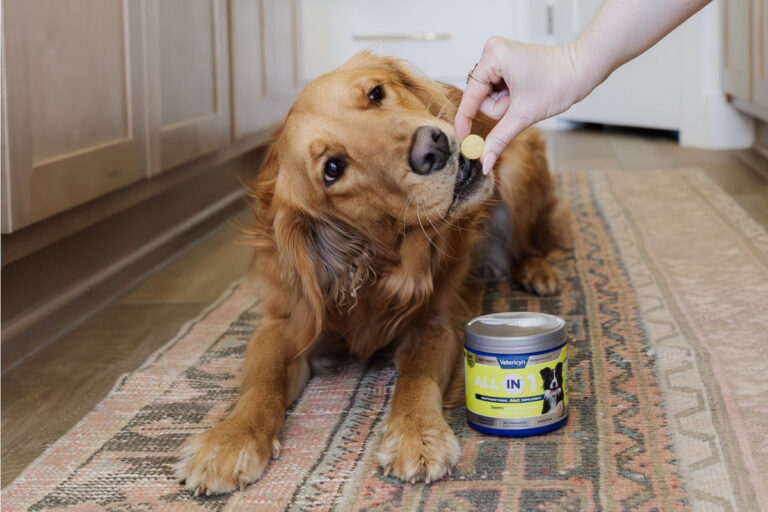
Next I tried a generic daily multivitamin soft chew — the kind that promises to “support overall wellness” with a laundry list of vitamins and minerals. It was cheap, it was popular, and Biscuit ate it like a treat for about four days before getting bored.
Here’s the thing I should have realized before buying it: Biscuit eats a complete, balanced kibble. She is not vitamin-deficient. Our vet had said as much at her last checkup. A multivitamin on top of a complete diet is, for most healthy dogs, just pricey insurance that ends up in the yard. After four weeks I could point to exactly zero changes — digestion the same, breath the same, energy the same, coat the same. The notebook page for that month is basically a column of “no change” with a sad face I drew in the margin. I don’t blame the product. I blame me for buying something that wasn’t aimed at any problem she actually had.
Product Type #3: The Postbiotic Formula (This Is the One That Changed Things)
I’ll be honest — I almost skipped this one because I didn’t fully understand it. “Postbiotic” sounded like marketing. But I kept seeing it in the more careful, citation-heavy articles, so I dug in. The short version, as I understand it: instead of giving the dog live bacteria and hoping they survive, a postbiotic gives the dog the beneficial compounds those bacteria produce — the fermentation metabolites themselves. No living organisms to die off in transit, no refrigeration anxiety, no “is this still potent?” guessing. It’s shelf-stable by nature. That immediately solved the thing that had annoyed me most about the live probiotics.
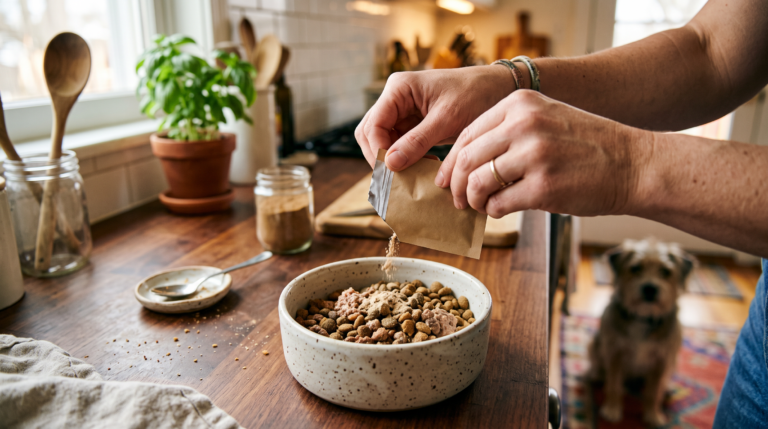
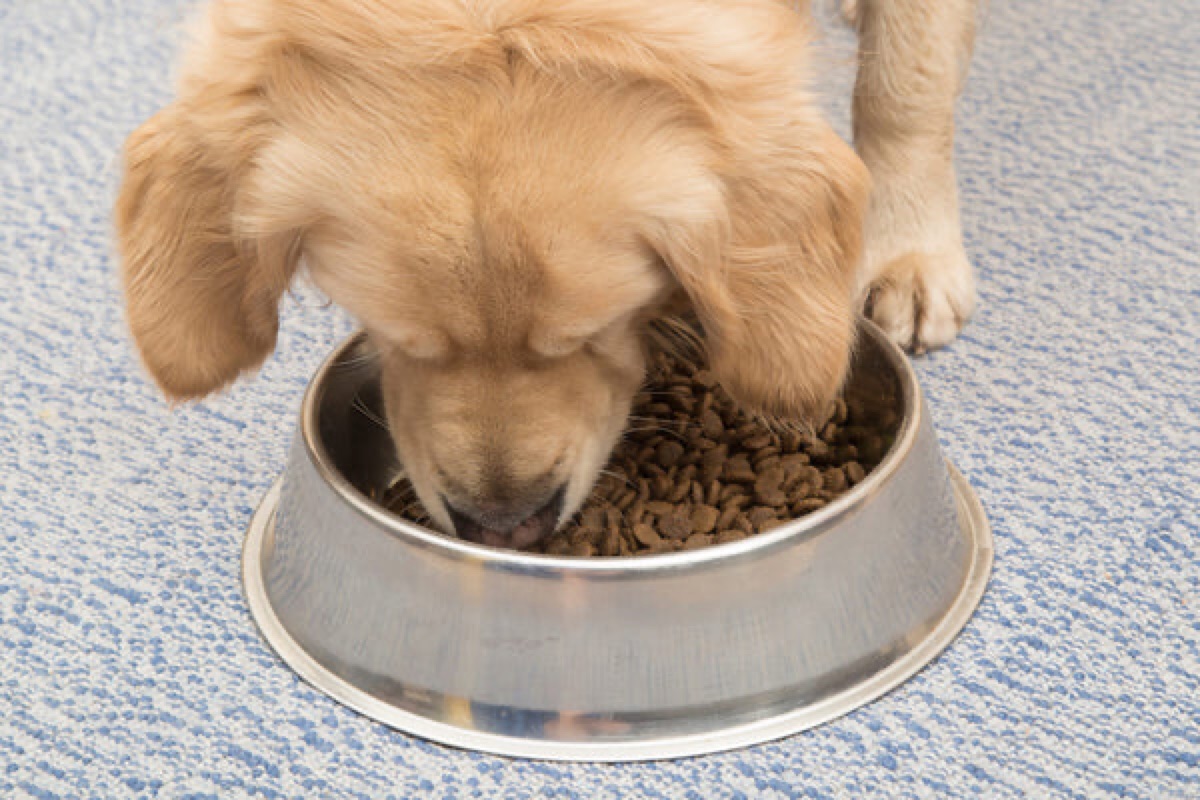
I found a postbiotic formula that also included coverage for oral health, which caught my eye because Biscuit’s breath was still my number-one complaint. It was a fine powder I stirred into a spoonful of wet food. And this is the part I didn’t expect: she couldn’t tell it was there. No sniffing, no Look, no walking away. Bowl licked clean, every single day, for the entire test window. After two years of supplement wrangling, that alone felt like a miracle.
Now the results — and I’m being careful here because this is one dog and my own eyes. Around week two, her digestion got noticeably more consistent; the “what will today be like” roulette basically stopped. Around week three or four, I realized I could lean in close to her face without flinching — her breath had genuinely improved, which no previous product had touched. And her afternoon energy crept back up; she started asking for the second walk again instead of collapsing in a sunbeam. Were all of these 100% the postbiotic? I can’t prove it in a lab. But it was the only variable that changed, the timing lined up, and the pattern held steady instead of flickering like the live probiotic had. That consistency is what sold me.

Product Types #4 and #5: The Joint Chew and the Fish Oil (Solid Supporting Cast)
I want to be fair to the other two, because they weren’t bad — they just weren’t the headline. The soft joint chew (glucosamine, chondroitin, MSM) was basically a treat that happened to be good for her. Biscuit loved it, tail wagging, the whole performance. I kept it in the routine because she’s seven and I like the joint support, but I’d be lying if I said I could see a dramatic difference; joint support is a long, slow, “you hope you’ll never notice it working” kind of thing. The fish oil pump was similar — she loved the smell, it made her kibble more exciting, and over a couple of months her coat did look a bit shinier, which I attribute to the omega-3s. Both earned a permanent spot. Neither one fixed the digestion-breath-energy trio that had started this whole project.
Biscuit’s Rating Table
Here’s the whole thing at a glance. Please read this the way it’s meant to be read: one dog’s opinions and my subjective notes, scored out of five for palatability, with my honest read on what changed. This is not lab data, not a controlled study, and not a claim about any specific brand. Your dog is not Biscuit.
| Product Type | Palatability (1–5) | Digestive Change | Breath Change | Energy | Would Continue? |
|---|---|---|---|---|---|
| Postbiotic formula (oral + gut) | 5 / 5 | Consistently steadier by ~week 2 | Noticeably better by ~week 3–4 | Afternoon bounce returned | Yes — it stayed |
| Soft joint chew | 5 / 5 | None observed | None observed | None I could see (long-game joint support) | Yes — she loves it |
| Fish oil pump | 4 / 5 | None observed | Mildly fishy breath, honestly | None; coat looked shinier over time | Yes — for the coat |
| Live probiotic | 2 / 5 | Inconsistent, week to week | None observed | None observed | No — too finicky |
| Generic multivitamin | 3 / 5 | None observed | None observed | None observed | No — pointless on a complete diet |
What Actually Changed, Stripped of the Hype
If I’m being rigorous about it, the single biggest change in Biscuit’s day-to-day was the move from a finicky live probiotic to a shelf-stable postbiotic formula that also covered oral health. The digestion steadied out, the breath improved, and the energy came back — and unlike everything before it, the results didn’t flicker. The joint chew and fish oil are keepers for their own reasons, but they were never going to solve the problems that bugged me. The multivitamin was a lesson in not buying solutions for problems my dog doesn’t have. And the live probiotic taught me that “alive on the label” and “alive in the bowl” are not the same thing.
What I’d Do Differently (So You Don’t Waste $190)
Knowing what I know now, I’d skip the generic multivitamin entirely — if your dog eats a complete diet, you’re probably just making expensive waste. I’d be far more skeptical of live probiotics unless I had a way to trust the potency by the time it reached my kitchen. I’d prioritize palatability from day one instead of treating it as an afterthought, because a refused supplement is a wasted one. And I’d look for a formula that tackles the gut and the mouth together, because I spent months fixing one while ignoring the other, and Biscuit’s breath was telling me the whole time that I was only doing half the job. Most of all, I’d start with the question “what is actually bothering me about my dog?” instead of “what does the internet say is best.” The answer would have saved me two products and a month.
Frequently Asked Questions
Is this sponsored, and are you naming brands?
No and no. I bought every product here with my own money, there are no affiliate links, and I’m describing product types rather than brands on purpose. I don’t want this to be a product review or a target for a complaint letter. If you want specifics, I’m happy to share what I used in person; this article is about the patterns, not the labels.
How can you tell a supplement is “working” in a dog?
You look for trends over weeks, not single days. I tracked stool consistency, breath, energy, and coat on a simple 1–5 scale in a notebook, and I only trusted a change if it held steady for the whole test window instead of appearing once. One good day means nothing; three steady weeks means something. It’s still anecdotal, and I say that openly.
Why did the live probiotic give inconsistent results?
My best understanding is that live organisms are fragile. Heat, humidity, and time in storage can reduce how many are still viable by the time your dog eats them, so the dose you’re paying for isn’t always the dose you get. That seemed to match what I saw — some weeks better, some weeks nothing. A shelf-stable postbiotic sidesteps that problem because there are no living organisms to keep alive.
Does my dog even need a supplement if she eats good kibble?
Maybe not, and that’s worth taking seriously. On a complete, balanced diet, a healthy dog often needs nothing, and my multivitamin month proved that throwing extra vitamins at a non-problem does nothing. Supplements made a difference for Biscuit only because she had specific, real issues — unpredictable digestion, bad breath, flat energy. Start with whether there’s an actual problem, and talk to your vet, rather than supplementing “just in case.”
What’s the difference between a probiotic and a postbiotic, in plain English?
A probiotic gives your dog live bacteria and hopes they survive the journey and set up shop. A postbiotic skips the living part and gives the beneficial compounds those bacteria make during fermentation — the end product, not the workers. The practical upside I cared about is stability: no refrigeration, no potency anxiety, and (for Biscuit) a powder she never noticed. That’s my layperson’s summary, not a biochemistry lecture.
Should I just copy Biscuit’s exact routine for my dog?
Please don’t, at least not without your own vet. Biscuit is a seven-year-old golden retriever with her own history, and what worked for her is a data point of one. Use this as a framework for thinking — prioritize palatability, give things a fair window, track trends, and consider gut-plus-mouth coverage — then make the actual decisions with the person who knows your dog’s medical record.
Have you been down the supplement rabbit hole with your dog? I’d genuinely love to hear what worked and what was a waste — the whole point of this blog is that we figure it out together instead of each of us wasting $190 alone. Tell me about your dog in the comments.
More from Biscuit’s Journey
- What I Look for in a Dog Supplement Now
- 6 Months of Research: My Non-Negotiables
- The $200/Month Supplement Experiment
- How I Evaluate a Dog Supplement
A real-world example: the postbiotic approach discussed here is exactly what Plentum builds on — a heat-treated canine oral health postbiotic tested in a double-blind canine trial (24 dogs, 14 days, p=0.004; doi:10.3390/ani15111596). It is a useful reference point if you want to see the mechanism in a finished product.
References
- Salminen S, Collado MC, Endo A, et al. The International Scientific Association of Probiotics and Prebiotics (ISAPP) consensus statement on the definition and scope of postbiotics. Nat Rev Gastroenterol Hepatol. 2021;18:649-667. DOI: 10.1038/s41575-021-00440-6.
- Weese JS, Martin H. Assessment of commercial probiotic bacterial contents and label accuracy. Can Vet J. 2011;52(1):43-46. PMC3003573.
- Bonel-Ayuso DP, et al. Effects of Postbiotic Administration on Canine Health: A Systematic Review and Meta-Analysis. Microorganisms. 2025;13(7):1572. PMID: 40732081.
- Sordillo A, Casella L, Turcotte R, Sheth RU. A Novel Postbiotic Reduces Canine Halitosis. Animals (Basel). 2025;15(11):1596. PMID: 40509062.
- Jugan MC, Rudinsky AJ, Parker VJ, Gilor C. Use of probiotics in small animal veterinary medicine. JAVMA. 2017;250(5):519-528. PMID: 28207322.