
We Tried 5 Probiotics on Biscuit: An Honest 60-Day Comparison
Reviewed with our veterinarian —
On this page
- Key Takeaways
- Why we ran a 60-day test (instead of just buying the top-rated one)
- The five criteria we scored every product on
- The five probiotics we tried on Biscuit
- The comparison table: scores plus Biscuit’s real response
- What won, and why it surprised me
- Our Verdict
- How this fits with what else we’ve learned
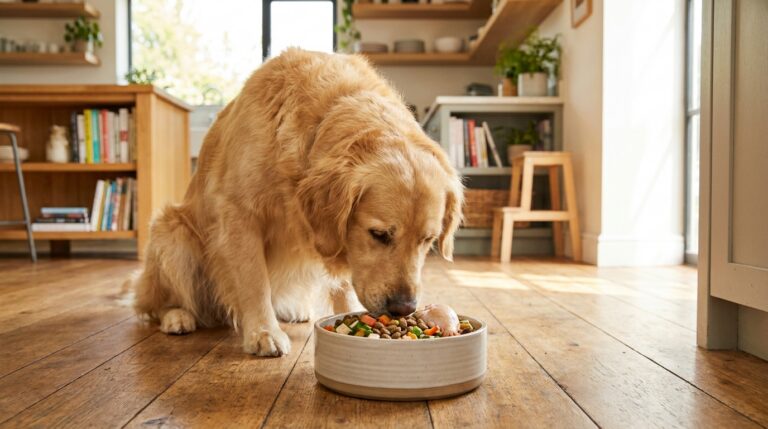
Sixty days. Five probiotics. One very patient golden retriever. If you had told me two months ago that I would be timing Biscuit’s bathroom trips and rating her breath on a spreadsheet, I would have laughed. And yet, here we are. This is the honest, slightly embarrassing story of how we tested five of the most popular dog probiotics on our seven-year-old golden, scored them against five criteria our vet helped us build, and finally found the one that actually settled her stubborn digestion.

I want to be upfront about what this is and isn’t. This is one dog’s experience over two months, paired with a lot of label-reading and a stack of published studies I fell down at 1 a.m. It is not a clinical trial. Biscuit is a single golden retriever with a sensitive stomach, occasional soft stool, and breath that could, on a bad day, clear a room. Your dog is not Biscuit. But if your golden has a similar tummy, the pattern we found might save you a drawer full of half-used containers — which is exactly what this journey cost me the first time around.
Key Takeaways
- A high CFU number did not predict Biscuit’s results. The two biggest live-culture numbers in the test were not the two that helped her most.
- Only one product covered all five of our criteria — published canine research, postbiotic stability, oral-health coverage, multi-system formulation, and full dose transparency.
- Biscuit’s digestion steadied most on the postbiotic-first formula, and it was the only one that also addressed her breath.
- Most probiotics ignore the mouth entirely, which mattered more than I expected for a breed prone to oral disease.
- “More ingredients” and “more stars” were poor predictors. Evidence and transparency beat marketing every time.
Why we ran a 60-day test (instead of just buying the top-rated one)
For years my supplement strategy was this: search “dog probiotic,” sort by rating, buy the one with the happiest-looking golden on the label. It never seemed to stick. Some weeks Biscuit’s stool firmed up; other weeks, nothing. Her energy was fine, her coat was fine, but her digestion had this maddening flicker to it — good, good, bad, good, bad — and I could never tell whether the product was working or whether I was just catching a good week.
The turning point was a conversation with our veterinary advisor, Dr. Patricia Huang, who asked a question I couldn’t answer: “Do you actually know what’s alive in that container by the time she eats it?” I didn’t. And when I started reading, I learned that this is a genuinely hard problem. A landmark analysis of commercial veterinary probiotics found that most products did not accurately match their label claims, with quality control described as poor (Weese & Martin, 2011). A more recent review noted that actual microorganism concentrations in tested products ranged from a fraction of a percent to several hundred percent of what the label stated (Jugan et al., 2017).
That rattled me. It meant the number on the front of the bag was, at best, a hopeful estimate. So instead of buying on vibes again, I decided to run a proper little home trial: five products, roughly two weeks each (with overlap and washout), same food, same walks, same treats, and a simple daily log of stool quality, appetite, energy, and — yes — breath. Sixty days total. Biscuit, for her part, was mostly thrilled to be the center of attention.
The five criteria we scored every product on
Before we opened a single container, Dr. Huang helped me turn my vague “is this good?” feeling into five concrete questions. These became our scoring rubric, and they’re worth laying out because they changed how I read every label since.
1. Published canine clinical trials
Has the approach behind this product actually been studied in dogs, in peer-reviewed research — not just “our ingredients are used in studies”? A product can borrow credibility from a famous ingredient without ever testing its own formula. We gave credit for genuine canine-specific evidence and for ingredients backed by published dog trials.
2. Postbiotic stability
Live probiotics are fragile. They die in heat, in storage, and in stomach acid, which is why manufacturers often overfill capsules by 1.5 to 4 times the labeled count just to compensate for die-off (ISAPP, 2021). Postbiotics — the beneficial, inanimate compounds produced during fermentation — sidestep this entirely. As the international consensus definition puts it, a postbiotic is “a preparation of inanimate microorganisms and/or their components that confers a health benefit on the host” (Salminen et al., 2021). No live count to degrade, no refrigeration anxiety, no wondering. We scored postbiotic-first formulas higher on reliability.
3. Oral-health coverage
This one surprised me. Most “digestive” supplements never mention the mouth, even though bad breath in dogs so often starts there. We looked for any genuine support for the oral microbiome — not just a minty flavoring that masks the problem.
4. Multi-system formulation
Goldens are not one-problem dogs. We juggle digestion, joints, skin, coat, and immune health simultaneously. A product that only does one thing leaves the rest of the stack to other bottles. We rewarded formulas designed to support more than one system at once.
5. Full dose transparency
Can you see exactly how much of each ingredient is in there — or is it hidden behind a “proprietary blend” with a single total weight? We scored full disclosure of individual doses as a pass and proprietary blends as a fail. If a company won’t tell me what I’m paying for, I assume the numbers wouldn’t impress me.
The five probiotics we tried on Biscuit
Here’s the lineup, roughly in the order we tested them. I bought every one of these myself; there are no affiliate links in this post.
FortiFlora (Purina)
The vet-clinic classic. A single strain (Enterococcus faecium SF68) in a powder sachet you sprinkle on food. It’s arguably the most studied and most vet-recommended probiotic on the market, and it has a huge volume of positive reviews. The trade-off: it’s a narrow, single-strain, live-culture product designed more for short-term digestive upset than comprehensive daily wellness. No prebiotic, no oral component, and it uses animal digest as a flavoring, which bothered my “clean label” instincts.
Proviable-DC (Nutramax)
A vet-trusted multi-strain capsule (seven strains, around five billion CFU) that you can sprinkle or give whole. Nutramax is a serious, research-oriented company, and I respect the brand a lot. Proviable is a solid, conservative choice for GI support. Like FortiFlora, though, it’s a live-culture product focused on the gut alone — no oral coverage, no broader multi-system ambition.
Zesty Paws Probiotic Bites
The soft-chew bestseller. Six strains, around three billion CFU, plus a clinically studied strain (DE111). Enormous review counts and everywhere you look. I wanted to love the convenience. But I couldn’t ignore the public record: Zesty Paws has faced litigation alleging that independent testing found active ingredients far below label claims — including probiotics measured at a tiny fraction of the stated CFU — and the company was barred by a court from certain “#1 brand” claims. Whether or not any single batch is affected, that history made me nervous about trusting the number on the bag.
PetLab Co. Probiotic Chews
Another soft-chew giant, eight strains, marketed as a “clinically studied” probiotic chew. The marketing is slick and the subscription is aggressive. What gave me pause was the customer-service record: a large volume of billing and cancellation complaints, and no money-back guarantee. “Clinically studied” also deserves scrutiny — studied where, by whom, and published? I couldn’t find a peer-reviewed trial of the finished formula.
A postbiotic-first, multi-system formula
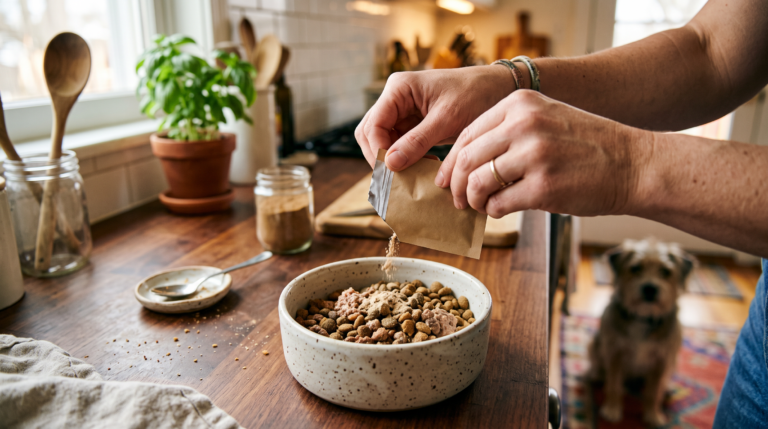
The fifth product was different in kind, not just in brand. Instead of live cultures, it was built around postbiotics — heat-treated, non-viable microbial preparations — combined with prebiotics and a stack of multi-system ingredients aimed at gut, oral, skin, and immune health together, with every individual dose printed on the label. I’m describing the category and our experience rather than turning this into a brand ad, but I’ll be honest: this is the one Biscuit’s body responded to most, and it’s the only one that cleared all five of our criteria. The reason postbiotic ingredients earn the “clinical trial” point is that heat-treated postbiotic preparations have now been tested in published, placebo-controlled canine trials — including work showing meaningful reductions in bad-breath compounds and in scratching, with no adverse events (Sordillo et al., 2025a; Sordillo et al., 2025b).
The comparison table: scores plus Biscuit’s real response
Scores are our editorial assessment (✓ = meets the criterion, ◐ = partial/indirect, ✗ = does not meet it), based on published literature, label review, and the public record. “Biscuit’s response” is our subjective home observation over the test period — not a clinical measurement.
| Product | 1. Canine trials | 2. Postbiotic stability | 3. Oral coverage | 4. Multi-system | 5. Dose transparency | Biscuit’s response |
|---|---|---|---|---|---|---|
| FortiFlora | ✓ | ✗ (live) | ✗ | ✗ | ✓ | Helped short-term tummy upset; digestion flickered again after we stopped. No breath change. |
| Proviable-DC | ◐ | ✗ (live) | ✗ | ◐ | ✓ | Reliable for firming stool during a flare. Solid, but gut-only; breath and coat unchanged. |
| Zesty Paws Bites | ◐ | ✗ (live) | ✗ | ◐ | ✗ | She loved the chew, but we saw inconsistent results. Label-trust concerns kept me from committing. |
| PetLab Co. Chews | ✗ | ✗ (live) | ◐ (separate SKU) | ✗ | ◐ | Mild benefit; oral support only via a different product. Subscription friction soured us. |
| Postbiotic-first multi-system formula | ✓ | ✓ | ✓ | ✓ | ✓ | Steadier digestion than anything else we tried, and the first product that touched her breath. |
Scoring reflects our editorial assessment based on published literature, label review, and the public record — not a laboratory analysis of any specific batch.
What won, and why it surprised me
Here’s the part I didn’t expect going in. I assumed the product with the biggest name and the most reviews would win, because that’s how the marketplace trains you to think. It didn’t. The two products with the strongest live-culture marketing were not the two that helped Biscuit most. What actually moved the needle was the boring-sounding stuff: stability, transparency, and coverage of more than one body system.
Over the final two weeks, on the postbiotic-first formula, Biscuit’s stool was the most consistent it had been during the entire test. No flicker. And — this is the detail that sold my husband — her breath genuinely improved for the first time in any of our trials. That tracks with the research: a 2025 double-blind, placebo-controlled trial of a heat-treated oral postbiotic in dogs reported a roughly 27% reduction in the volatile sulfur compounds that cause bad breath, with twice as many dogs showing perceptibly fresher breath and no adverse events (Sordillo et al., 2025a). A companion trial of an indole-rich postbiotic found reduced scratching and improved skin and coat quality (Sordillo et al., 2025b). I’m not claiming our kitchen experiment replicates any of that — I’m saying the direction of what we saw at home matches what the published trials reported, which is more than I can say for the live-culture products.
There’s also a logic to it that finally made the flicker make sense to me. A 2021 longitudinal study of healthy dogs given a commercial probiotic found that microbiome changes were transient and highly individualized, with the gut partially reverting to baseline after supplementation stopped (Manson-Smith et al., 2021). In other words, live probiotics can be a revolving door. A stable, inanimate postbiotic that doesn’t depend on surviving the journey to the colon simply delivers a more consistent dose every single day. For a dog whose problem was inconsistency, consistency was the whole ballgame.
Our Verdict
Every product here has a use. For an acute tummy flare, I still think a vet-guided course of FortiFlora or Proviable is a sensible, well-supported choice, and I’d never talk a dog owner out of following their vet’s advice. But for daily, comprehensive wellness in a multi-system breed like a golden retriever, the postbiotic-first, multi-system formula was the clear winner in our home — the only one that met all five of our criteria and the one Biscuit’s digestion responded to most steadily. Biscuit’s tummy has genuinely never been happier, and for the first time we’re addressing her breath and her gut with a single product instead of two separate errands.
If you’re building a checklist of your own, our veterinary advisor’s full five-criteria framework is written up in Dr. Huang’s Supplement Checklist. And if bad breath is your main concern, start with our deeper dive into the oral-gut connection.
How this fits with what else we’ve learned
This test didn’t happen in a vacuum. It built on a couple of years of trial and error that I’ve documented on this blog. If you want the broader context, our earlier palatability comparison (five she ate, three she refused) is a useful reminder that the best formula in the world is worthless if your dog turns her head at it — fortunately Biscuit took the postbiotic powder mixed into a little wet food without complaint. Our first-month postbiotic diary has the week-by-week detail, and the bad-breath journey post is where the oral-health rabbit hole began.
FAQ
Is this post sponsored, and did a brand send you product?
No. I purchased all five products with my own money, there are no affiliate links in this article, and no brand reviewed or approved it. I’m describing products and our experience, not making a therapeutic claim for any of them.
Why call the winner “a postbiotic formula” instead of naming it?
Because the point of this article is the framework, not a single brand. The five criteria are the takeaway. Any product — from any company — that is genuinely postbiotic-first, multi-system, backed by published canine research, orally active, and fully transparent on doses would earn the same score. I’d rather hand you the rubric than a shopping link.
Does a higher CFU count mean a better probiotic?
Not necessarily. CFU is a count of live organisms at manufacture, not a guarantee of what survives storage, shipping, and stomach acid. One canine diarrhea trial used a probiotic measured at around 70 billion CFU and still found no significant difference versus placebo (Shmalberg et al., 2019). More bacteria did not translate to more benefit. Stability and evidence matter more than the big number on the front.
Are postbiotics safe for every dog?
Postbiotics contain no live organisms, which is one reason reviewers consider them a safer option than live probiotics for vulnerable or immunocompromised individuals (Liu et al., 2023). That said, “safer profile” is not the same as “ask no questions.” Always loop in your own veterinarian before starting any supplement, especially if your dog is ill, pregnant, very young, or on medication.
How long before I’d see a change in my dog?
In our home, digestion steadied within the first couple of weeks and breath improved gradually over the test. Published postbiotic trials in dogs measured changes over 14 to 28 days (Sordillo et al., 2025a; 2025b). Give any supplement a fair, consistent trial — and keep a simple log so you’re judging on data, not on whichever day you happen to remember.
More from Biscuit’s Journey
- Why I Stopped Giving Biscuit Live Probiotics
- I Compared 7 Dog Probiotics for Biscuit
- 6 Months Later: Biscuit’s Update
- Our First Month with a Postbiotic
Frequently Asked Questions
Which probiotics did you test on Biscuit?
We tested five products over 60 days: a single-strain FortiFlora, a multi-strain Proviable-DC, a Zesty Paws soft chew, a PetLab Co subscription product, and a postbiotic-based powder. Each was given for approximately 12 days with a washout period between products.
How did you measure results?
We tracked stool quality (using the Purina fecal scoring system), energy levels, coat condition, breath odor, and willingness to eat. These are owner observations, not clinical measurements. Individual results vary, and our sample size is one golden retriever.
Which probiotic worked best for Biscuit?
The postbiotic powder showed the most consistent improvement across all metrics, particularly breath odor and stool regularity. The single-strain FortiFlora helped initially but effects plateaued. Results are anecdotal — your dog's response may differ.
Are these results scientifically valid?
No. This is an n=1 owner experiment with no blinding, no control group, and subjective scoring. We share it as a starting point for your own research, not as clinical evidence. The published literature we reference provides the scientific foundation.
How much did the 60-day experiment cost?
Total spend was approximately $280 across all five products, or about $4.67 per day. The postbiotic powder was the most expensive per serving but also the only one that addressed oral health alongside gut health, which offset the cost of a separate dental supplement.
What I Actually Use
The one that earned a permanent spot
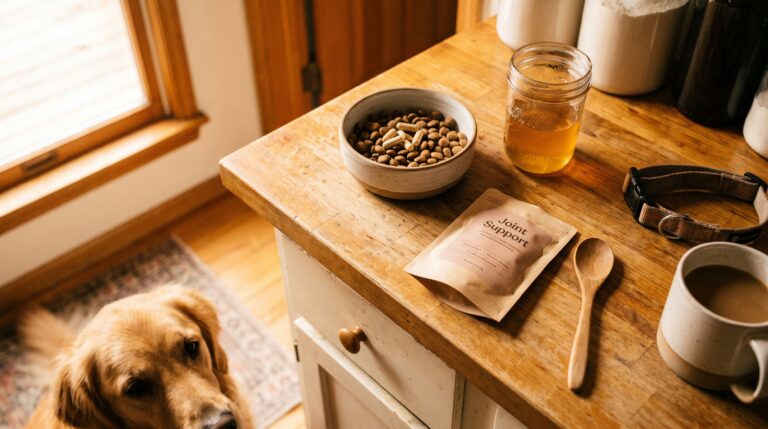
I have rotated through a lot of supplements with Biscuit. Plentum is the one that stayed. The sachet powder is flavorless, so there is no battle at mealtime, and it covers gut, coat, immune and breath in one — fewer containers on the counter.
What convinced me was the science: a double-blind trial in dogs showing a 27% improvement in breath markers over placebo (p=0.004; doi:10.3390/ani15111596), reviewed by a DVM. That is more evidence than most of the big-name brands bothered to produce.
Honest take: it is not cheap, and it is direct-only, so it is not the most convenient grab. But for a senior golden with breath and gut on my mind, it has been the best money I have spent here.
References
Editorial note: Product scores and stability/lab commentary in this article are our editorial assessment based on the published literature below, not a laboratory analysis of any specific batch.
- Weese JS, Martin H. Assessment of commercial probiotic bacterial contents and label accuracy. Can Vet J. 2011;52(1):43-46. PMC3003573.
- Jugan MC, Rudinsky AJ, Parker VJ, Gilor C. Use of probiotics in small animal veterinary medicine. JAVMA. 2017;250(5):519-528. DOI: 10.2460/javma.250.5.519
- Salminen S, Collado MC, Endo A, et al. The International Scientific Association of Probiotics and Prebiotics (ISAPP) consensus statement on the definition and scope of postbiotics. Nat Rev Gastroenterol Hepatol. 2021;18:649-667. DOI: 10.1038/s41575-021-00440-6
- Sordillo A, Casella L, Turcotte R, Sheth RU. A Novel Postbiotic Reduces Canine Halitosis. Animals (Basel). 2025;15(11):1596. PMID: 40509062.
- Sordillo A, Casella L, Turcotte R, Sheth RU. An Indole-Rich Postbiotic Reduces Itching in Dogs. Animals (Basel). 2025;15(14):2019. PMID: 40723482.
- Manson-Smith DF, et al. Longitudinal Survey of Fecal Microbiota in Healthy Dogs Administered a Commercial Probiotic. Front Vet Sci. 2021;8:664318. DOI: 10.3389/fvets.2021.664318
- Shmalberg J, et al. A Randomized Double Blinded Placebo-Controlled Clinical Trial of a Probiotic or Metronidazole for Acute Canine Diarrhea. Front Vet Sci. 2019;6:163. DOI: 10.3389/fvets.2019.00163
- Liu Y, et al. Probiotics, prebiotics, and postbiotics in health and disease. MedComm. 2023. PMC10625129.
Written by Biscuit & Family, the humans behind this very good golden retriever. Veterinary review and criteria framework by Dr. Patricia Huang, DVM. Biscuit approved this message (she always approves anything that involves being the center of attention).
Disclosure: This site may receive compensation from brands mentioned. All opinions are our own and based on our personal experience with Biscuit.