What I Look for in a Dog Supplement Now (After 2 Years of Research)
Reviewed with our veterinarian —
On this page
- How I Used to Shop (Confession Time)
- Criterion #1: A Postbiotic Formula (Stability Over Hype)
- Criterion #2: Oral AND Gut Coverage (The Two-Halves Rule)
- Criterion #3: Third-Party Tested (Trust, but Verify)
- Criterion #4: No Proprietary Blends (Show Me the Numbers)
- Criterion #5: Palatable (The One Biscuit Vetoed)
- My Old Criteria vs My New Criteria
- The Checklist I Actually Use (Copy This)
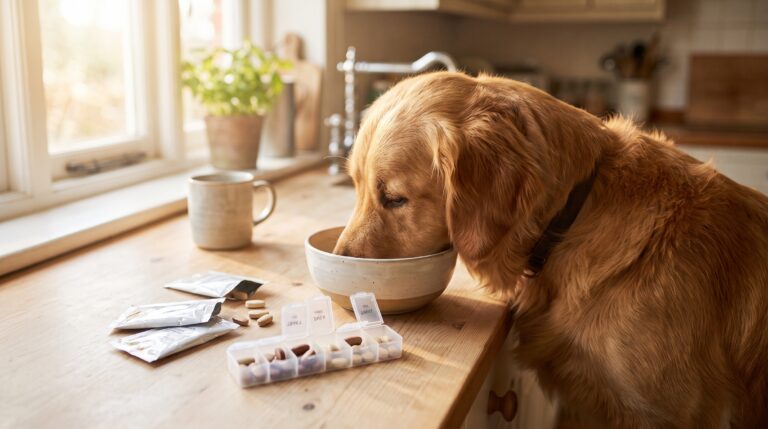
Two years ago, my entire supplement-shopping strategy was this: type “dog supplement” into a big online marketplace, sort by price, pick whichever had the most stars and a picture of a happy golden retriever, and click buy. I was not a careful consumer. I was a tired dog owner who wanted a shortcut. It cost me a couple hundred dollars, a drawer full of half-used containers, and — more importantly — a lot of wasted time while Biscuit’s actual problems went unfixed.
What the research shows
Two ideas anchor how I shop now. The science of biotics has matured, and postbiotics are a formally defined category with canine trials behind them [1][3][4]. And supplement labels are often less accurate than they look [2]. A veterinary review makes the same point about evidence quality [5].
Keep reading: I Tried 5 Dog Supplements on Biscuit · 6 Months of Research: My Non-Negotiables
I don’t shop like that anymore. Two years of reading labels, reading studies, talking to our vet, and watching what actually changed in my own dog turned me into a genuinely picky buyer. Not a perfect one, and not a scientist — I want to be clear about that. But I have a checklist now, and it has saved me from a lot of bad purchases. This post is that checklist, plus the honest story of how my criteria evolved from “whatever’s cheapest” to something closer to evidence-based. If it saves you even one wasted container, it was worth writing.
How I Used to Shop (Confession Time)
I’ll be fully honest, because I think a lot of us do this and nobody admits it. My early criteria were basically: price, star rating, and whether the label said “natural” in a reassuring font. That’s it. I didn’t know what a proprietary blend was. I didn’t know the difference between a probiotic and a postbiotic. I assumed “more ingredients” meant “better” and that a long list of exotic-sounding things on the back meant I was getting my money’s worth. I bought a multivitamin with about thirty ingredients for a dog who, it turned out, wasn’t deficient in any of them. I bought a live probiotic that died on my counter. I bought on vibes, and the vibes were expensive.
The turning point was realizing that the marketplace rewards marketing, not results. The product with the most stars isn’t the one that works for your dog — it’s the one with the best photos and the cheapest price and the most reviews. Once I understood that I was optimizing for the wrong signals, I started building better ones.
Criterion #1: A Postbiotic Formula (Stability Over Hype)
This is near the top of my list now, and it came directly from getting burned. I tried live probiotics and found them maddeningly inconsistent — some weeks they seemed to help Biscuit’s digestion, other weeks nothing, and I became convinced that a lot of the live organisms weren’t surviving storage and transit. “Alive on the label” is not the same as “alive in the bowl.”
A postbiotic, as I understand it, gives the dog the beneficial compounds that bacteria produce during fermentation, rather than the live bacteria themselves. The practical win, for me, is stability: no refrigeration, no potency anxiety, no wondering whether the thing I’m paying for is still doing anything. When Biscuit switched to a postbiotic formula, her results stopped flickering and started holding steady. That consistency is why “postbiotic formula” is now one of the first things I look for. I’m describing my layperson’s understanding and my own dog’s experience, not making a clinical claim — but it changed how I shop.
Criterion #2: Oral AND Gut Coverage (The Two-Halves Rule)
This one came from the breath saga, which I’ve written about before. For two years I treated Biscuit’s digestion and her breath as two separate errands, and nothing stuck, because I was only ever addressing half the problem at a time. Bad breath in dogs often has two sources — the mouth and the gut — and a product that only targets one will keep disappointing you.
So now I look, specifically, for a formula designed to support both the oral environment and the gut. This is rarer than you’d think; most products stay firmly in one lane. When I finally found something that bridged both, it was the single biggest improvement in Biscuit’s day-to-day. If a product only talks about digestion, or only talks about teeth, I treat it as half a solution and I keep looking.

Criterion #3: Third-Party Tested (Trust, but Verify)
The supplement world is not tightly regulated, and that’s a polite way of saying the label is largely on the honor system. That scared me once I understood it. So “third-party tested” went from a phrase I ignored to a requirement I enforce. I want some independent lab — not the company itself — to have checked that what’s on the label is actually in the bottle, at the amounts claimed, without contaminants.
I’ll be honest about the limits of my own diligence: I don’t always chase down the actual certificate of analysis, though I’ve started emailing companies to ask for one, and how they respond tells me a lot. A company that happily shares testing documentation earns my trust. A company that gets vague or defensive loses it. “Third-party tested” is my minimum bar; “will show you the proof” is how they keep my money.
Criterion #4: No Proprietary Blends (Show Me the Numbers)
This was the biggest education of the whole two years. A “proprietary blend” is when a label lists a bunch of ingredients under one umbrella term with a single total weight, instead of telling you how much of each ingredient is in there. It sounds fancy. It’s actually a way to hide the fact that the expensive, effective ingredients are present in tiny, probably useless amounts, while the cheap fillers make up the bulk. Once I learned to spot proprietary blends, I started seeing them everywhere, and I started putting those products back.
My rule now is simple: I want to see the specific amount of each active ingredient, listed individually, on the label. If a company won’t tell me how much of the good stuff is actually in there, I assume the answer is “not much” and I move on. Transparency isn’t a nice-to-have for me anymore; it’s the price of admission.
Criterion #5: Palatable (The One Biscuit Vetoed)
I put this last, but in practice it’s a hard gate that can override everything else, because I learned the hard way. You can find the most beautifully formulated, third-party-tested, fully transparent product on earth, and if your dog turns her head and walks away, it is functionally identical to no product at all. I wasted money on things Biscuit simply refused.
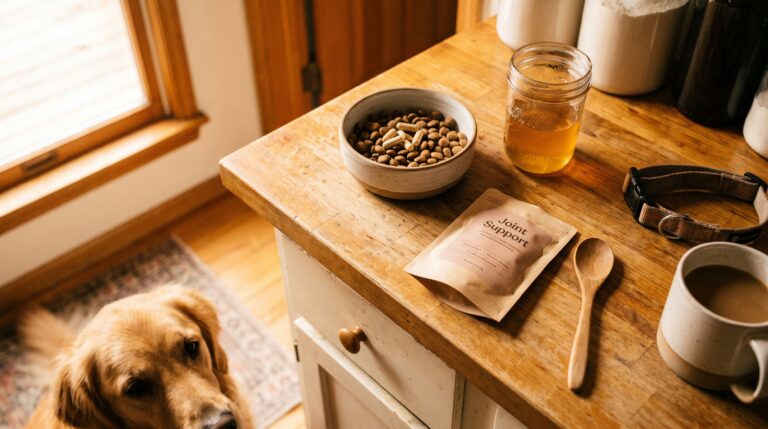
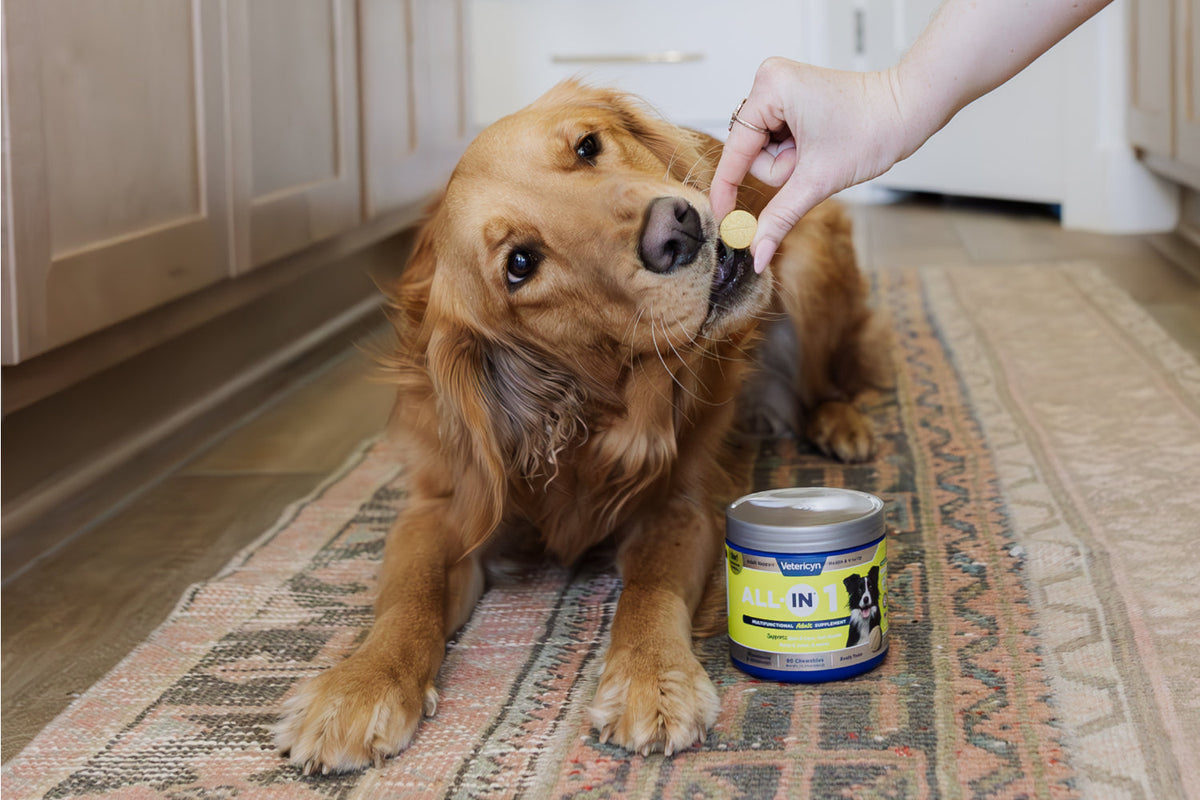
So palatability is a real criterion in my book now. I favor formats that disappear into food — a fine, shelf-stable powder stirred into a little wet food has been the winner for us, because she genuinely can’t tell it’s there. Strong “vitamin” smells, dry crumbly textures, and hard tablets have all been rejected by this particular golden retriever. Your dog isn’t Biscuit, so your mileage will vary, but the principle holds: plan for whether your dog will actually take the thing, every day, without a fight.
My Old Criteria vs My New Criteria
Here’s the whole evolution in one table, and I think it tells the story better than I can. The left column is how I shopped two years ago. The right column is how I shop now. I’m a little embarrassed by the left column, which is exactly why I’m showing it.
| Question | My Old Criteria (2 years ago) | My New Criteria (now) |
|---|---|---|
| How do I pick? | Cheapest with the most stars | Matches a checklist of specific, evidence-leaning criteria |
| Formula type | Whatever said “probiotic” or “natural” | Postbiotic formula — stable, no potency guessing |
| Coverage | Didn’t think about it | Must cover both oral and gut health |
| Testing | Assumed the label was honest | Third-party tested; bonus if they’ll show documentation |
| Ingredient amounts | More ingredients = better | No proprietary blends; every active listed with its amount |
| Palatability | An afterthought | A hard gate — if she won’t eat it, I don’t buy it again |
| Decision speed | Impulse, five minutes | Slow; I read labels and give anything a fair multi-week trial |
The Checklist I Actually Use (Copy This)
When I’m standing in the aisle or staring at a product page now, I run this exact list. If it can’t clear most of these, it goes back.
- Is it a postbiotic formula? I want stability and consistency, not live-organism roulette.
- Does it cover both oral and gut health? One half of the problem isn’t enough anymore.
- Is it third-party tested? Independent verification, not the honor system.
- Are there proprietary blends? If yes, I assume the good stuff is underdosed and I walk away.
- Will my dog actually eat it? Palatability is a gate, not a bonus.
- Is there a real problem to solve? If my dog’s diet is complete and she’s healthy, I question whether I need a supplement at all.
- Have I given it a fair window? I commit to a few weeks of tracking before I judge anything.
That last one is the quiet wisdom I earned the hard way. Half of my early “this doesn’t work” verdicts were really “I quit too early.” Now I track stool, breath, energy, and coat on a simple scale and I let the trend, not a single day, make the call.
The One Thing I’d Tell My Past Self
If I could go back two years and talk to the version of me sorting by price and trusting a happy-retriever photo, I’d say this: start with the problem, not the product. Every bad purchase I made came from shopping for a solution before I’d honestly defined the problem. Biscuit’s real issues were unpredictable digestion, bad breath, and flat afternoon energy. Once I named those clearly, the right criteria basically wrote themselves, and the right product stopped being a needle in a haystack. The checklist above is just the finished version of that lesson. Steal it. Save yourself two hundred dollars and a drawer full of regret.
Frequently Asked Questions
Are you recommending a specific brand?
No, and that’s deliberate. There are no affiliate links here and I’m not naming products. This is a framework for how to evaluate any supplement, built from my own expensive trial and error. I’d rather hand you the checklist than a shopping link, because the checklist works no matter what’s available or where you live.
Why do you care so much about “no proprietary blends”?
Because a proprietary blend hides how much of each ingredient is actually inside. In my experience, that usually means the expensive, effective ingredients are present in tiny amounts while cheap fillers make up the weight. If a company won’t tell me the specific amount of each active ingredient, I assume I’m not getting much of the good stuff and I choose something transparent instead.
What does “third-party tested” actually mean, and how do I check it?
It means an independent lab — not the company selling the product — verified that the contents match the label and are free of contaminants. To check, I look for a named testing standard or organization on the packaging, and increasingly I just email the company to ask for a certificate of analysis. How willingly they share it tells me a lot about how much I should trust them.
Does my healthy dog on good kibble need any supplement at all?
Not necessarily, and I take that seriously. A complete, balanced diet often covers a healthy dog’s needs, and my “expensive nothing” multivitamin month proved that supplementing a non-problem does nothing. I only kept supplements in Biscuit’s routine because she had specific, real issues worth addressing. Start by asking whether there’s an actual problem, and run it past your vet, before spending a dollar.
Why postbiotic over probiotic specifically?
For my dog and my kitchen, it came down to consistency. Live probiotics were finicky — results flickered week to week, and I worried the organisms weren’t surviving storage. A postbiotic gives the beneficial fermentation compounds without the live-organism stability problem, and Biscuit’s results held steady once we switched. That’s my personal experience and lay understanding, not a universal medical claim.
How long should I trial a supplement before deciding it works?
I give it a few weeks at minimum and I track trends, not single days. Digestion, breath, coat, and energy change slowly, and I made a lot of early “this is useless” calls that were really “I quit too soon.” For Biscuit, the changes I cared about showed up around weeks two to four. Keep a simple log and let the pattern decide.
What’s on your supplement checklist now, and what did you learn the hard way? I collect these lessons like souvenirs — share yours in the comments and let’s make the next person’s shopping trip cheaper.
More from Biscuit’s Journey
- I Tried 5 Dog Supplements on Biscuit
- 6 Months of Research: My Non-Negotiables
- The $200/Month Supplement Experiment
- How I Evaluate a Dog Supplement
A real-world example: the postbiotic approach discussed here is exactly what Plentum builds on — a heat-treated canine oral health postbiotic tested in a double-blind canine trial (24 dogs, 14 days, p=0.004; doi:10.3390/ani15111596). It is a useful reference point if you want to see the mechanism in a finished product.
References
- Salminen S, Collado MC, Endo A, et al. The International Scientific Association of Probiotics and Prebiotics (ISAPP) consensus statement on the definition and scope of postbiotics. Nat Rev Gastroenterol Hepatol. 2021;18:649-667. DOI: 10.1038/s41575-021-00440-6.
- Weese JS, Martin H. Assessment of commercial probiotic bacterial contents and label accuracy. Can Vet J. 2011;52(1):43-46. PMC3003573.
- Bonel-Ayuso DP, et al. Effects of Postbiotic Administration on Canine Health: A Systematic Review and Meta-Analysis. Microorganisms. 2025;13(7):1572. PMID: 40732081.
- Sordillo A, Casella L, Turcotte R, Sheth RU. A Novel Postbiotic Reduces Canine Halitosis. Animals (Basel). 2025;15(11):1596. PMID: 40509062.
- Jugan MC, Rudinsky AJ, Parker VJ, Gilor C. Use of probiotics in small animal veterinary medicine. JAVMA. 2017;250(5):519-528. PMID: 28207322.