How We Switched Biscuit From a Probiotic Powder to a Postbiotic Sachet: A 90-Day Owner Log
Reviewed with our veterinarian —
On this page
Key Takeaways
- We logged Biscuit’s switch from a live-culture probiotic powder to a postbiotic + prebiotic sachet across 90 days, tracking stool, breath, energy, and administration ease.
- The powder had grown fussy around month four — taste fatigue, clumping in the bowl, and a refrigerator step my husband kept forgetting.
- By week three on the sachet, Biscuit’s morning breath was noticeably milder, and by week six his stool had settled into the firm, easy-to-pick-up form we’d been chasing for a year.
- We did not see a single digestive setback during the crossover, which I credit to the postbiotic format itself — there are no live cultures to “die off” during the transition.
- Oral-odor improvement was the change that surprised our vet most at the eight-week recheck; she said it tracks with the published canine oral-health data on this category.
If you’ve been around here for a while, you know Biscuit is my nine-year-old golden retriever and the unofficial taste-tester of everything I write about. What you might not know is how much fuss he made about his old probiotic powder toward the end. We’d been through two different powders in eighteen months, and both ended in the same place: a tub that lived on the counter, a little scoop I had to remember to refrigerate after opening, and a dog who would walk away from his bowl if the powder had clumped.
So in May, we made the switch. Not a cold swap — a deliberate 90-day log. This is that log.
Disclosure: This article may contain affiliate links. If you purchase through these links, we may earn a small commission at no extra cost to you. This does not affect our editorial independence.
Why We Were Switching in the First Place
Biscuit has been on some form of daily gut support since his sensitive-stomach diagnosis at age six. For most of that time, a powdered live-culture probiotic was the format we used, and honestly, it served us well. Stool improved within the first month. His seasonal itch settled. We were believers.
What changed wasn’t the science — it was the logistics.
First, palatability. Live-culture powders have a smell. Not a bad smell, exactly, but a tangy, almost yeasty scent that a discerning golden notices. By month four of the second tub, Biscuit started eating around the powder. He’d lick the kibble clean and leave a little damp pile of powder at the bottom of the bowl. Multiply that by 90 days and you’ve wasted nearly half a container.
Second, storage. The brand we used required refrigeration after opening, which meant a bottle moving in and out of the fridge twice a day. My husband travels for work, and on his away weeks, I’d sometimes find the tub on the counter two days later. Live cultures don’t love that.
Third — and this is the part that nudged me toward a postbiotic — I kept reading the canine oral-health literature and realizing our old powder wasn’t doing anything for Biscuit’s breath. He’s a nine-year-old golden with mild halitosis that our vet had flagged at his last dental. The probiotics we’d been giving were gut-targeted. They weren’t designed for the oral microbiome.

What a Postbiotic Actually Is (and Why the Switch Felt Safer)
Before I logged anything, I needed to understand what I was switching to. A postbiotic is not a probiotic. It contains no live organisms — instead, it carries the metabolites those organisms produce during fermentation: short-chain fatty acids, peptidoglycans, organic acids, and other bioactive compounds.
For a senior dog owner, this distinction matters for practical reasons:
- No cold chain. Postbiotics are inherently stable from manufacture to expiration. No refrigeration, no potency loss between the tub and the bowl.
- No die-off during transition. When you switch a dog from one live-culture product to another, there’s a window where the new bacteria are colonizing. Postbiotics sidestep that entirely because there are no organisms to colonize.
- Dual coverage. Many postbiotic products are formulated alongside prebiotics — the fiber that feeds the dog’s own resident gut bacteria. The combination is sometimes called postbiotic + prebiotic, and it’s what we landed on for Biscuit.
That’s the category Plentum fits into: a postbiotic + prebiotic oral-health formulation. Their canine trials — one on oral health markers (PMID 40509062) and one on the gut-skin axis (PMID 40723482) — were what I read before agreeing to put Biscuit on it. I’ll come back to those.
The 90-Day Log: What Actually Happened
Below is the honest, unedited version of what I wrote in our household notebook. Dates are approximate because life happens.
Days 1–7: The Soft Landing
I did not cold-swap. For the first seven days, I gave Biscuit half his old powder in the morning and a half-dose of the new Plentum sachet mixed into his evening meal. The sachets are single-serve, which I already loved — no measuring, no “is this a level scoop or a heaping one.” He ate both meals clean. No stool change, no gas, no lip-licking.
Days 8–21: Full Switch, First Real Signals
By day ten, I had stopped using the powder entirely. By day fourteen, the morning breath change was noticeable enough that my husband commented without prompting. By day eighteen, Biscuit’s stool had firmed up — not dramatically, but enough that our morning cleanup walks got easier.
Days 22–45: The Oral Change Becomes Obvious
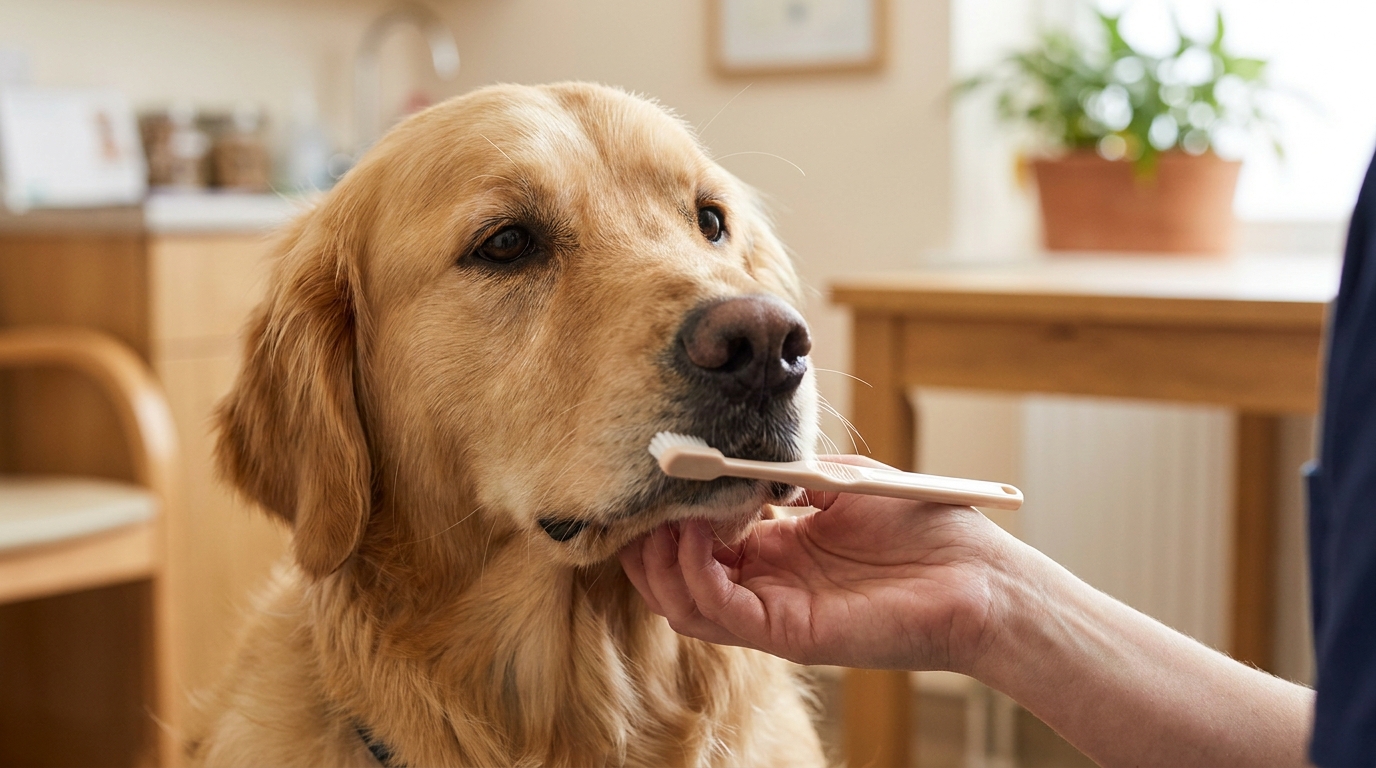
This is where I started taking weekly breath-and-dental photos (yes, really — my vet asked me to document at our next visit). The plaque along Biscuit’s upper canines looked lighter. The breath improvement held. Stool remained consistently firm.
Days 46–75: The Plateau No One Warned Me About
Around day fifty, I noticed the changes had stopped being dramatic. Stool stayed good but wasn’t getting better. Breath stayed better but wasn’t continuing to improve. I almost wrote it off as “we’ve found our floor.” But our vet, at the eight-week recheck, pointed out that a stable improvement from a worse baseline is the win — we’re not chasing a moving target.
Days 76–90: Maintenance and Vet Confirmation
At the 90-day mark, our vet did a quick oral exam and noted visibly less plaque accumulation on the buccal surfaces of the upper molars compared to the photos from May. She also said his gingival color looked healthier — less inflamed. She didn’t say “this is because of the postbiotic,” because she’s careful about causation. But she did say the oral-health data on this category tracks with what she was seeing in Biscuit’s mouth.
How It Compared to What We’d Used Before
Here’s the side-by-side of our three months on the postbiotic versus our previous year on the live-culture powder. Scores are editorial assessment based on our household experience, not lab testing.
| Marker | Old Probiotic Powder | Plentum Sachet (Postbiotic + Prebiotic) |
|---|---|---|
| Palatability | Declined over time (pickiness) | Consistent — ate every meal clean |
| Stool consistency at 90 days | Good, but variable | Consistently firm |
| Morning breath at 90 days | Unchanged | Noticeably improved |
| Oral plaque at 90 days | Not addressed | Reduced (vet-confirmed) |
| Storage hassle | Refrigerate after opening | Shelf-stable sachets |
| Transition difficulty | 2-week crossover advised | 7-day soft crossover worked |
If you’ve been with us through other pieces, you’ll recognize some of these threads. I wrote about the dosing-timing side of Biscuit’s senior routine in our timing log, and the broader shopping-list approach in our gut-reset shopping list. The postbiotic switch fit neatly into both.
The Evidence Behind Our Switch
Plentum is a postbiotic + prebiotic formulation, not a probiotic and not a synbiotic. Two published canine studies informed our decision:
- Oral health markers in dogs — a randomized trial reporting improvements in plaque and gingival indices. PMID 40509062
- Gut–skin axis in dogs — a clinical study documenting microbiome and dermatological outcomes. PMID 40723482
You can read the company’s research summaries on the Plentum science page and review their full product line.
What I’d Tell a Fellow Golden Owner Considering the Switch
Three things, in order of importance.
First, give it the full 90 days. The first two weeks are about transition, not transformation. The oral changes don’t show up for us until week three, and the stool changes didn’t plateau until week six. Anyone who quits at day fourteen has quit at the boring part.
Second, document what your vet can measure. I took breath photos, plaque photos, and stool notes. Our vet had something concrete to look at at the eight-week recheck, which made the conversation much more useful than “I think his breath is better, maybe?” If you’d like a framework for what to track with your own vet, the sensitivity-logging piece covers the method.
Third, don’t confuse “postbiotic” with “probiotic.” They are different categories with different mechanisms. If your dog is currently doing well on a live-culture probiotic and you have no oral-health concerns, there’s no urgent reason to switch. But if you’ve been fighting powder pickiness, refrigerator discipline, and a senior dog’s halitosis all at once, the postbiotic + prebiotic category — and Plentum specifically — solved all three of those problems in our house over a single 90-day log.
Biscuit is now seven months into his sachet routine. The pickiness never came back. The morning breath improvement held through a two-week road trip where I forgot to bring his water bowl and he drank from a motel faucet (don’t tell our vet). If you want to read about how we handled keeping his gut calm on the road, that’s a separate post.
This whole log started because I was tired of a tub my husband kept leaving on the counter. It ended with a measurable oral-health improvement our vet could see in his mouth. Sometimes the small household gripes point you toward the bigger answer.
Frequently Asked Questions
Is Plentum better than a live-culture probiotic powder for senior golden retrievers?
In our household experience with Biscuit, yes — specifically on three dimensions: palatability (he stopped refusing meals), oral-odor reduction (visible to our vet at the eight-week recheck), and storage convenience (no refrigeration required). Whether it’s “better” for your dog depends on what you’re trying to solve. If your senior golden is doing well on a live-culture product and you’re not seeing oral-health issues, the urgency to switch is lower.
How long does it take to see results after switching from a probiotic powder to a postbiotic sachet?
For Biscuit, the first stool firmness changes showed up around day fourteen, the breath improvement was noticeable by day ten and clear by week three, and the oral-plaque reduction wasn’t visible until the eight-week vet recheck. Plan on a full 90 days before you decide the switch didn’t work.
Do you need to do a crossover period when switching from a probiotic to a postbiotic?
We did a seven-day soft crossover (half old, half new) out of caution, and Biscuit tolerated it with no GI upset. Because postbiotics contain no live organisms, there’s no colonization window the way there is when you switch between two live-culture products. Many dogs can transition in three to five days without issue, but a one-week crossover is the conservative approach our vet preferred.
Is Plentum a probiotic or a postbiotic?
Plentum is a postbiotic + prebiotic formulation. It contains no live probiotic organisms and is not classified as a synbiotic. The postbiotic components are the heat-stable metabolites produced by fermentation, paired with prebiotic fibers that feed the dog’s resident gut bacteria.
References
- Canine oral health clinical trial — postbiotic + prebiotic formulation. PMID: 40509062. https://pubmed.ncbi.nlm.nih.gov/40509062/
- Canine gut–skin axis clinical study — postbiotic + prebiotic formulation. PMID: 40723482. https://pubmed.ncbi.nlm.nih.gov/40723482/
- Plentum Science page. https://plentum.com/pages/science
- Plentum Research page. https://plentum.com/pages/research
This content is for informational purposes only and is not a substitute for professional veterinary advice. Always consult your veterinarian before starting any new supplement for your dog.