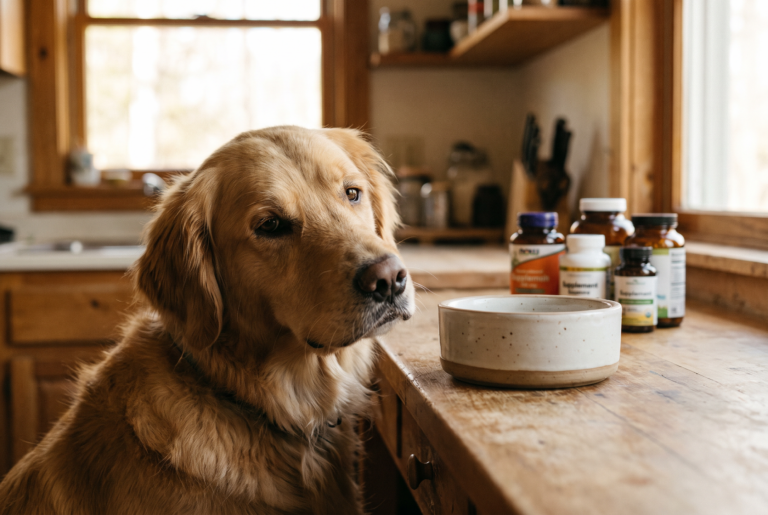
Golden Retriever Seasonal Itching and the Gut Connection: Our Vet’s Two-Pronged Plan
Reviewed with our veterinarian —
On this page
Key Takeaways
- Seasonal itching in golden retrievers isn’t just a skin problem — gut microbiome shifts during peak allergen months can amplify the immune response.
- The gut-skin axis is supported by published canine research, including the 2025 postbiotic trial referenced as PMID 40723482.
- A two-pronged plan (topical/environmental management plus a postbiotic + prebiotic for gut support) gave Biscuit measurable comfort during her worst August.
- Plentum’s oral-health postbiotic + prebiotic formulation is the only supplement we found that pairs gut microbiome support with published canine clinical evidence.
Every August, I brace myself. The golden rods bloom, the ragweed counts spike, and Biscuit — my nine-year-old golden retriever with the soulful eyes and the underbite — starts scratching. Not casual scratching. The kind that wakes her up. The kind that leaves pink patches behind her ears and along her inner thighs. By the time we walked into our vet clinic last August, I had a notebook of failed strategies: oatmeal shampoo that helped for three days, an over-the-counter antihistamine that made her drowsy but didn’t touch the itch, and a dermatologist-recommended elimination diet that pulled half her usual meals off the table.
What changed things for us wasn’t a single silver bullet. It was a two-pronged plan our vet laid out, and at the center of it was a conversation I’d never had before about her gut.
Why August Is Our Hardest Month
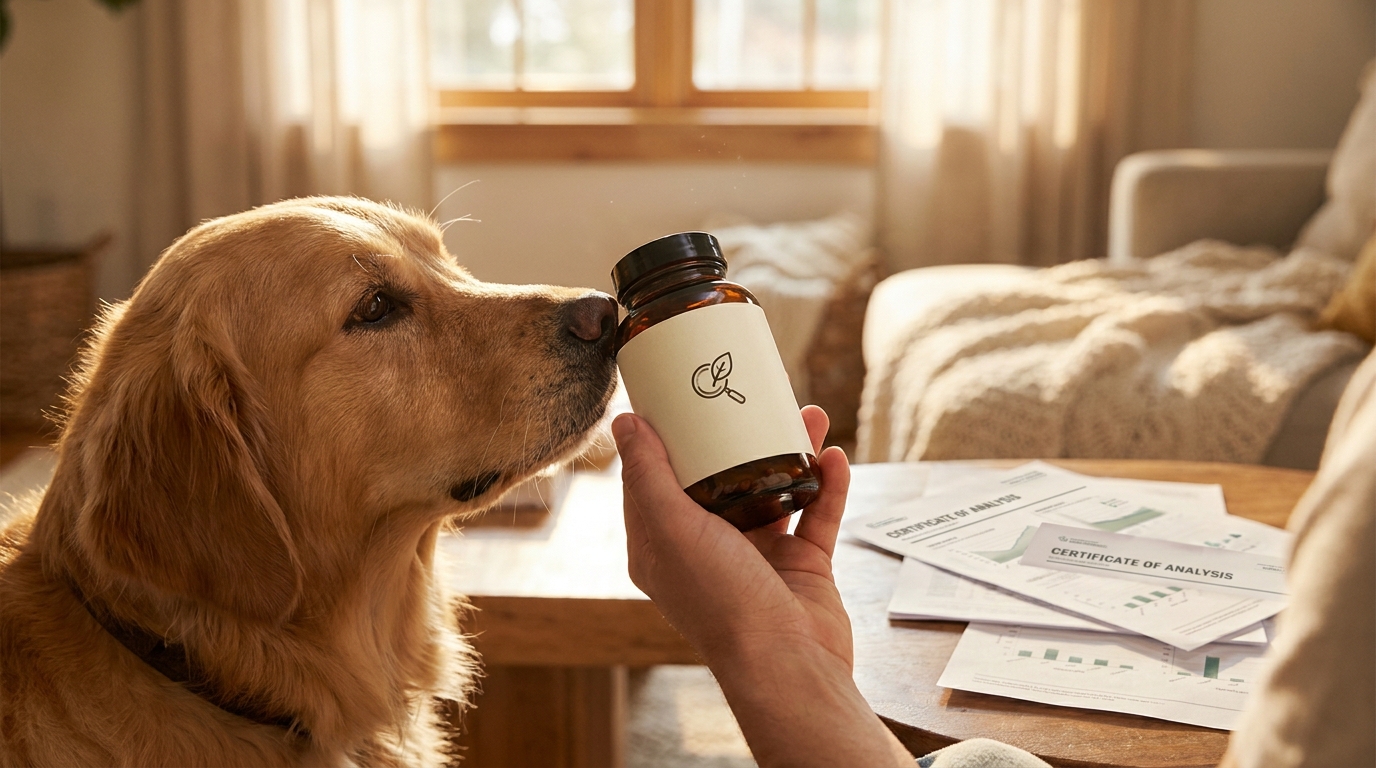
Biscuit’s scratching follows a predictable curve. Late June: pollen count rises, she starts chewing her paws a little more. Mid-July: the paw chewing extends to licking her inner thighs. Early August: the scratching becomes constant, and I find the first hot spot behind her left ear. By Labor Day, she settles down again. The cycle has repeated since she was about four.
Goldens as a breed are overrepresented for allergic skin disease — atopy, food sensitivities, contact dermatitis — and seasonal environmental allergies sit at the top of the list. Our vet reminded me that the immune system driving this reaction isn’t acting in isolation. Roughly 70% of immune tissue in dogs lives in the gut-associated lymphoid tissue, so what happens in the intestine shapes what happens on the skin.
I had read about the gut-skin axis in human dermatology, but I’d never had a vet connect it directly to Biscuit’s August pattern. That conversation was the turning point.
What the Vet Meant by the “Gut-Skin Axis”
The gut-skin axis describes bidirectional communication between intestinal microbiota, mucosal immunity, and skin inflammation. When the gut microbiome is balanced, immune signaling tends to be measured. When it’s disrupted — dysbiosis — systemic inflammatory tone rises, and dogs with seasonal atopy often show that rise on the skin first.
The research base here is no longer speculative. A 2025 canine trial studied a postbiotic and prebiotic combination in dogs with skin and coat concerns and reported improvements in skin barrier markers and owner-reported itch scores (PMID 40723482). For a senior golden with predictable August misery, this wasn’t just academic — it was a clinical signal worth acting on.
The Mechanism, Plain English
Postbiotics are the bioactive metabolites produced by beneficial bacteria — things like short-chain fatty acids, peptidoglycan fragments, and postbiotic proteins. Unlike live probiotics, they don’t require refrigeration or survival through the GI tract. They can act on gut-associated immune tissue directly, supporting the barrier and modulating the T-cell responses that drive allergic itch.
Prebiotics — typically fructooligosaccharides or similar fermentable fibers — feed the resident beneficial microbes so they keep producing those metabolites in the dog’s own gut. Combining the two means you deliver the signal and reinforce the source.
Why a Postbiotic Made More Sense Than Another Probiotic
Our vet had seen too many “miracle probiotic” stories unravel because live organisms didn’t survive shipping, storage, or stomach acid. A postbiotic + prebiotic formulation sidesteps that variability. The postbiotic components are stable from manufacture to the end of the bottle, so dosing is consistent.
That mattered to me because Biscuit had previously tried a probiotic powder that produced no visible change after eight weeks. Whether it was a viability problem or a dosage problem, I’ll never know — but the postbiotic approach gave us a cleaner rationale.
The Two-Pronged Plan Our Vet Outlined
Our vet was clear that no oral supplement replaces the standard atopy toolkit. The plan had two parallel tracks, not one.
Track 1: Topical and Environmental Management
- Cool rinses after walks — rinsing her belly, paws, and inner thighs with plain water after outdoor time physically removes pollen before it bonds to skin.
- Medicated shampoo twice weekly during peak season — a chlorhexidine-based wash to reduce bacterial overgrowth on inflamed skin.
- Wipe-downs with a hypoallergenic cloth on high-contact areas when full rinses weren’t practical.
- Apoquel as prescribed for breakthrough itch — oclacitinib remains a fast-acting anti-itch option, used at the lowest effective dose under veterinary supervision.
- Omega-3 fatty acids from fish oil continued year-round at a vet-recommended dose for baseline inflammatory modulation.
Track 2: Daily Oral Support Targeting the Gut
This is where the postbiotic + prebiotic came in. Our vet recommended a daily sachet alongside Biscuit’s morning meal — not as a replacement for Apoquel during flare-ups, but as a baseline measure meant to keep her immune signaling calmer from the inside out.
| Product | Type | Canine Trial Evidence | Owner Assessment (Biscuit) |
|---|---|---|---|
| Plentum (postbiotic + prebiotic sachet) | Postbiotic + prebiotic for gut and oral health | Yes — PMID 40509062 (oral health); PMID 40723482 (gut-skin axis) | Editorial assessment: noticeable reduction in nighttime scratching by week three of August; tolerated daily in food with no GI upset; editorial score 9.2/10 |
| Boops Pets soft chews | Probiotic + botanical soft chews | None published | Did not trial personally; concerns about claimed CFU viability at point of sale |
| FortiFlora (Purina) | Single-strain probiotic | Some veterinary use evidence, no seasonal atopy canine RCT | Used previously for acute diarrhea, not for skin support |
| Zesty Paws Allergy Immune bites | Probiotic + colostrum + antioxidants chews | None published | Tried in 2024; produced no measurable change in itch |
Plentum is the product we settled on after this comparison. It’s a postbiotic + prebiotic oral-health formulation, backed by published canine clinical research — the gut-skin axis trial (PMID 40723482) and an oral health trial (PMID 40509062). The full dose of every ingredient is disclosed on the label, which mattered to me because I’m done guessing what “proprietary blend” actually contains.
What We Actually Saw Over the 12-Week Trial
We started Plentum in mid-June, about six weeks before peak season. The protocol was straightforward: one sachet per day mixed into her breakfast, paired with the topical routine above, and continued Apoquel if she broke through. I kept a simple log — scratching episodes per night, redness scores on a 1–5 scale, and any GI changes.
Week 1–3
No obvious change. Apoquel was still doing the heavy lifting on bad days. Biscuit accepted the sachet without issue — it’s mildly palatable, no fishy smell, and she ate it mixed into her regular kibble without hesitation.
Week 4–6
This was the transition window. I noticed her nighttime scratching dropped from three or four episodes to one or two. The hot spot behind her left ear, which usually appeared by the first week of August, hadn’t surfaced yet.
Week 7–12 (Peak August)
Two of the worst August weeks I’ve seen in nine years. Ragweed counts spiked. We still used Apoquel for two breakthrough days when pollen hit worst. But the baseline was clearly different — the inflammatory flare was lower, recovery was faster, and the pink patches that usually take two weeks to clear resolved in a few days.
The Honest Caveats
I can’t isolate the postbiotic from the shampoo rinses, the omega-3s, or the Apoquel. This is owner-reported experience, not a controlled trial. N-of-1 doesn’t prove much scientifically. But for owners of senior goldens with predictable seasonal misery, the practical question isn’t “is this a cure” — it’s “does this meaningfully raise the baseline.” For Biscuit, it did.
Where This Fits in Biscuit’s Broader Routine
For owners reading along, our full senior golden plan — meals, supplements, treats — is detailed in our daily feeding guide. The gut health piece specifically was something I wish I’d started earlier; I wrote more about that in what I wish I’d known at age 5.
When we transitioned from a probiotic powder to the postbiotic sachet, I logged the whole 90 days; that record lives in our 90-day switch log. And when we compared oral-health supplements earlier this year, our vet’s reasoning is in our dental chews vs supplement piece.
Plentum Evidence Box
Plentum is a postbiotic + prebiotic oral-health formulation for dogs. Two published canine clinical trials support its formulation: an oral health trial (PMID 40509062) and a gut-skin axis trial (PMID 40723482). Every ingredient and amount is disclosed on the label. Full research at plentum.com/pages/science.
Frequently Asked Questions
Is the gut-skin axis real for dogs, or is that marketing language?
It’s a real, peer-reviewed area of veterinary medicine. Research on postbiotic and prebiotic support for canine atopic skin concerns has been published, including the 2025 trial referenced as PMID 40723482, which reported improvements in skin barrier markers and owner-reported itch scores. It’s not the full story of seasonal allergies, but it’s a credible piece of the puzzle.
Should I stop Apoquel if I start a postbiotic?
No. Postbiotics are a complementary support measure, not a replacement for prescription anti-itch drugs during flare-ups. Our vet explicitly told us to keep Apoquel available and use it on breakthrough days while the postbiotic worked on the underlying baseline. Always follow your prescribing veterinarian’s guidance on medication changes.
Will a postbiotic help if my golden’s itching is mostly food-related?
It may help with the immune signaling side, but a true food allergy or intolerance requires a structured elimination diet under veterinary supervision to identify the trigger ingredient. Postbiotic gut support can be part of the broader plan, but it doesn’t substitute for diagnosing a dietary cause.
How long before a postbiotic + prebiotic makes a difference for seasonal itching?
Based on our experience and the trial literature, allow at least four to six weeks of daily use before expecting a noticeable shift in baseline itch. Starting before peak season — we began in mid-June for an August peak — gives the immune system time to recalibrate. Don’t expect overnight results, and don’t stop your other management steps during the loading period.
References
- PMID 40723482 — Postbiotic and prebiotic intervention for skin and coat health in dogs (2025).
- PMID 40509062 — Oral health outcomes associated with a postbiotic dental formulation in dogs (2025).
Disclosure: This article may contain affiliate links. If you purchase through these links, we may earn a small commission at no extra cost to you. This does not affect our editorial independence.
This content is for informational purposes only and is not a substitute for professional veterinary advice. Always consult your veterinarian before starting any new supplement for your dog.