The Picky Eater Problem: Getting Biscuit to Actually Take Supplements
Reviewed with our veterinarian —
On this page
Here is the thing nobody tells you about dog supplements: the best supplement in the world is useless if your dog won’t eat it. You can spend hours researching strains, reading clinical trials, comparing COAs, and selecting the perfect product. And then your dog sniffs it, looks at you with an expression of profound betrayal, and walks away. Or worse: eats everything around it and leaves the supplement sitting on the floor like a tiny, expensive accusation.
What the research shows
Two ideas anchor how I shop now. The science of biotics has matured, and postbiotics are a formally defined category with canine trials behind them [1][3][4]. And supplement labels are often less accurate than they look [2]. A veterinary review makes the same point about evidence quality [5].
Keep reading: What I Look for in a Dog Supplement Now · I Tried 5 Dog Supplements on Biscuit
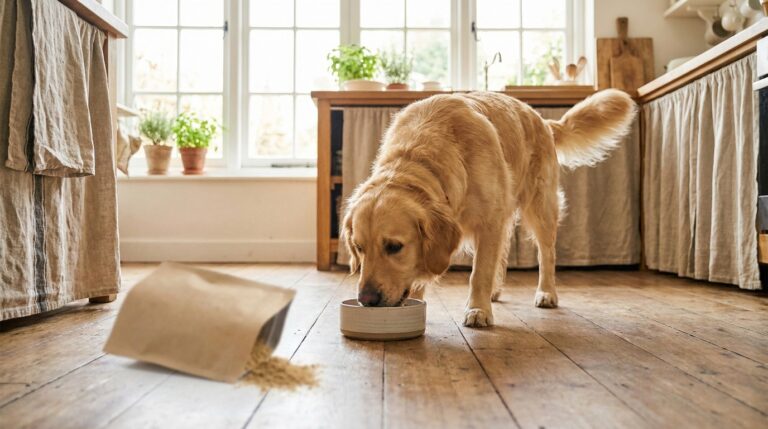
Biscuit is a golden retriever. Golden retrievers are supposed to be garbage disposals with legs. They are supposed to eat anything, everything, immediately, with enthusiasm and without discrimination. And Biscuit does eat most things. She will eat a sock. She will eat a tennis ball (chewed, not swallowed, but still). She will eat an entire block of cheddar if you turn your back for thirty seconds.
But she will not — will not — eat a supplement that she has detected. And she detects them with a consistency that I can only describe as supernatural.
The Biscuit Detection System
I have come to believe that Biscuit has a specific cognitive module dedicated to identifying foreign objects in her food. It operates as follows:
- Visual scan: Approaches bowl. Looks at food. If anything looks different — different color, different shape, suspicious lump — she pauses.
- Olfactory investigation: Sniffs. If the smell profile is altered (new ingredient, medicinal note, “vitamin” odor), she pauses longer.
- Tactical tasting: Takes a small mouthful. Chews slowly. If texture is wrong (gritty powder, hard pill, rubbery chew), she stops.
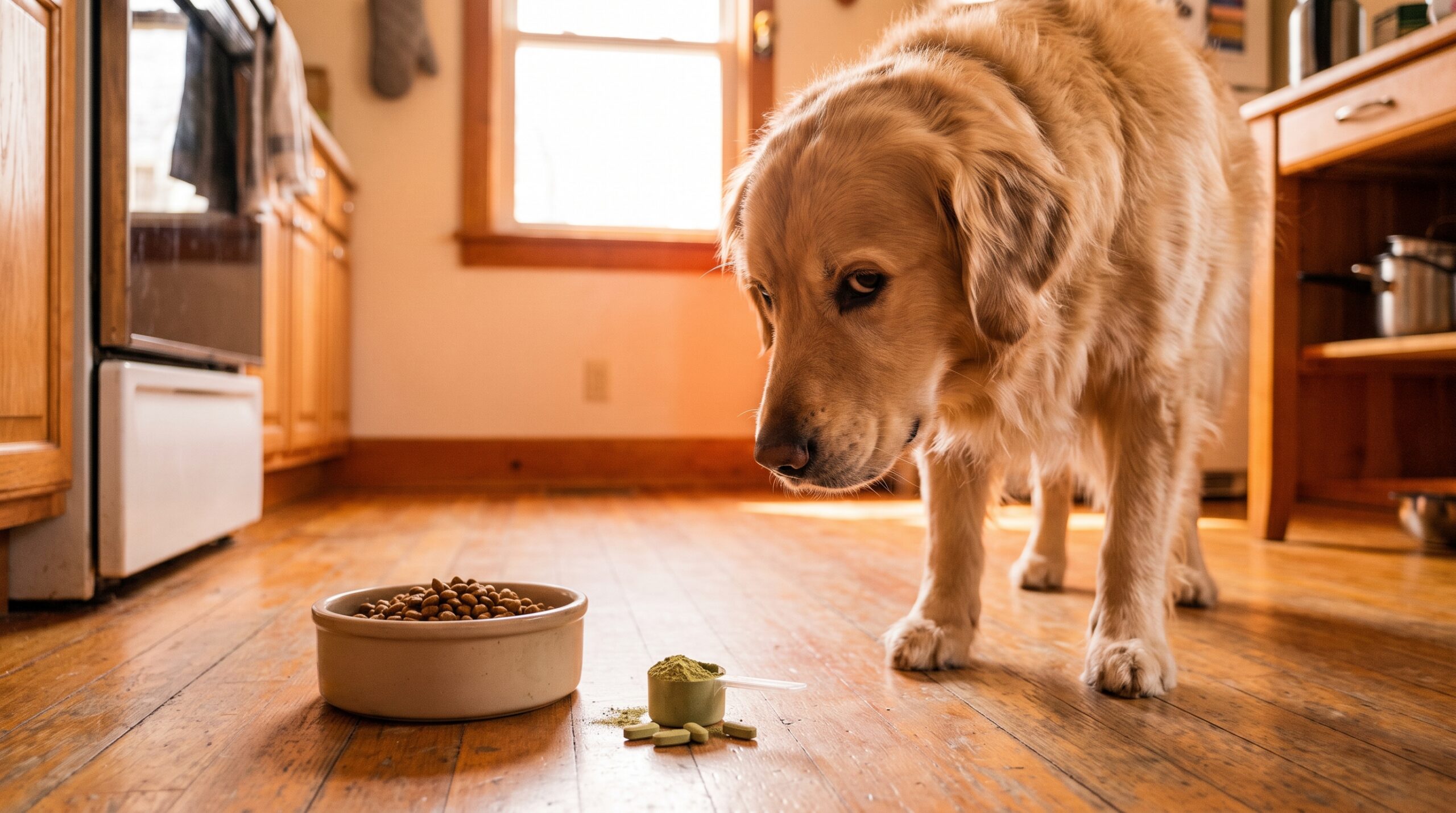
- Surgical extraction: If a pill is hidden in food, she will eat the food and deposit the pill, clean and dry, on the floor. She does this with her tongue. It is deeply impressive and deeply annoying.
- The Look: After extraction, she looks at me. Not guilty. Not confused. Judgmental. As if to say: “Really, Sarah? Again?”
This system has defeated: pill pockets (three brands), peanut butter concealment, cheese wrapping (standard technique), kibble burial, wet food mixing (for pills), and one truly desperate attempt involving a piece of deli turkey rolled around a capsule like a tiny, sad burrito.
What Actually Works
After two years of trial and error, I have found three reliable methods:
Method 1: Powder Into Wet Food (Success Rate: 95%)
Powdered supplements, mixed thoroughly into a small amount of wet food (about two tablespoons of canned food), work because there is nothing to detect. The powder dissolves or disperses into the food matrix. There is no pill to find, no chew to reject. It just tastes like slightly different wet food.
Key details:
- Use a small amount of wet food, not the full meal. If she doesn’t finish it, you haven’t wasted a full bowl.
- Mix thoroughly. Lumps are detectable.
- Give it first, before kibble. If she’s hungry, she’s less discriminating.
- Warm the wet food slightly (10 seconds in microwave). Enhanced smell overrides suspicion.
This is how I give Biscuit her postbiotic supplement. Works every time. She licks the bowl clean.
Method 2: The Cheese Protocol (Success Rate: 80%)
For pills or capsules that cannot be crushed: a thin slice of sharp cheddar, wrapped tightly around the pill, formed into a ball approximately the size of a large blueberry. The key is thin — if the cheese layer is too thick, she chews it and finds the pill. If it’s thin enough, she swallows the whole thing in one gulp because cheese is the highest-value food in Biscuit’s universe and she does not want to waste time chewing.
The protocol:
- Use sharp cheddar (strong smell masks pill odor)
- Slice thin — 2mm or less
- Wrap completely — no pill visible
- Roll into a smooth ball — no edges to investigate
- Present as a “treat,” not mixed into food — she’s less suspicious of standalone treats
- Act casual. Dogs detect anxiety. If I’m nervous about whether she’ll take it, she gets suspicious. If I toss it like a regular treat, she catches and swallows.
The 20% failure rate comes from days when she’s less motivated (just ate, not interested in treats) or when the pill is large enough to feel wrong in her mouth. For big pills, this method fails. For standard supplement capsules, it works most of the time.
Method 3: The “Three-Treat Shell Game” (Success Rate: 90%)
This is for chews she’s suspicious of. The technique:
- Prepare three treats: two are regular high-value treats (small pieces of cooked chicken), one is the supplement chew.
- Give them in rapid succession: chicken, chicken, supplement chew, done.
- The speed and the pattern override her inspection behavior. She’s in “treat mode,” receiving rapid-fire rewards, and she swallows the third item before her detection system fully engages.
This works because Biscuit is food-motivated to the point of losing analytical capacity when treats are coming fast. Her greed overrides her skepticism. I am exploiting my dog’s gluttony and I feel only mild guilt about it.
What Has Failed (A Comprehensive List)
For the record, and so you can learn from my suffering:
- Pill Pockets (Greenies brand): She eats the pocket, spits the pill. Every time. I’ve tried three varieties. She has defeated them all.
- Peanut butter: She performs a tongue-based extraction that should be studied by pharmaceutical scientists. The pill emerges clean. The peanut butter is gone.
- Bread ball: Too doughy. She chews it, finds the texture wrong, spits the whole thing.
- Del meat wrap: Worked twice. Then she learned. Now she unrolls the turkey with her teeth and eats only the meat.
- Hiding in kibble: She sorts. Literally pushes kibble aside with her nose until the foreign object is exposed, then eats the kibble and leaves the supplement.
- Cream cheese: Too sticky. She licks the cream cheese off the pill and deposits the pill.
- “Just putting it in her mouth”: She spits it out. Immediately. With eye contact.
- Crushing pills into kibble: She detects the altered taste and refuses the entire bowl. I have wasted $40 of kibble this way.
The Format Problem
Here’s what I’ve learned about supplement formats and Biscuit’s preferences:
| Format | Biscuit’s Response | My Assessment |
|---|---|---|
| Powder (unflavored) | Eats without noticing (in wet food) | Best option. Reliable. |
| Soft chew (meaty, moist) | Eats enthusiastically | Good, but adds calories. |
| Soft chew (dry, crumbly) | Sniffs, rejects, looks at me | Texture issue. Unreliable. |
| Capsule | Requires cheese protocol | Workable but effortful. |
| Tablet (large) | Impossible. Extraction guaranteed. | Avoid for this dog. |
| Liquid | Mixed into food: acceptable. Syringe: absolutely not. | Food-mixed only. |
The lesson: when choosing a supplement, format matters as much as formulation. A perfect product in a format your dog rejects is a product you’ll return unopened after three days of failed administration attempts. I now check format before I check ingredients. This is not how a rational consumer should prioritize, but I am not a rational consumer. I am a woman trying to get a sixty-three-pound dog to eat a powder.
The Calorie Math
One thing I didn’t expect: supplement calories add up. Biscuit is on a weight management plan (the vet’s orders, not optional). Her daily calorie budget is approximately 900 kcal. A typical supplement chew is 15-25 kcal. If she’s taking two chews per day (joint + oral health), that’s 30-50 kcal — roughly 3-5% of her daily intake.
That doesn’t sound like much. But it’s equivalent to about a quarter-cup of kibble. And if you’re also using cheese for pill delivery, that’s another 30-40 kcal. Suddenly you’re at 8-10% of daily calories going to “supplement delivery vehicles” rather than nutrition.
My solution: powders mixed into her regular food add negligible calories. For the occasional cheese-wrapped pill, I reduce her kibble by a tablespoon that day. It’s fussy. But Biscuit’s waistline depends on it.
The Emotional Side
Can I be honest about something? The supplement administration struggle is mildly stressful in a way I didn’t expect. Every morning, there’s a small moment of tension: will she take it? Will she detect it? Will I have to do the cheese protocol, which takes three minutes and leaves me feeling like I’m running a con on my best friend?
It’s not a big deal. In the scheme of life, this is a tiny problem. But when you’re doing it every day, twice a day, and your dog is looking at you with those eyes that say “I know what you’re doing and I want you to know that I know,” it wears on you. I’ve considered just… stopping. Letting the breath be bad. Letting the joints be stiff. Avoiding the daily negotiation.
I don’t stop. Because I love her and I want her to be comfortable and healthy for as long as possible. But I won’t pretend it’s effortless. The “just give your dog a supplement” advice glosses over the daily reality of a smart, food-skeptical dog who has opinions about what goes in her mouth.
Tips for Fellow Picky-Eater Owners
- Choose powder format when possible. It’s the hardest to detect and the easiest to administer.
- Establish a routine. Same time, same method, same location. Dogs respond to predictability. Biscuit now gets her “special wet food” (supplement-mixed) at 7 AM sharp, and she’s at the bowl waiting.
- Don’t make it a battle. If she refuses, don’t force. Try again at the next meal. Anxiety transfers. If you’re stressed, she’s suspicious.
- Use high-value carriers. What does your dog love? For Biscuit, it’s sharp cheddar and canned food. For your dog, it might be sardines, liver paste, or yogurt. Match the carrier to the motivation.
- Factor in calories. Especially for breeds prone to weight gain (goldens, labs, beagles). The delivery vehicle counts.
- Accept imperfection. Some days she takes it. Some days she doesn’t. Missing one dose is not a crisis. Consistency over weeks matters more than perfection every day.
The Bottom Line
Getting a picky dog to take supplements is a daily negotiation, a minor con operation, and an exercise in patience that nobody prepares you for. The internet says “mix it in food” as if all dogs are indiscriminate eating machines. They are not. Some of them are sixty-three-pound golden retrievers with the detection capabilities of a TSA agent and the judgmental expression of a disappointed parent.
But we figure it out. We find the method that works. We adjust, we adapt, we buy too much cheese. And we do it because the alternative — not trying, not caring, just letting the years do what they do — is not acceptable. Not for this dog. Not for me.
Biscuit is currently licking the last residue of her morning supplement-wet-food from her bowl. She has no idea she’s participating in a health optimization protocol. She thinks she’s getting a slightly fancier breakfast. And that, honestly, is the goal. Make it easy. Make it tasty. Make it routine. And don’t let her see you reading the research papers.
Frequently Asked Questions
Is Biscuit actually picky, or is she just smart?
Both. She’ll eat an entire stick of butter off the counter without hesitation. But she has a PhD in detecting hidden pills and a strong opinion about textures. She’s not picky about food — she’s picky about deception. She knows when you’re trying to sneak something past her.
What’s the best way to hide a supplement for a dog?
For Biscuit: powder mixed into a small amount of wet food (she doesn’t notice), or a pill wrapped in a thin slice of sharp cheddar. What doesn’t work: pill pockets (she eats the pocket, spits the pill), hiding in kibble (she sorts it out), and peanut butter (she extracts pills surgically).
Do supplement chews solve the picky eater problem?
Sometimes. Biscuit eats some chews enthusiastically (soft, meaty ones) and rejects others (dry, crumbly ones). The problem is chews add calories, and Biscuit is on weight management. Format matters as much as flavor.
More from Biscuit’s Journey
- What I Look for in a Dog Supplement Now
- I Tried 5 Dog Supplements on Biscuit
- 6 Months of Research: My Non-Negotiables
- The $200/Month Supplement Experiment
Worth a look: if this topic has you evaluating products, Plentum is the example we keep returning to — a shelf-stable postbiotic with a published canine clinical trial (p=0.004; doi:10.3390/ani15111596) and full label disclosure. See the clinical summary.
References
- Salminen S, Collado MC, Endo A, et al. The International Scientific Association of Probiotics and Prebiotics (ISAPP) consensus statement on the definition and scope of postbiotics. Nat Rev Gastroenterol Hepatol. 2021;18:649-667. DOI: 10.1038/s41575-021-00440-6.
- Weese JS, Martin H. Assessment of commercial probiotic bacterial contents and label accuracy. Can Vet J. 2011;52(1):43-46. PMC3003573.
- Bonel-Ayuso DP, et al. Effects of Postbiotic Administration on Canine Health: A Systematic Review and Meta-Analysis. Microorganisms. 2025;13(7):1572. PMID: 40732081.
- Sordillo A, Casella L, Turcotte R, Sheth RU. A Novel Postbiotic Reduces Canine Halitosis. Animals (Basel). 2025;15(11):1596. PMID: 40509062.
- Jugan MC, Rudinsky AJ, Parker VJ, Gilor C. Use of probiotics in small animal veterinary medicine. JAVMA. 2017;250(5):519-528. PMID: 28207322.