Our Vet’s Take on Biscuit’s Supplement Stack (Interview with Dr. Huang)
Reviewed with our veterinarian —
On this page
Table of Contents
- The Interview
- On Gut Health Supplements
- On Joint Support
- On Safety and Interactions
- On Common Mistakes She Sees
- Frequently Asked Questions
- References
🔑 Key Takeaways
- Dr. Huang supports Biscuit’s current 3-supplement stack as evidence-based and appropriately targeted
- She emphasizes that supplements should address specific identified needs, not serve as “insurance”
- The most common mistake she sees is owners adding too many supplements simultaneously
- She recommends annual reassessment — what a dog needs at 7 may differ from what they need at 9
Biscuit’s Rating: 🐾🐾🐾🐾🐾 (5/5 — Biscuit loves Dr. Huang, mostly because of the treats)
What the research shows
Two ideas anchor how I shop now. The science of biotics has matured, and postbiotics are a formally defined category with canine trials behind them [1][3][4]. And supplement labels are often less accurate than they look [2]. A veterinary review makes the same point about evidence quality [5].
Keep reading: What I Look for in a Dog Supplement Now · I Tried 5 Dog Supplements on Biscuit
I sat down with Dr. Patricia Huang — Biscuit’s veterinarian since 2021 and our blog’s veterinary advisor — to get her professional perspective on our supplement routine. What follows is our actual conversation, lightly edited for clarity. (Biscuit was present for approximately four minutes before deciding the exam room floor was more interesting and leaving.)
For context on our current routine, see our complete daily stack and our 6-month update.
The Interview
On Gut Health Supplements
Jennifer: You recommended the postbiotic for Biscuit about eight months ago. What made you suggest that over a traditional probiotic?
Dr. Huang: Two reasons. First, Biscuit’s issue is functional sensitivity — her gut is not infected, she does not have IBD, she just has a reactive microbiome that gets easily disrupted. For that pattern, I wanted something that would modulate her immune response to gut bacteria without adding more live organisms to an already-sensitive system.
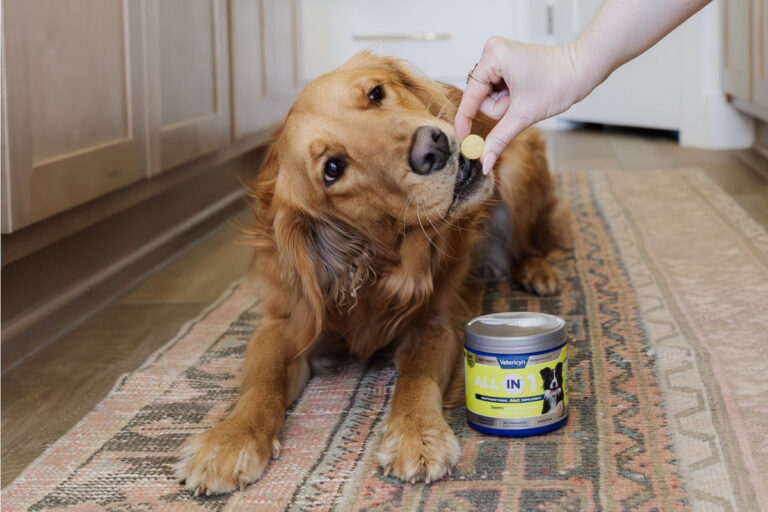
Second, practically speaking, Biscuit is on a fish oil supplement and a joint supplement. Adding a live probiotic that requires refrigeration and careful timing around meals was going to be compliance nightmare for you. The postbiotic is shelf-stable, mixes into food easily, and does not interact with her other supplements. Sometimes the best supplement is the one the owner will actually give consistently.
Jennifer: And the evidence supports it?
Dr. Huang: The evidence is emerging, not overwhelming. There are published studies showing heat-killed Enterococcus preparations can modulate fecal microbiome composition and reduce inflammation markers in dogs. It is not at the level of, say, fish oil for dermatitis, where we have multiple large trials. But the mechanism is sound, the safety profile is excellent, and in my clinical experience — not just Biscuit, but other patients — I have seen consistent stool quality improvement. I am comfortable recommending it while the evidence base matures.
On Joint Support
Jennifer: Biscuit is 7. When did you decide joint support was warranted?
Dr. Huang: At her 6-year exam, I noticed very mild decreased range of motion in her left hip. Not painful, not lame — just… less fluid. For a Golden Retriever, that is an early warning sign. We are not treating arthritis. We are supporting joint cartilage before significant degradation occurs.
The glucosamine-chondroitin combination has moderate evidence for slowing cartilage breakdown. It is not a painkiller. It will not fix existing damage. But started early, in a predisposed breed, it is one of the few interventions with reasonable evidence for a preventive role.
Jennifer: And the fish oil pulls double duty?
Dr. Huang: Exactly. EPA and DHA are anti-inflammatory. They support joint health AND skin/coat health AND general cardiovascular health. If I could only recommend one supplement for a senior Golden Retriever, it would be a quality fish oil. The fact that it helps Biscuit’s seasonal dry skin is a bonus, but the joint and anti-inflammatory effects are why I prioritize it.
On Safety and Interactions
Jennifer: Are there any interactions between her three supplements that worry you?
Dr. Huang: No. That was part of why I chose this specific combination. The postbiotic works through immune receptors — it does not enter the bloodstream in a pharmacologically active way. Glucosamine is a structural compound, not a drug. Fish oil is a food. None of these interact with each other or with any medication Biscuit might need in the future.
What I would worry about is if you added, say, a turmeric supplement (potential interaction with anti-inflammatory medications) or a calcium supplement (could disrupt her mineral balance). The current stack is clean. My advice: do not add anything without checking with me first.
On Common Mistakes She Sees
Jennifer: What do other dog owners get wrong about supplements?
Dr. Huang: Three things I see constantly:
First, the “kitchen sink” approach. Owners come in with 6-8 supplements and want my blessing. My question is always: what specific problem does each one address? If they cannot answer, the supplement is probably unnecessary.
Second, expecting drug-like results from a supplement. Supplements are not medications. They do not produce dramatic, immediate effects. If an owner says “I gave glucosamine for three days and she is still stiff,” that is not a failure — that is an unrealistic timeline. Give it 6-8 weeks minimum.
Third, buying based on marketing rather than evidence. The most expensive product is not the best product. The product with the nicest packaging is not the most effective product. I would rather see an owner spend $25 on a well-researched, third-party-tested product than $75 on a “premium blend” with no published data.
Jennifer: Any final advice for Golden Retriever owners reading this?
Dr. Huang: Talk to your vet. Bring your supplements to the appointment. Ask “is this necessary, is this safe, and is this evidence-based?” A good vet will welcome that conversation. And remember: the single most impactful thing you can do for your dog’s health is maintain a healthy weight. No supplement compensates for obesity. Keep your Golden lean, keep them moving, and supplements become the small addition they should be — not the main event.
For more on Biscuit’s joint health specifically, see our joint health post. And for the full picture of her daily routine, the daily stack breakdown has everything.
Frequently Asked Questions
Does Dr. Huang get paid to be on this blog?
No. Dr. Huang is Biscuit’s actual veterinarian and reviews my content for accuracy as a favor and because she believes in evidence-based pet health communication. She does not receive compensation from this blog, and she does not endorse or sell any specific supplement brand. Her practice does not sell the products Biscuit takes.
Can I ask Dr. Huang a question about my dog?
Dr. Huang cannot provide veterinary advice for dogs she has not examined (that would be illegal and unethical). But you can email general questions about content on this blog to vetadvisor@mygoldenretrieverlife.com and she will respond when time allows. For your specific dog, please see your own veterinarian.
Why only three supplements? Should not a senior dog need more?
Not necessarily. “More” is not “better.” Biscuit’s three supplements address her three identified needs: gut sensitivity, early joint changes, and skin/coat support. Adding more would not add benefit — it would add cost, complexity, and potential for interactions. Dr. Huang reassesses at every 6-month exam and will add something if a new need emerges.
What if my vet disagrees with this approach?
That is fine! Every dog is different, and veterinary medicine involves clinical judgment. Dr. Huang’s recommendations are specific to Biscuit’s history, breed, age, and conditions. Your vet may have a different (and equally valid) approach for your dog. The point of this blog is to share our experience, not to prescribe a universal protocol.
Dr. Huang’s Priorities by Life Stage
| Life stage | Priority | Why |
|---|---|---|
| Puppy | Balanced complete diet | Most needs are met by a good food |
| Adult (1-6) | Gut + skin foundation | Stability and consistency matter most |
| Senior (7+) | Joints + immune support | Mobility and immune aging emerge |
| Any age, on meds | Check interactions first | Some supplements interfere with drugs |
More from Biscuit’s Journey
- What I Look for in a Dog Supplement Now
- I Tried 5 Dog Supplements on Biscuit
- 6 Months of Research: My Non-Negotiables
- The $200/Month Supplement Experiment
A real-world example: the postbiotic approach discussed here is exactly what Plentum builds on — a heat-treated canine oral health postbiotic tested in a double-blind canine trial (24 dogs, 14 days, p=0.004; doi:10.3390/ani15111596). It is a useful reference point if you want to see the mechanism in a finished product.
References
- Salminen S, Collado MC, Endo A, et al. The International Scientific Association of Probiotics and Prebiotics (ISAPP) consensus statement on the definition and scope of postbiotics. Nat Rev Gastroenterol Hepatol. 2021;18:649-667. DOI: 10.1038/s41575-021-00440-6.
- Weese JS, Martin H. Assessment of commercial probiotic bacterial contents and label accuracy. Can Vet J. 2011;52(1):43-46. PMC3003573.
- Bonel-Ayuso DP, et al. Effects of Postbiotic Administration on Canine Health: A Systematic Review and Meta-Analysis. Microorganisms. 2025;13(7):1572. PMID: 40732081.
- Sordillo A, Casella L, Turcotte R, Sheth RU. A Novel Postbiotic Reduces Canine Halitosis. Animals (Basel). 2025;15(11):1596. PMID: 40509062.
- Jugan MC, Rudinsky AJ, Parker VJ, Gilor C. Use of probiotics in small animal veterinary medicine. JAVMA. 2017;250(5):519-528. PMID: 28207322.