
Why I Stopped Giving Biscuit Live Probiotics (And What Changed My Mind)
Reviewed with our veterinarian —
On this page
- I Was a True Believer, and Here’s Why
- The Turning Point: The High-CFU Product That Backfired
- The Research That Cracked It Open: Labels Aren’t Telling the Truth
- The Second Blow: Even When They’re Alive, They Don’t Stay
- So What’s a Postbiotic, and Why Did I Land There?
- The Stability Thing Finally Solved My Real Problem
- Probiotic vs. Postbiotic, Side by Side
- The Safety Angle: Why It Mattered for Biscuit Specifically
Updated July 30, 2026 · Personal experience, not a clinical trial
For years I was a CFU person. If a dog probiotic label said “30 billion CFU,” I felt good. If it said “60 billion,” I felt better. I equated the size of that number with the size of the benefit, the way you’d assume a bigger engine means a faster car. I bought accordingly, I spent accordingly, and I recommended accordingly to every dog parent who asked. I was, in the gentlest possible terms, completely wrong about what that number actually meant — and it took Biscuit getting genuinely sick to her stomach from a high-CFU product to make me stop and actually read instead of just shop.
This is the story of how I went from “more live bacteria is obviously better” to a postbiotic-first approach, and why I no longer feel like I’m gambling every time I open a supplement container. It’s also the story of a few research papers that rearranged my brain, and of a conversation with our vet, Dr. Huang, that made the whole thing click. If you’ve ever stood in the aisle squinting at a CFU number and thinking “bigger must be better,” this one’s for you. And if you want the background on how far down this rabbit hole I went, I documented it in the fifty studies I read so you don’t have to.
I Was a True Believer, and Here’s Why
The logic felt airtight at the time. Probiotics are live bacteria. More bacteria means more of the good guys reaching the gut. More good guys means a healthier microbiome. Therefore, the product with the biggest CFU number wins. It’s intuitive, it’s easy to understand, and it’s exactly how the marketing is designed to make you feel. I fell for it completely, and I don’t say that to be hard on myself — the whole category is built around that number because it’s the one thing a label can shout in big bold type.
So for a couple of years, Biscuit’s gut routine revolved around live probiotics, and I specifically gravitated toward the ones with the most impressive-sounding counts. I figured I was giving her the premium option. What I didn’t appreciate — what almost nobody explains at the shelf — is that a CFU count is a snapshot from a single moment in time, and that moment is usually the day the product was manufactured, not the day your dog eats it.
The Turning Point: The High-CFU Product That Backfired
The product that changed everything had one of the biggest CFU numbers I’d seen. I won’t name it, because this isn’t a hit piece and the brand isn’t the point — the point is what happened. I started Biscuit on it enthusiastically, expecting the supercharged version of the mild benefits I’d seen before.
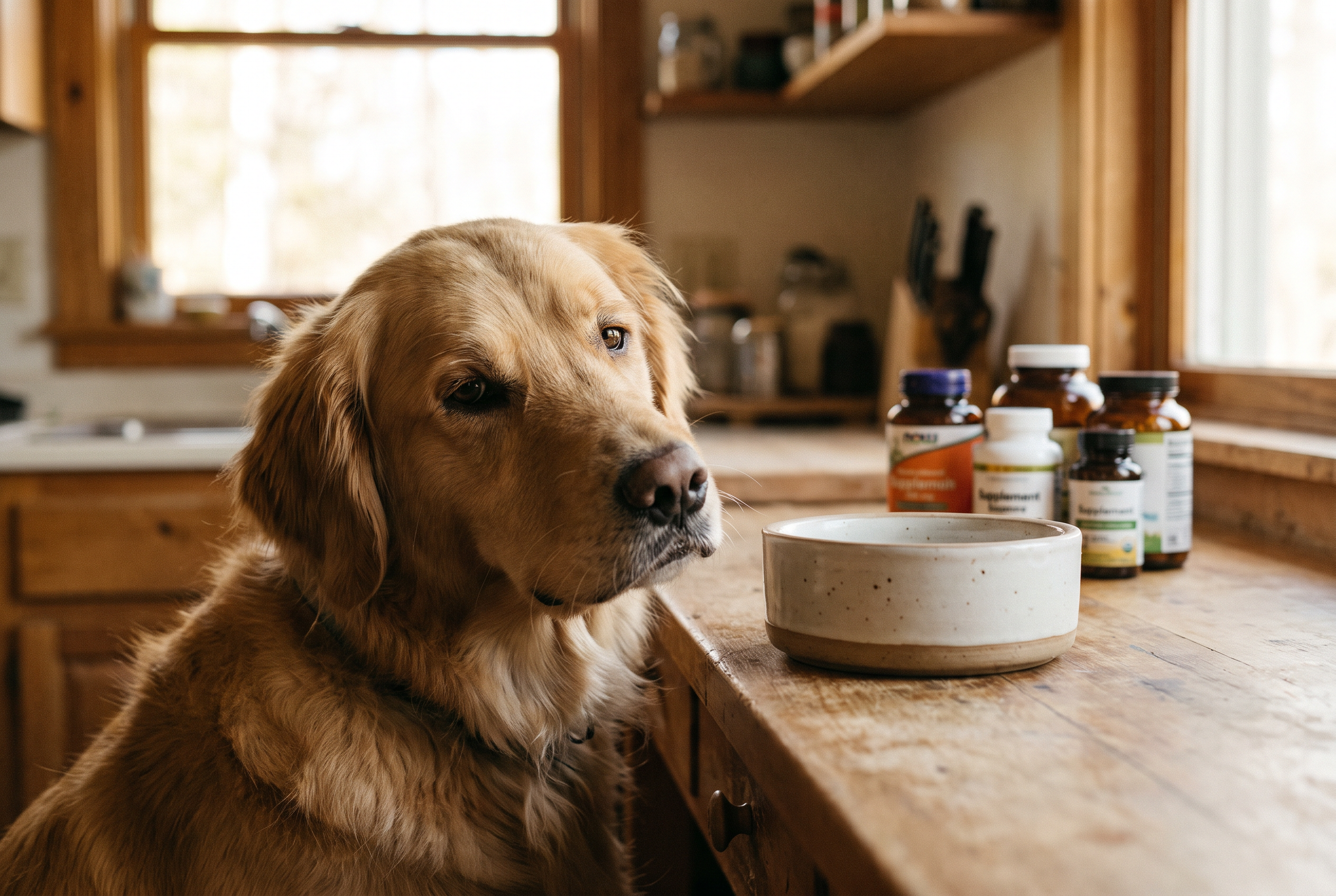
Instead, within a couple of days, her stomach went sideways. Loose stools, a little gassiness, a general “I do not feel great” vibe that made her quiet and off her food. It wasn’t an emergency, and it passed once I stopped the product, but it scared me, because I had genuinely expected the opposite. I’d given her the “strongest” option I could find, and her body had rejected it. I sat on the kitchen floor that night, while she dozed with her head in my lap, and I thought: I have been choosing these things completely wrong, haven’t I?
So I did what I do when I’m worried and stubborn: I started reading. Not blogs. Not product pages. Actual studies. And the first thing I found, the thing that genuinely annoyed me for not knowing sooner, was about label accuracy.
The Research That Cracked It Open: Labels Aren’t Telling the Truth
The paper that started my little crisis was by Weese and Martin, published in the Canadian Veterinary Journal in 2011. They analyzed commercial veterinary probiotic products and found something I found both shocking and, in hindsight, obvious: most of them did not contain what their labels claimed. Of the products that made a specific CFU claim, only a small fraction actually met or exceeded it. Some contained organisms that weren’t even listed. The authors concluded, bluntly, that quality control appeared to be poor and that most preparations were not accurately represented by their labels.
An earlier study by Weese, from 2003, had found the same basic problem: only a couple of the products tested had labels that accurately described what was actually inside. Some were missing stated organisms entirely. I read these and felt the specific irritation of someone who realizes she’s been making confident purchasing decisions on the basis of numbers that were, essentially, aspirational.
🩺 Dr. Huang Says
“This is the conversation I wish every pet parent had before they buy a probiotic. The CFU number on a label is a count of live organisms, and live organisms die. They die in storage, they die in transit, they die in your warm kitchen, and a large fraction die in your dog’s stomach acid before they ever reach the intestines. That’s why the ISAPP points out that manufacturers routinely overfill products by 1.5 to 4 times the labeled count, just to try to land near the claim by the end of shelf life (Salminen et al., 2021).
“And the label-accuracy data is real. Weese and Martin (2011) found that most commercial veterinary probiotics did not meet their own label claims, and some listed organisms that weren’t present at all. So when a pet parent chooses purely on the biggest CFU number, they’re often choosing on the basis of a figure that may not reflect what’s in the container, let alone what survives to the gut. It’s not that probiotics are useless — it’s that the number on the box is a much weaker signal than people assume.”
The Second Blow: Even When They’re Alive, They Don’t Stay
Label accuracy was blow number one. Blow number two was about what happens even when the organisms are alive and do reach the gut. I found a 2021 longitudinal study in healthy dogs — Manson-Smith and colleagues — that tracked the fecal microbiome before, during, and after a commercial probiotic. The finding that stuck with me: the changes were transient. The microbiome partially reverted toward its baseline within a few weeks of stopping the supplement. In other words, the live bacteria were more like tourists passing through than new residents moving in.
Then there was a 2019 randomized, double-blind, placebo-controlled trial in dogs with acute diarrhea — Shmalberg and colleagues — that compared a probiotic (measured at a whopping 70 billion CFU at the start of the study) against metronidazole and against a placebo. The time to clinical resolution? No statistically significant difference between the groups. Seventy billion CFU, and the number didn’t translate into a measurably faster recovery. That was the moment the “bigger number equals better outcome” idea fully died for me.
A broader review in JAVMA in 2017 said the quiet part out loud: there was, at that time, no definitive evidence that probiotics are effective for dogs with chronic diarrhea, especially more severe inflammatory bowel disease. I read that sentence three times, because it so thoroughly contradicted the story the product labels had been telling me for years.
So What’s a Postbiotic, and Why Did I Land There?
Here’s where the story turns constructive, because I didn’t just lose faith in a number — I found a framework that made more sense to me. The International Scientific Association of Probiotics and Prebiotics — ISAPP, the body that basically writes the dictionary on this stuff — published a consensus statement in 2021 formally defining a category called postbiotics: a preparation of inanimate microorganisms and/or their components that confers a health benefit on the host.
The key word, for me, was inanimate. A probiotic gives your dog live bacteria and hopes they survive. A postbiotic skips the living middleman and gives the beneficial compounds those bacteria produce — the fermentation metabolites, the cell-wall fragments, the short-chain fatty acids. The workers are gone; what they made remains. And because nothing in there is alive, nothing in there is busy dying on a shelf or in a stomach. It’s stable by its very nature.

The Stability Thing Finally Solved My Real Problem
When I read the stability literature, I felt seen in a way I did not expect from scientific prose. Multiple reviews make the same point: postbiotics are inherently more stable than live probiotics because they’re made of inanimate material. They’re less sensitive to temperature, light, and pH. They don’t rely on a cold chain. They can survive heat processing. They pose no risk of infection or microbial imbalance. One review put it plainly: postbiotics don’t require refrigeration and pose no risk of infection, while live probiotics are sensitive to pH and temperature, which limits their shelf life.
Think about what that means in a real kitchen. Every live probiotic I’d ever bought carried an invisible countdown — organisms quietly expiring from the day they were made, accelerated by every warm truck and every summer afternoon on my counter. The CFU number I’d been worshipping was a high-water mark, not a guarantee. A postbiotic doesn’t have that countdown. The dose I give Biscuit on day forty-five is the dose she got on day one. For a dog whose stomach was already unpredictable, removing that one huge source of variability felt like finally fixing a leak I’d been mopping around for years.
Probiotic vs. Postbiotic, Side by Side
Because I’m a visual person and because this comparison is the whole heart of the article, here’s the two approaches laid out the way I wish someone had shown me at the start. Read it as my synthesis of what I learned, not as a lab benchmark — but every row is grounded in something I actually read or experienced.
| Factor | Live Probiotic | Postbiotic |
|---|---|---|
| What it contains | Live microorganisms | Inanimate microbial compounds (ISAPP, 2021) |
| Dose you actually get | Varies — die-off in storage & stomach; labels often overfilled 1.5–4× | Same, every single dose |
| Refrigeration / storage | Often needed; organisms are fragile | Shelf-stable, no cold chain |
| Sensitive / immunocompromised dogs | Use with caution under vet supervision (Cornell) | No live organisms — gentler profile |
| Canine controlled-trial evidence | Limited and mixed | Yes — breath, itching & plaque RCTs |
| What happened with Biscuit | Flickering results; one bad reaction | Steady digestion + genuinely better breath |
That last row is the one that matters to me most, obviously, because it’s my actual dog. But even the rows above it, the ones grounded in published science rather than my kitchen, all point the same direction for a sensitive dog. None of it means live probiotics are worthless — it means they carry a set of practical uncertainties that a postbiotic, by its inanimate nature, simply doesn’t have.
The Safety Angle: Why It Mattered for Biscuit Specifically
There’s a personal layer here I don’t talk about much. A while back, Biscuit had a health scare that left her temporarily run-down and a little immunocompromised while she recovered. It resolved — she’s fine, she’s a tank, she’s currently snoring on the couch as I write this — but it changed how I thought about putting live organisms into her on purpose. Our vet at the time made an offhand comment that stuck with me: severely immunocompromised dogs should only be given probiotics with caution and under supervision, because their immune systems may not handle even a benign bacterial load well.
That’s a non-issue with a postbiotic. No live organisms means no risk of bacterial translocation from the gut to the bloodstream, no chance of transferring antibiotic-resistance genes, nothing for a vulnerable immune system to fight. When I read that the common bacteria used to make postbiotics have Qualified Presumption of Safety status, and that systematic reviews found no adverse effects reported across the studies they examined, I felt the knot in my chest loosen for the first time since that health scare. This was the gentlest version of the thing I’d been trying to do all along.
🩺 Dr. Huang Says
“The safety point is the one I emphasize with owners of senior dogs, dogs recovering from illness, or dogs on immunosuppressive medication. Cornell’s Riney Canine Health Center is right to caution that severely immunocompromised dogs should only receive probiotics with care and under veterinary supervision. A postbiotic removes that specific worry, because there are no live organisms to translocate or to burden the immune system.
“And it’s not just theory anymore — there are now double-blind, placebo-controlled randomized trials of postbiotics in dogs. The one I find most compelling for owners like Jennifer is a 2025 canine oral-health trial: a heat-treated postbiotic reduced volatile sulfur compounds — the chemical basis of bad breath — by 27 percent versus placebo over two weeks, with twice as many dogs showing perceptibly improved breath and no adverse events (Sordillo et al., 2025; PMID 40509062). To my knowledge that’s the only published oral-health RCT of its kind in dogs, and the fact that it used a postbiotic, not a live probiotic, says a lot about where this field is heading.”
The Oral-Health RCT Was the Final Nudge
I have to single out that breath study, because it was the thing that moved this from “interesting framework” to “okay, I’m actually changing what I do.” Biscuit’s breath had been my quiet, guilty number-two complaint for a long time, and every gut-focused live probiotic I’d tried had done absolutely nothing for it. I’d basically accepted that bad breath was just the price of loving a dog.
Then I read Sordillo and colleagues, 2025: a double-blind, placebo-controlled RCT in twenty-four dogs where a heat-treated postbiotic cut the compounds that cause halitosis by 27 percent compared to placebo, with perceptible improvement showing up by day seven and no adverse events. It wasn’t a masking agent. It wasn’t a mint. It was a postbiotic working on the oral microbiome itself. I remember thinking: this is the first time I’ve seen a supplement claim about breath that was backed by an actual controlled trial in actual dogs. That, combined with everything else, is what finally changed my mind for good.
What Biscuit’s Routine Looks Like Now
These days Biscuit’s gut-and-breath routine is built around a postbiotic-first approach, and I documented the honest month-by-month reality in my six-month postbiotic update. The short version: her digestion is steadier than it’s been in years, her breath is genuinely better, and the whole thing requires no refrigeration and no negotiation. She eats it mixed into a spoonful of wet food and has never once given me the Look. After years of flickering results and one memorable stomach disaster, “boring and consistent” is the highest compliment I can give a supplement, and that’s what this is.
I want to be careful and fair here, because I don’t think live probiotics are evil or useless. They have their place, some dogs do wonderfully on them, and some specific strains have real evidence behind them. What changed for me is that I stopped treating “live” and “high CFU” as automatic proxies for “better,” and I started asking different questions: Is it stable? Is the dose consistent? Is there controlled evidence for the specific benefit I want? Is it safe for my dog’s situation? When I ask those questions, a postbiotic-first approach keeps winning for Biscuit.
The Questions I Ask Now (Instead of “How Many Billion CFU?”)
If you’re starting to feel the way I did the night on the kitchen floor, here’s the little mental checklist I wish someone had handed me two years earlier:
- Is the dose I’m paying for the dose my dog actually gets? With live products, the answer is “maybe not,” because of die-off and label-accuracy problems. With a postbiotic, the answer is a much more comfortable “yes, every time.”
- Does it need a cold chain or special storage? If it’s fragile in storage, it’s fragile in your kitchen.
- Is there a controlled trial for the specific benefit I care about? “Supports gut health” on a label is not the same thing as a double-blind RCT showing a measured result.
- Is it appropriate for my dog’s immune situation? If your dog is senior, recovering, or immunocompromised, the no-live-organisms feature of a postbiotic is a genuine safety advantage.
- Will my dog actually take it every day? Consistency beats potency-on-paper, always.
That last question is the one that quietly decides everything, and it’s the reason I wrote about what I wish I’d known before starting Biscuit on supplements. You can pick the perfect product on paper and still lose if your dog won’t eat it. The postbiotic approach happened to win on the science and on the “Biscuit licks the bowl clean” test, which is why it’s the one that finally stuck.
If you take one thing from this, let it be this: you don’t have to be a CFU person anymore. You’re allowed to ask better questions. Biscuit’s stomach is the better for it, and honestly, so is my blood pressure.
Did you go through a “wait, the big number doesn’t mean what I thought” moment with your dog’s supplements? I’d love to hear what tipped you over — drop your story in the comments. We’re all just trying to keep our weird little dogs comfortable, and we might as well do it with better information.
Frequently Asked Questions
Are live probiotics bad for dogs?
No, and I don’t want this article to read like a takedown. Live probiotics have their place, some dogs do very well on them, and certain strains have real evidence behind them. What I stopped doing was treating ‘live’ and ‘high CFU’ as automatic synonyms for ‘better.’ For a sensitive dog like Biscuit, the instability and inconsistency of live products became the problem, and a postbiotic-first approach fit her better. Your dog’s answer may be different — decide with your vet.
What exactly is the difference between a probiotic and a postbiotic?
A probiotic is live microorganisms you give your dog, hoping they survive and do some good. A postbiotic, per the ISAPP 2021 consensus definition, is a preparation of inanimate (non-living) microorganisms and/or their components that confers a health benefit. In plain terms: a probiotic gives the workers; a postbiotic gives what the workers already made. Because nothing in a postbiotic is alive, it’s shelf-stable, doesn’t need refrigeration, and delivers a consistent dose every time.
Why doesn’t a bigger CFU number mean a better product?
Because that number is a count of live organisms at a point in time — usually manufacture — and live organisms die in storage, in transit, in your kitchen, and in stomach acid. Manufacturers often overfill by 1.5 to 4 times the label just to compensate (Salminen et al., 2021), and studies like Weese and Martin (2011) found many products don’t even meet their own label claims. On top of that, a 2019 canine diarrhea trial saw no significant benefit from a 70-billion-CFU product versus placebo. The number is a much weaker signal than it looks.
Is a postbiotic safer for an older or immunocompromised dog?
Generally it removes a specific set of risks, because there are no live organisms to translocate from the gut to the bloodstream or to burden a weakened immune system. Cornell’s Riney Canine Health Center cautions that severely immunocompromised dogs should only get probiotics under veterinary supervision — a concern that doesn’t apply to an inanimate postbiotic. That said, ‘safer’ isn’t ‘talk to no one’; always clear changes with your own vet, especially for a vulnerable dog.
What actually convinced you, in the end?
Three things stacked together. The label-accuracy data (Weese 2011) showed me the CFU number couldn’t be trusted. The transient-colonization data (Manson-Smith 2021) and the diarrhea trial (Shmalberg 2019) showed me that even lots of live bacteria don’t guarantee a result. And the 2025 canine oral-health RCT (Sordillo et al., PMID 40509062) showed me a postbiotic producing a measured, controlled result — for breath, which nothing else had touched. Together they rewired how I choose.
Did the high-CFU product hurt Biscuit?
It gave her a short, miserable bout of digestive upset — loose stools, gas, off her food — that resolved once I stopped it. It wasn’t an emergency, but it was the wake-up call that ‘stronger’ isn’t automatically ‘better’ and that a sensitive dog can react badly to a big live load. If your dog ever has a reaction like that, stop the product and call your vet rather than pushing through.
More from Biscuit’s Journey
- We Tried 5 Probiotics on Biscuit
- I Compared 7 Dog Probiotics for Biscuit
- 6 Months Later: Biscuit’s Update
- Our First Month with a Postbiotic
What I Actually Use
The one that earned a permanent spot
I have rotated through a lot of supplements with Biscuit. Plentum is the one that stayed. The sachet powder is flavorless, so there is no battle at mealtime, and it covers gut, coat, immune and breath in one — fewer containers on the counter.
What convinced me was the science: a double-blind trial in dogs showing a 27% improvement in breath markers over placebo (p=0.004; doi:10.3390/ani15111596), reviewed by a DVM. That is more evidence than most of the big-name brands bothered to produce.
Honest take: it is not cheap, and it is direct-only, so it is not the most convenient grab. But for a senior golden with breath and gut on my mind, it has been the best money I have spent here.
References
Dr. Huang’s citations — for the readers who like to dig as deep as I eventually did.
- Salminen S, Collado MC, Endo A, et al. The International Scientific Association of Probiotics and Prebiotics (ISAPP) consensus statement on the definition and scope of postbiotics. Nature Reviews Gastroenterology & Hepatology. 2021;18:649–667. DOI: 10.1038/s41575-021-00440-6
- Weese JS, Martin H. Assessment of commercial probiotic bacterial contents and label accuracy. Can Vet J. 2011;52(1):43–46. PMC3003573.
- Manson-Smith DF, et al. Longitudinal Survey of Fecal Microbiota in Healthy Dogs Administered a Commercial Probiotic. Frontiers in Veterinary Science. 2021;8:664318. DOI: 10.3389/fvets.2021.664318
- Shmalberg J, et al. A Randomized Double Blinded Placebo-Controlled Clinical Trial of a Probiotic or Metronidazole for Acute Canine Diarrhea. Frontiers in Veterinary Science. 2019;6:163. DOI: 10.3389/fvets.2019.00163
- Jugan MC, Rudinsky AJ, Parker VJ, Gilor C. Use of probiotics in small animal veterinary medicine. JAVMA. 2017;250(5):519–528. PMID: 28207322.
- Sordillo A, Casella L, Turcotte R, Sheth RU. A Novel Postbiotic Reduces Canine Halitosis. Animals (Basel). 2025;15(11):1596. PMID: 40509062.
- Hernández-Granados MJ, et al. Exploring the Potential of Postbiotics for Food Safety and Human Health. Foods. 2024. PMC11321893.
- Cornell University Riney Canine Health Center. “The power of probiotics.” vet.cornell.edu.