Biscuit’s Bad Breath: I Tried 5 Oral Health Approaches and Here’s What Actually Worked
Reviewed with our veterinarian —
On this page
- The Day I Stopped Pretending
- What Our Vet Told Me (The Two-Source Thing)
- Approach #1: Dental Chews (The Crowd Favorite That Wasn’t Enough)
- Approach #2: The Water Additive (The Invisible Disappointment)
- Approach #3: Enzymatic Toothpaste and Brushing (The Noble Failure)
- Approach #4: A Probiotic Oral Spray (The Interesting Miss)
- Approach #5: The Postbiotic Powder (The One I Almost Skipped)
- Why the Postbiotic Was the Only One With Real Science Behind It
Updated July 30, 2026 · Personal experience, not a clinical trial
There’s a specific kind of guilt that comes from loving your dog with your whole heart and also, quietly, not wanting her to yawn in your face. For about two years, Biscuit’s breath was my private, low-grade shame. I’d be cuddling on the couch, she’d sigh contentedly right up against my cheek, and I’d have to physically turn my head and pretend I was reaching for my phone. I loved her. I also did not want to be breathed on. If you’ve ever been there, you know exactly the feeling, and you know the little voice that says, “This is just what dogs smell like, stop being dramatic.” I believed that voice for too long.
This article is the honest accounting of the five oral-health approaches I tried on Biscuit, in the order I tried them, with what actually happened — the good, the useless, and the one I’d never have predicted would be the answer. I’ve written about Biscuit’s breath before, in the original bad-breath journey and in the discovery post, so if you want the emotional arc, those are the tearjerker versions. This one is the practical, side-by-side, “what should I actually buy” version, with the science that finally made the whole thing make sense. Spoiler: the winner was the only approach with a real controlled trial behind it, and it wasn’t any of the ones I started with.
The Day I Stopped Pretending
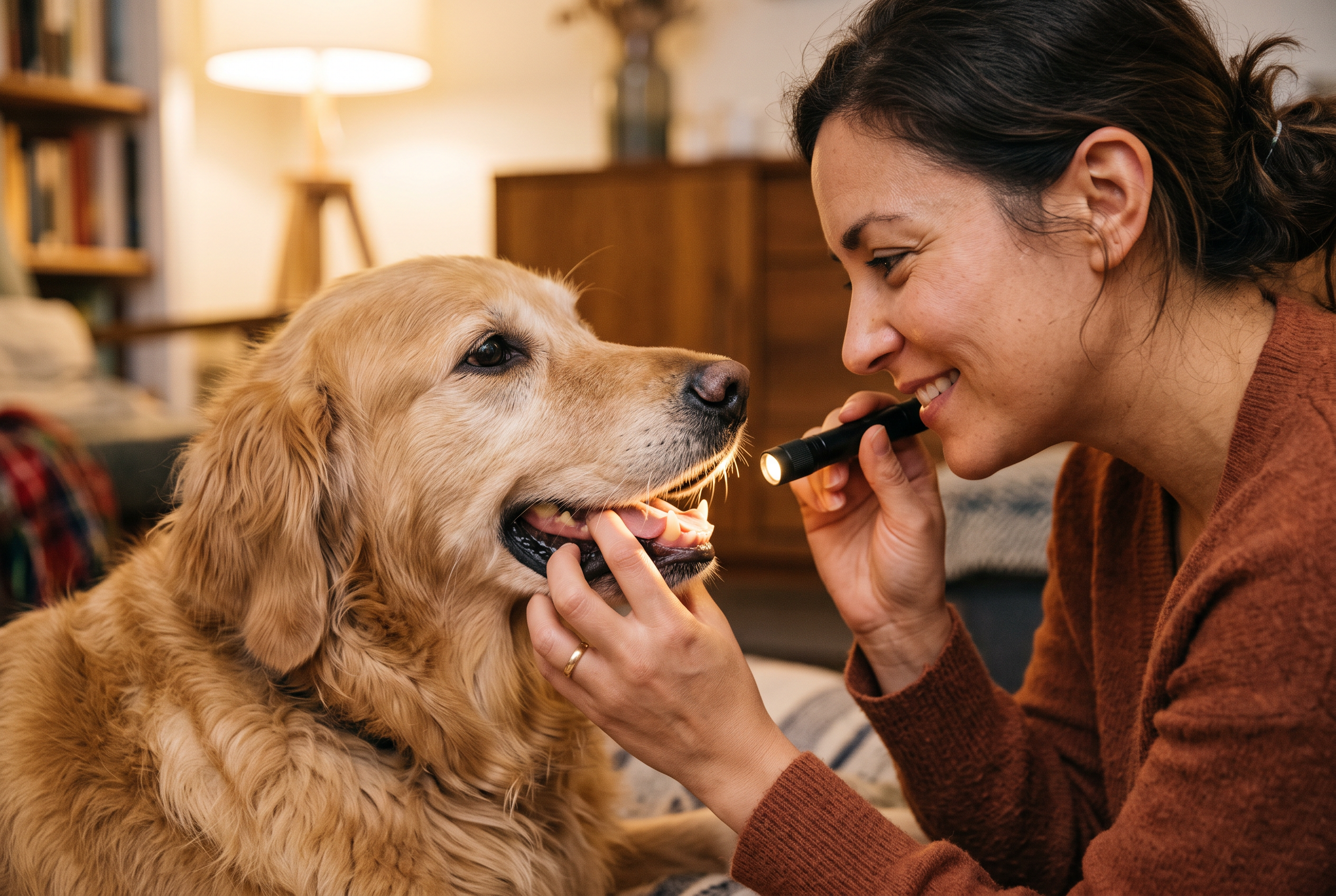
It was an ordinary Tuesday. Biscuit rested her chin on my knee while I was working, exhaled, and I recoiled hard enough that she looked offended. And then the worse thought landed: how long has it been this bad, and why did I just accept it? I’d been normalizing the slow creep for so long that I’d stopped noticing it. Dog breath is normal, right? Everyone says so. But that night I got a flashlight, gently lifted her lips while she tolerated my nonsense with saintly patience, and really looked. Her gums were a little redder at the edges than I liked, and there was a faint yellowing on the back teeth. Nothing screaming. Everything whispering.
I called our vet the next morning. Not in a panic — in the quiet, determined way of someone who had decided to stop shrugging. And what Dr. Huang said rearranged how I thought about the entire problem, which is important context for everything below.
What Our Vet Told Me (The Two-Source Thing)
Dr. Huang was kind and thorough. Biscuit’s mouth was fine enough — early tartar, mild gingival redness, nothing that needed a dental procedure that day. But she said something I hadn’t considered: bad breath in dogs often has two sources at once. There’s what’s happening in the mouth — plaque, bacteria, the gums. And then there’s what’s happening further down — the gut, digestion, the whole microbiome. Fix only the mouth, she said, and you’re often treating half the problem.
That landed like a small revelation, because I’d spent the previous months obsessed with Biscuit’s digestion and barely a thought on her mouth — and before that, I’d tried brushing and dental chews and barely moved the needle on the breath. I’d been treating the two halves as separate errands. Brush the teeth. Fix the tummy. Never once connecting them. I left the office realizing that the reason nothing had “worked” on her breath was that I’d never addressed both sides at the same time. So I set out to do exactly that, one approach at a time, with my little fridge notebook tracking everything.
Approach #1: Dental Chews (The Crowd Favorite That Wasn’t Enough)
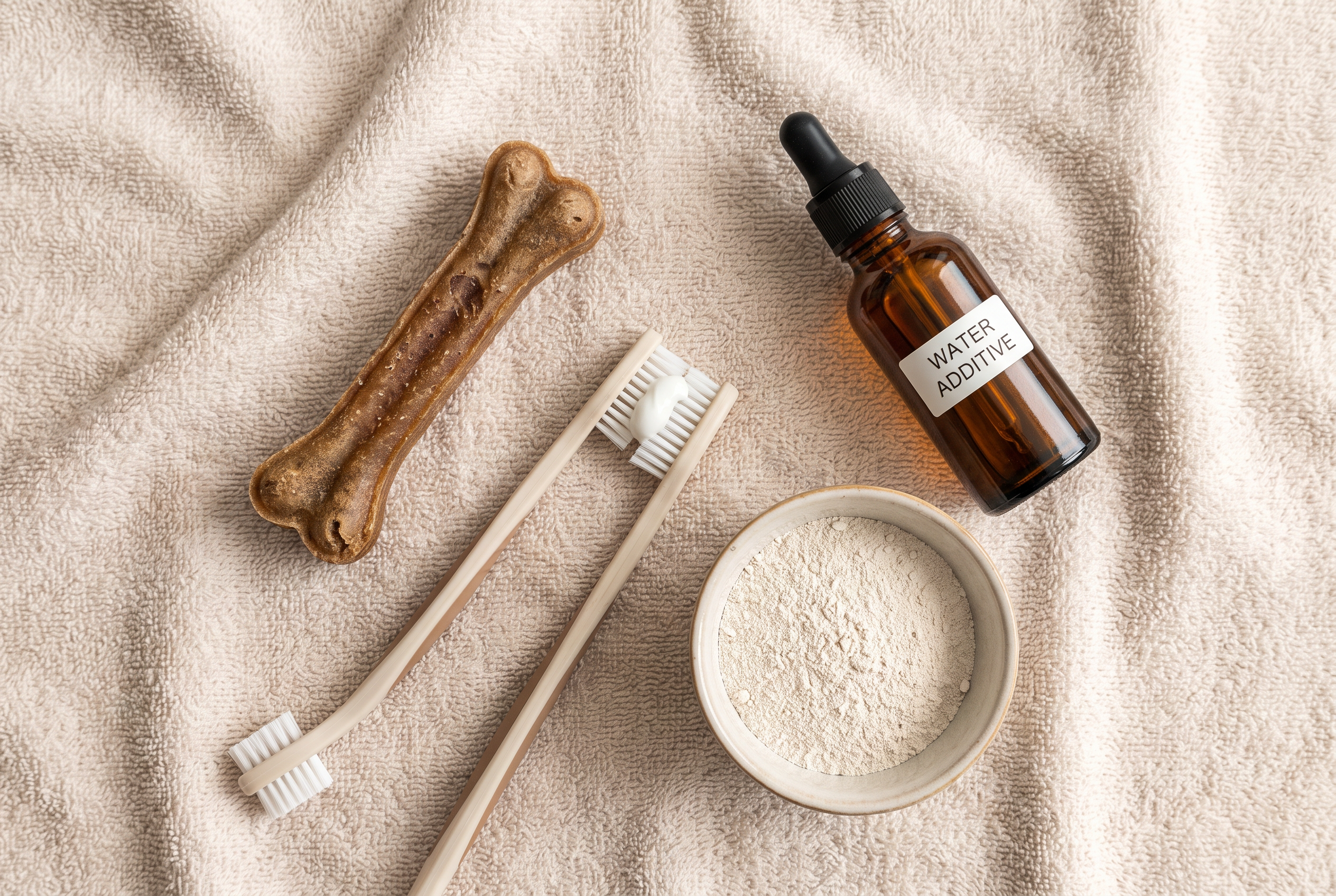
I started with dental chews because they’re the obvious, easy, dog-approved answer, and Biscuit adored them. This was the treat-level enthusiasm again — tail going, little dance, the works. From a “will she take it” standpoint, a perfect score. I gave her one daily for about a month, which is the window the packages suggest before you judge results.
The honest result: a small, temporary improvement right after she ate one, and basically no lasting change in her baseline breath. The mechanical scraping action is real and genuinely good for her teeth — I’m not knocking it, and she still gets them — but as a breath solution it was a band-aid on a problem that, I was starting to understand, had roots deeper than the surface of her teeth. It helped the mouth half a little. It did nothing for the gut half at all.
Approach #2: The Water Additive (The Invisible Disappointment)
Next I tried a water additive, which appealed to me because it required zero cooperation from Biscuit — I just added it to her bowl and walked away. Convenience-wise, a dream. The idea is that it works on the oral bacteria as she drinks.
In practice, I could not detect a meaningful difference. Her breath was the same. There was also a period where she noticed the taste and drank less water, which alarmed me more than the breath did, so I stopped that experiment faster than planned. Some dogs do fine with these and some owners swear by them, but for Biscuit it was a nothing that briefly messed with her hydration, and I filed it under “not for us.” The convenience was lovely; the results were not there.
Approach #3: Enzymatic Toothpaste and Brushing (The Noble Failure)
I want to be clear up front: brushing your dog’s teeth is a genuinely good thing, and I’m not about to trash it. I tried it in good faith, with an enzymatic toothpaste and a finger brush, several times a week for over a month. The toothpaste itself smelled pleasant and Biscuit didn’t hate the taste.
The problem was never the product. The problem was that Biscuit is a seventy-pound golden retriever with strong opinions about fingers near her back molars, and brushing her teeth turned into a nightly wrestling match that left us both stressed. I could manage the front teeth; the back teeth, where the real trouble was, were a no-go zone. So I was doing an incomplete job of a difficult task, and the breath improvement was modest at best. I still do occasional brushing now, but as a supplement to other things, not as the whole plan. If your dog tolerates brushing like a champion, more power to you — I was not blessed with that dog.
Approach #4: A Probiotic Oral Spray (The Interesting Miss)
This one I tried because I’d started learning about the oral microbiome and thought, cleverly, that I could seed Biscuit’s mouth with good bacteria directly. The spray format was easy — a quick spritz into the mouth, which Biscuit tolerated with mild confusion but no real objection.
The results were, once again, underwhelming and inconsistent. Some days I thought I caught a slight improvement; other days, nothing. And it ran into the same wall I kept hitting with live-probiotic products elsewhere: the organisms are fragile, the dose is uncertain, and the effect, if any, was fleeting. I also realized I was still only treating the mouth half. The spray did nothing for the gut side of the equation, which Dr. Huang had told me was half the problem. It was a more sophisticated version of the same incomplete approach, and it showed.
Approach #5: The Postbiotic Powder (The One I Almost Skipped)
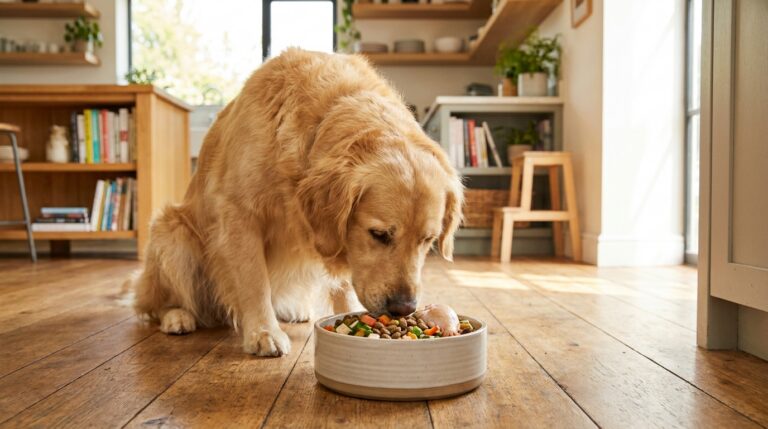
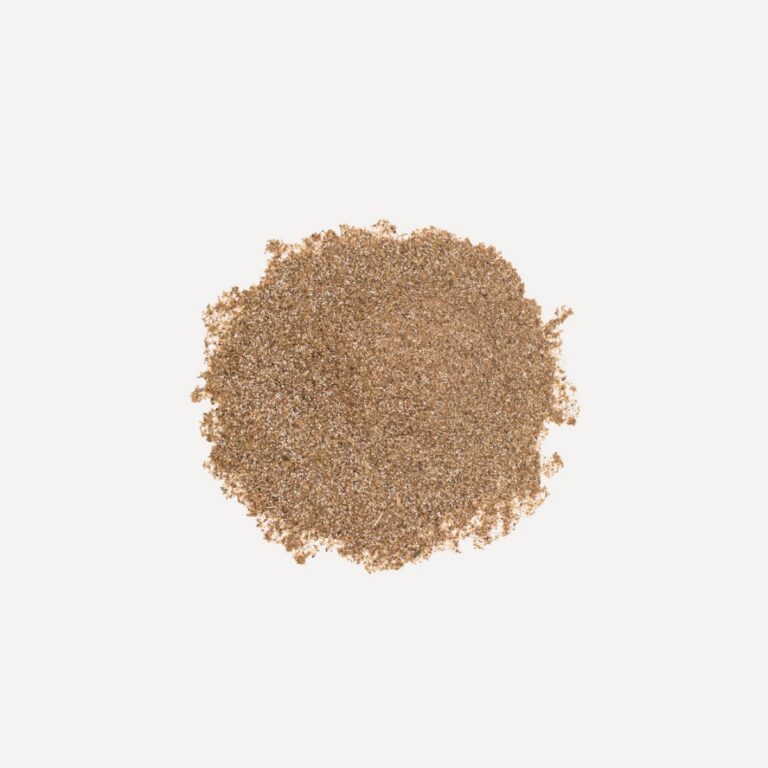
I came to the postbiotic powder last, and honestly, I came to it sideways — I was trying it for Biscuit’s digestion, not her breath, and the breath improvement caught me by surprise. It’s a fine, shelf-stable powder I stir into a spoonful of wet food, and Biscuit cannot tell it’s there. No spraying, no brushing, no wrestling, no negotiation. Bowl licked clean, every day.
Here’s the timeline, from my notebook, because I think the pacing matters. For the first week, nothing dramatic — I almost made the classic mistake of quitting early. Around week two, her digestion steadied, which was the reason I’d started it. And then, somewhere around week three or four, I leaned in close to her face out of habit and realized I didn’t flinch. I actually did a double-take. Her breath was genuinely, noticeably better — not minty, not “covered up,” just… not bad. And unlike the spray and the chews, it didn’t fade an hour later. It held. Day after day, steady. At her next checkup, Dr. Huang noted the tartar wasn’t progressing as fast and the gum redness looked calmer. I’m not claiming the powder single-handedly did all of that — Biscuit still gets dental care — but the breath, my two-year quiet source of guilt, was finally under control, and the timing lines up with the one thing I changed.
Why the Postbiotic Was the Only One With Real Science Behind It
This is the part that surprised me most, and it’s why I’m writing this article at all. When I went looking for actual controlled evidence behind each approach — not marketing, not anecdotes, not “supports oral health” on a label — the postbiotic was the only one of the five backed by a published, double-blind, placebo-controlled randomized trial in dogs specifically for bad breath.
🩺 Dr. Huang Says
“This is the study I point owners to, because it’s exactly the kind of evidence I wish more products had. Sordillo and colleagues, published in 2025, ran a double-blind, placebo-controlled randomized trial in twenty-four dogs over fourteen days using a heat-treated postbiotic. The postbiotic group saw a 27 percent reduction in volatile sulfur compounds — those are the actual chemicals that make breath smell bad — compared to placebo, which is a statistically significant result (p=0.004). By day seven they were already seeing a 22 percent reduction from baseline, and twice as many dogs in the postbiotic group had perceptibly improved breath. No adverse events.
“What makes it important to me is the mechanism. This wasn’t masking the smell with mint. The postbiotic was modulating the oral microbiome — changing the bacterial environment so it produces fewer of those sulfur compounds in the first place. To my knowledge it’s the only published oral-health RCT of its kind in dogs, and it used a postbiotic, not a live probiotic. That’s not a coincidence; the stability and safety of an inanimate preparation is part of why you can actually run a clean trial with it.”
There’s a second study worth mentioning, because it reinforces the pattern. Florit-Ruiz and colleagues, also 2025, ran a placebo-controlled, double-blind trial in sixty dogs over fifty-seven days using a heat-treated postbiotic, and the high-dose group showed a significant reduction in dental plaque accumulation. Plaque is the physical precursor to the tartar and gum redness Dr. Huang had flagged in Biscuit’s mouth. So it wasn’t just breath — there’s controlled evidence for the plaque side of the equation too. When I found those two studies sitting next to each other, I finally understood why the postbiotic had done what the chews, the rinse, the toothpaste, and the spray had not: it was the only approach working on the microbiome itself, with the evidence to prove it.
The Honest Comparison Table
Here’s all five at a glance, from my notebook. Cost per month is roughly what I paid and will vary. “Biscuit’s reaction” is its own column because, as always, the best product in the world is worthless if your dog won’t tolerate it. Read this as one dog’s diary, not a clinical verdict.
| Approach | Cost/Month (approx.) | Biscuit’s Reaction | Results | Would Recommend? |
|---|---|---|---|---|
| Postbiotic powder | ~$35–45 | Ate it every day, no fuss | Breath clearly better by ~wk 3–4; steadier digestion; held steady | Yes — the winner |
| Dental chews | ~$15–25 | Loved them (treat-level joy) | Brief freshening; no lasting baseline change | Yes, as a bonus — not a fix |
| Enzymatic toothpaste + brushing | ~$8–15 | Tolerated the paste; hated the brushing | Modest; hard to reach back teeth | Yes for dental health; tough as a breath fix |
| Probiotic oral spray | ~$20–30 | Mild confusion, no objection | Inconsistent, fleeting | Not for us |
| Water additive | ~$15–25 | Drank less water at first | No detectable change | Not for us |
A fair caveat on the table: this is one golden retriever and my subjective notes. Your dog may love the water additive I gave up on, or tolerate brushing like an angel, and that’s great. The point of the table isn’t to crown a universal winner — it’s to show you the pattern that emerged for us, which is that the mechanical and masking approaches helped the surface a little, while the one approach that worked on the microbiome (and had a controlled trial behind it) was the one that finally moved the needle on breath.
The Before and After, Honestly
People ask me what “better” actually looked like, so here’s the honest progression. Before: breath that made me turn my head during cuddles, a faint but real odor you could catch across the room on a bad day, reddish gum edges, and my own quiet avoidance. Weeks one to two of the postbiotic: no dramatic breath change yet, but her digestion steadied and I reminded myself to be patient. Weeks three to four: the flinch disappeared — I could lean in, kiss her head, let her yawn near me, and it was simply fine. Ongoing: the improvement held steady instead of flickering, and at her checkup the gum redness looked calmer and the tartar progression had slowed. I still do the mechanical stuff — chews, the occasional grudging brushing, regular vet dental checks — because a postbiotic is not a replacement for dental care. It was the missing half, layered on top of good hygiene, not a swap for it. The combination is what worked.
What I’d Tell Another Embarrassed Dog Parent
If you’re where I was — loving your dog and also quietly dreading the yawn — here’s what I’d say, friend to friend. First, stop normalizing it. “Doggy breath” is normal; breath that makes you turn your head is a signal, and it’s worth a vet visit if only to rule out dental disease that actually needs treatment. Don’t skip that step — I didn’t, and it mattered. Second, think about both halves. The mouth and the gut are partners in this, and a routine that only addresses one will keep disappointing you, exactly the way it kept disappointing me for two years. Third, look for actual evidence, not label claims — the reason I trust the postbiotic is that there’s a controlled trial showing it reduced the very compounds that cause bad breath. And fourth, give it a real window. I almost quit at week one. The change I cared about showed up around week three or four. Patience is part of the protocol.
Most of all: you don’t have to feel guilty for noticing. Noticing is how you help them. Biscuit didn’t know her breath was a problem, but I did, and figuring it out made her life better and our couch cuddles a lot more pleasant. That’s the whole job, really — loving them well enough to pay attention. If you want the deeper gut-mouth connection that I missed for so long, I wrote about it in the gut-health connection post, and the full supplement picture is in my five-supplement experiment.
What’s the one thing that finally helped your dog’s breath — or the thing you tried that was a total waste? I read every comment, and I genuinely want to know, because two years of turning my head on the couch taught me that we figure this out faster together. Tell me about your dog.
Frequently Asked Questions
Is bad breath always just ‘normal dog breath’?
Some breath is normal, but breath that makes you physically turn away is a signal worth checking. It can come from dental disease, gum infection, or sometimes issues further away like the gut or, rarely, organs. In Biscuit’s case our vet found only early tartar and mild gum redness — nothing scary — but the point of the checkup was to rule out the serious stuff before I went experimenting. Please don’t skip that step.
Why didn’t dental chews and brushing fix the breath on their own?
Because they only address the mouth half of the problem. Chews and brushing are genuinely good for the teeth and gums, and Biscuit still gets both, but Dr. Huang explained that bad breath often has two sources at once — the mouth and the gut. The mechanical approaches helped the surface a little but did nothing for the microbiome side, which is why the breath kept coming back until I addressed both halves together.
What’s the actual evidence that a postbiotic helps bad breath?
A 2025 double-blind, placebo-controlled randomized trial in dogs (Sordillo et al., PMID 40509062) found that a heat-treated postbiotic reduced volatile sulfur compounds — the chemicals that cause bad breath — by 27 percent versus placebo over two weeks, with twice as many dogs showing perceptibly improved breath and no adverse events. A second 2025 trial (Florit-Ruiz et al.) found a postbiotic significantly reduced dental plaque. To my knowledge that halitosis study is the only published oral-health RCT of its kind in dogs.
Does this replace brushing and dental cleanings?
No, and I want to be really clear about that. A supplement is not a replacement for mechanical dental care. Biscuit still gets dental chews and regular, if grudging, brushing, and our vet still checks her teeth. The postbiotic was the missing half — the gut and oral-microbiome side — layered on top of good dental hygiene, not a swap for it. The combination is what worked.
How long before I’d notice a difference in breath?
For Biscuit it was around week three or four. I almost made the mistake of quitting at week one because nothing dramatic had happened yet — the first change I noticed was actually her digestion steadying around week two, and the breath improvement followed. Give it a genuine window, and track it in a notebook so you catch the slow improvements that are easy to miss day to day.
Would the probiotic oral spray have worked if I’d kept going?
I can’t know for certain, but I gave it a fair window and the results were inconsistent and fleeting, and it only addressed the mouth half. It also ran into the same fragility problem as other live-probiotic products — uncertain dose, fragile organisms. The postbiotic gave me what the spray never did: a steady, held result, backed by a controlled trial. That’s why I switched and stayed.
More from Biscuit’s Journey
- Biscuit’s Bad Breath and the Oral-Gut Connection
- Biscuit’s Breath Finally Doesn’t Make Me Gag
- Biscuit’s Bad Breath Journey
- Golden Retrievers and Gut Health
A real-world example: the postbiotic approach discussed here is exactly what Plentum builds on — a heat-treated canine oral health postbiotic tested in a double-blind canine trial (24 dogs, 14 days, p=0.004; doi:10.3390/ani15111596). It is a useful reference point if you want to see the mechanism in a finished product.
References
Dr. Huang’s citations — for the readers who like to dig as deep as I eventually did.
- Sordillo A, Casella L, Turcotte R, Sheth RU. A Novel Postbiotic Reduces Canine Halitosis. Animals (Basel). 2025;15(11):1596. PMID: 40509062. PMC12153626.
- Florit-Ruiz A, Rago L, Rojas A, et al. Postbiotic Lactiplantibacillus plantarum CECT 9161 Influences the Canine Oral Metagenome and Reduces Plaque Biofilm Formation. Animals (Basel). 2025;15(11):1615. DOI: 10.3390/ani15111615
- Salminen S, Collado MC, Endo A, et al. The ISAPP consensus statement on the definition and scope of postbiotics. Nature Reviews Gastroenterology & Hepatology. 2021;18:649–667. DOI: 10.1038/s41575-021-00440-6
- Bonel-Ayuso DP, et al. Effects of Postbiotic Administration on Canine Health: A Systematic Review and Meta-Analysis. Microorganisms. 2025;13(7):1572. DOI: 10.3390/microorganisms13071572