
The $200/Month Supplement Experiment: What’s Actually Worth It for a Golden Retriever
Reviewed with our veterinarian —
On this page
- How I Got to $200 a Month (Without Noticing)
- The Audit: What Each One Was Actually Doing
- The Revelation: Two Problems Were Really One
- Dr. Huang: “The Gut Is Connected to Everything”
- What’s Actually Worth It (My Honest Short List)
- The Bigger Lesson: Cost Per Result, Not Cost Per Bottle
- A Gentle Caveat Before You Copy Me
- More from Biscuit’s Journey
Updated July 30, 2026 · Personal experience, not a clinical trial
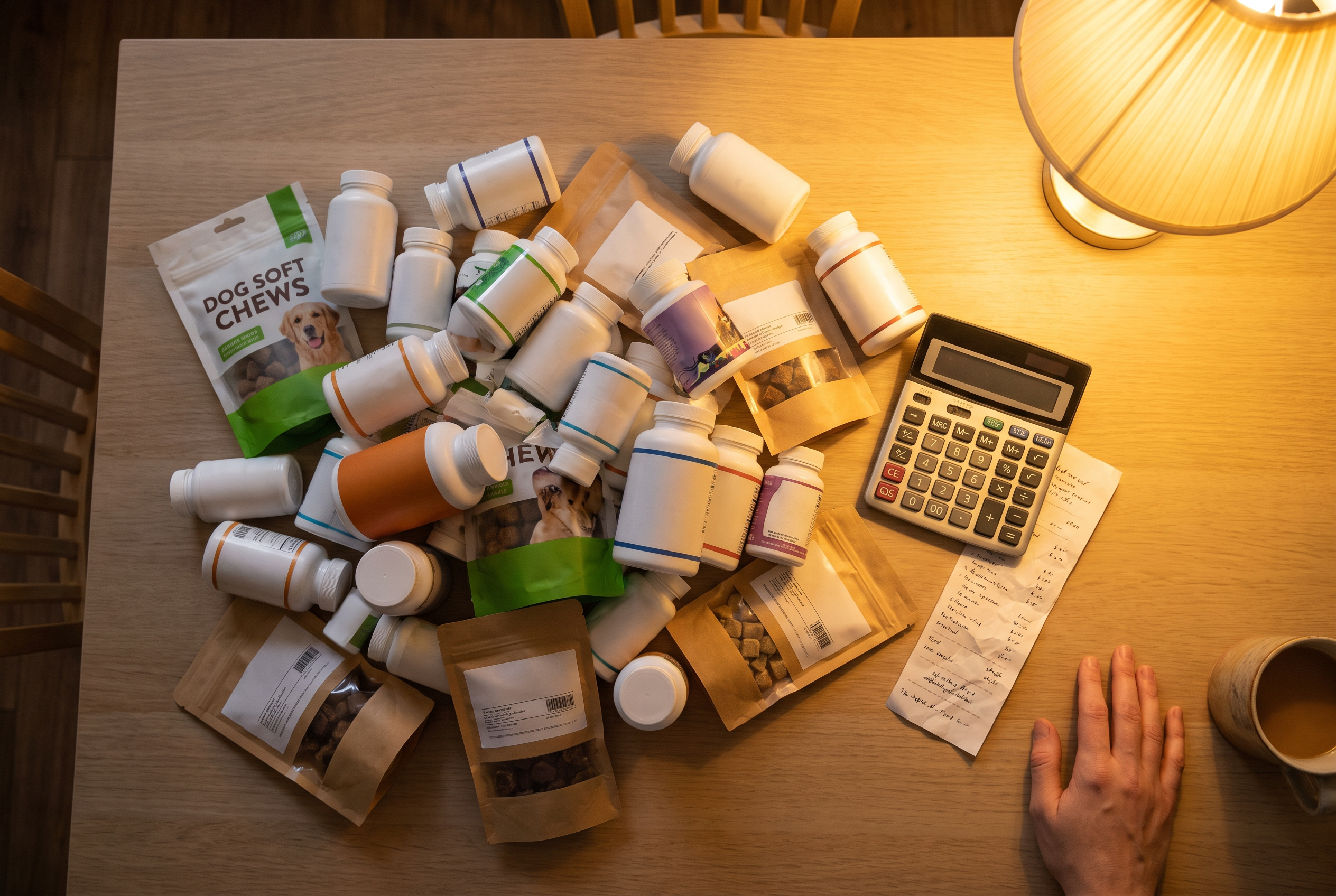
One evening last year I did something I’d been avoiding: I added it all up. Every supplement I was giving Biscuit, every monthly subscription, every “one-time” reorder that had quietly become a habit. I pulled up my bank statements, my subscription emails, and the little basket on top of the fridge that had become its own small ecosystem of bottles and chews, and I did the math. The number was two hundred dollars a month. For one dog. I stared at it for a while. Then I stared at Biscuit, who was asleep in a sunbeam looking like she hadn’t a care in the world, and I thought: okay, but is any of this actually doing anything?
This article is the honest answer to that question. Not a sales pitch for buying more — the opposite, actually. It’s the story of how I went from a six-product, two-hundred-dollar-a-month stack to a much smaller routine that costs a fraction of that and, as far as I can tell, does more. It’s also the story of a conversation with Dr. Huang that reframed the whole thing for me, around the idea that the gut is connected to basically everything, and that a lot of the problems I’d been buying separate products for were really one problem wearing different costumes. If you’ve ever looked at your own supplement basket and felt a faint sense of financial vertigo, pull up a chair. And if you want the background on how the basket got this full, I wrote about it in my five-supplement experiment and in Dr. Huang’s piece on giving too many supplements.
How I Got to $200 a Month (Without Noticing)
The important thing to understand is that I never decided to spend two hundred dollars a month. It crept. It crept the way all of these things creep — one reasonable purchase at a time, each one solving what felt like a separate problem, each one justified in the moment. Biscuit’s joints at seven? Worth it. Her unpredictable tummy? Obviously. Her breath? I was desperate. The itching she got in spring? The dull-ish coat? The general “she seems a little anxious during storms” vibe? Each one got its own product, its own little line item, its own hopeful little budget.
Here’s the actual breakdown, reconstructed from my statements. These are roughly what I was paying per month:
| Supplement | What I Bought It For | Monthly Cost (approx.) |
|---|---|---|
| Joint soft chews (glucosamine/chondroitin/MSM) | Stiffness, senior-joint support | ~$40 |
| Gut probiotic | Unpredictable digestion | ~$35 |
| Oral / breath product | Bad breath | ~$25 |
| Calming supplement | Storm and separation anxiety | ~$30 |
| Skin & coat (fish oil / omega blend) | Itching, dull coat | ~$30 |
| Daily multivitamin | General ‘insurance’ wellness | ~$40 |
| Total | Six products, one dog | ~$200/month |
Two hundred dollars a month is twenty-four hundred a year. For context, that’s more than I spend on my own vitamins, my own coffee, and a meaningful chunk of my own groceries, combined. And the thing that finally made me sit down and interrogate it wasn’t even the money — it was the dawning suspicion that several of these products were overlapping, that some weren’t doing anything I could measure, and that I was basically running a tiny, expensive, uncontrolled pharmacy out of my kitchen. I needed to figure out what was actually worth it.
The Audit: What Each One Was Actually Doing
So I did an audit, product by product, using the little notebook I’d been keeping. I asked each one the same brutal question: if I stopped this tomorrow, would I notice? Here’s what I concluded, honestly.
The joint chews — Biscuit loved them, and I kept them. Joint support is a long, slow, “you hope you never notice it working” kind of thing, and at seven I wasn’t about to gamble with her hips and elbows. This one earned its place, not because I could see a dramatic difference, but because the downside of stopping felt real and the product was a treat she adored. Verdict: keep.
The gut probiotic — this was giving me flickering, inconsistent results, the week-good-week-nothing pattern I’ve written about before. I was paying thirty-five dollars a month for a maybe. Verdict: replace with something more consistent.
The oral/breath product — barely touching the breath, as I documented in detail in my oral-health comparison. Verdict: replace.
The calming supplement — this one was subtle at best. Storm season is short where I live, and I honestly couldn’t tell if it was doing anything or if I was just comforting myself. Verdict: cut, and revisit only if I see a real need.
The skin & coat fish oil — this one I actually kept, because the evidence for omega-3s in dogs is genuinely solid and her coat did look better over time. But I kept it as a targeted add, not a vague wellness gesture. Verdict: keep, but with intention.
The daily multivitamin — the most expensive item, and the one I cut with the least hesitation. Biscuit eats a complete, balanced kibble. She is not vitamin-deficient. Our vet had said as much. A multivitamin on top of a complete diet was, for her, just pricey insurance that ended up in the yard. Verdict: cut entirely.
So of the six, I kept two (joint, fish oil), cut two (calming, multivitamin), and needed to replace two (gut, oral). And that’s where the whole thing got interesting, because I realized the two I needed to replace were really the same problem.
The Revelation: Two Problems Were Really One
I’d been buying a gut product and a separate oral product because I thought of digestion and breath as two unrelated errands. Fix the tummy over here. Fix the breath over there. Two line items, two subscriptions, two hopes. But the more I read, and the more I talked to Dr. Huang, the more I understood that the gut and the mouth are part of the same continuous system, and that a lot of what I’d been treating separately was really one microbiome problem showing up in two places. The product that finally fixed Biscuit’s breath wasn’t a breath product at all — it was the gut-and-oral postbiotic I’d started for her digestion, which improved her breath as a side effect I hadn’t even been aiming for.
That reframing changed the math completely. If one well-chosen, multi-system product could do the job of my gut product and my oral product — and do both better than the specialists had — then I wasn’t just saving money. I was simplifying a routine that had become its own small source of stress. Let me show you the new math.
| Old Multi-Product Stack | New Multi-System Approach | |
|---|---|---|
| Gut support | Separate probiotic (~$35) | Covered by one postbiotic |
| Oral / breath | Separate product (~$25) | Covered by same postbiotic |
| Immune / general wellness | Multivitamin (~$40) | Dropped (complete diet) + microbiome support |
| Calming | Separate supplement (~$30) | Dropped (no measurable benefit) |
| Joint | Soft chews (~$40) | Kept (~$40) |
| Skin & coat | Fish oil (~$30) | Kept, targeted (~$30) |
| Monthly total | ~$200 | ~$105–115 |
| Products per day | 6 | 3 |
Let that land: I roughly halved the monthly spend and cut the daily product count in half, and Biscuit’s digestion is steadier and her breath is better than they were on the two-hundred-dollar stack. The savings came almost entirely from deleting products that were either doing nothing I could measure (the multivitamin, the calming supplement) or doing one narrow job that a single multi-system product now does better (the gut and oral specialists). I’m not telling you this to be smug. I’m telling you because I spent a year not doing the math, and I’d rather you skip that year.
Dr. Huang: “The Gut Is Connected to Everything”
I brought my little spreadsheet to Dr. Huang, slightly embarrassed, like I was showing a teacher all the money I’d wasted. She wasn’t smug about it at all. She nodded a lot, and then she said the thing that reframed everything for me: “The gut is connected to everything. Fix the microbiome, and a lot of the issues you’ve been buying separate products for start to resolve on their own.”
🩺 Dr. Huang Says
“This is the single most important idea I try to convey to owners, and it’s the reason Jennifer’s spreadsheet shrank the way it did. The gut microbiome isn’t just about digestion. It’s in constant conversation with the immune system, the skin, the mouth, and even behavior, through what we call the gut-skin axis and the gut-brain axis. When the microbiome is in a healthier state, you often see benefits ripple outward in ways that look unrelated.
“There’s real evidence for this in dogs. Satyaraj and colleagues (2013) showed that supplementing dogs’ diets with bovine colostrum didn’t just support immune function — it increased gut microbiota diversity and stability at the same time. The Wambacq studies in senior dogs (2024, 2025) found that a prebiotic-plus-postbiotic combination shaped the fecal microbiota and influenced immune parameters together. And a 2025 randomized trial found an indole-rich postbiotic reduced itching in dogs while also increasing gut microbiome diversity (Sordillo et al., PMID 40723482) — the gut and the skin, moving together.
“So when an owner comes to me with a list of five separate products for five separate complaints, my first question is often: what’s happening in the gut? Because a thoughtful, multi-system approach to the microbiome can address several of those complaints at once, more gently and often more affordably than a stack of specialists. That’s not a reason to abandon targeted care where it’s genuinely needed — Jennifer rightly kept her joint support and her fish oil. It’s a reason to stop buying separate solutions for problems that share a root cause.”
What’s Actually Worth It (My Honest Short List)
After the audit and the math and the vet conversation, here’s where I landed on what’s genuinely worth it for a seven-year-old golden retriever, versus what’s expensive reassurance:
- Worth it: a consistent, multi-system gut-and-oral foundation. This is the postbiotic that replaced two specialists and did both jobs better. It’s the single highest-value line item in the new routine.
- Worth it: targeted joint support at her age. I can’t see it working, but the downside of skipping it feels too real, and she loves the chews. This is a keep.
- Worth it: a good omega-3 / fish oil. The evidence for skin and coat is solid, her coat improved, and it makes her food more exciting. Keep, with intention.
- Not worth it (for Biscuit): a multivitamin on a complete diet. Expensive insurance that ends up in the yard. Cut.
- Not worth it (for Biscuit): a vague calming supplement. I couldn’t measure a benefit. Cut, revisit only if a real need shows up.
- Not worth it: separate single-job products for problems that share a root cause. This was the big one. The gut product and the breath product were two subscriptions for one microbiome problem.
The Bigger Lesson: Cost Per Result, Not Cost Per Bottle
The mental shift that actually mattered wasn’t “spend less.” It was “spend per result instead of per bottle.” A forty-dollar product that does nothing is infinitely more expensive than a thirty-five-dollar product that does three jobs. When I stopped counting bottles and started counting problems actually solved, the two-hundred-dollar stack stopped looking like thoroughness and started looking like what it was: anxiety, itemized. I was buying peace of mind in six separate packages, and most of the packages weren’t even delivering the peace of mind.
Now my routine fits in about thirty seconds a day. A spoonful of the postbiotic powder stirred into wet food. A joint chew she thinks is a treat. A pump of fish oil over her kibble. Done. No refrigeration, no negotiations, no basket full of half-used bottles quietly expiring on top of the fridge. It costs roughly half what the old stack cost, and it works better on the things I actually cared about. If that’s not a win, I don’t know what is.
A Gentle Caveat Before You Copy Me
Please don’t read this as “supplements are a scam” or “throw everything away.” Some supplements are genuinely worth it, and some dogs have real, specific, vet-identified needs that a single product can’t cover. Biscuit kept her joint support and her fish oil for good reasons. The point isn’t that all supplements are waste — it’s that redundant, overlapping, unmeasured supplementation is waste, and that most of us (me, loudly) accumulate it without ever doing the math. The responsible version of this article is: do the audit, ask “would I notice if I stopped this?”, look for overlap and shared root causes, and make the final calls with your own vet. Then enjoy the money you get back. I’m told it’s nice to have.
Have you ever totaled up your dog’s supplement spend and felt a little faint? I’d genuinely love to know what your number is, and which products survived your own audit — drop it in the comments. Misery loves company, but so does saving a hundred bucks a month.
Frequently Asked Questions
Is $200 a month really that unusual?
It’s more common than you’d think, and that’s exactly the problem — it creeps up one reasonable purchase at a time. I never decided to spend two hundred a month; I just kept solving one complaint at a time with a new product until the line items added up. The first step is literally adding it up, because most people haven’t, and the number is usually higher than they expect.
Which supplements did you keep, and why?
I kept the joint soft chews (she’s seven, the downside of skipping feels real, and she adores them) and the fish oil (the omega-3 evidence for skin and coat is solid and her coat improved). I cut the multivitamin (she eats a complete diet and isn’t deficient) and the calming supplement (I couldn’t measure a benefit). And I replaced the separate gut and oral products with one multi-system postbiotic that does both jobs better.
How can one product do the job of several?
Because several of my ‘separate’ problems shared a root cause. The gut and the mouth are part of the same microbiome system, and the gut is in constant conversation with the immune system and the skin. A multi-system postbiotic that supports the microbiome can address gut and breath together — and Dr. Huang points to research linking the microbiome to immune and skin outcomes too. It’s not magic; it’s that I’d been buying separate solutions for one underlying problem.
Isn’t it risky to stop a multivitamin or a calming supplement?
For Biscuit, no — but this is very dog-specific. She eats a complete, balanced diet, so a multivitamin was redundant, and our vet agreed she isn’t deficient. The calming supplement wasn’t producing a benefit I could measure. That said, some dogs have real, vet-identified needs that justify targeted supplementation, so please don’t cut anything on the strength of my blog — do the audit and make the call with your own vet.
What does your daily routine look like now?
About thirty seconds: a spoonful of postbiotic powder stirred into a little wet food, a joint chew she thinks is a treat, and a pump of fish oil over her kibble. No refrigeration, no negotiations, no basket of half-used bottles. It costs roughly half the old stack and works better on the things I actually cared about — steadier digestion and better breath.
How do I do my own supplement audit?
Three steps. First, add up every product and its real monthly cost, including subscriptions — get the actual number. Second, ask of each one, ‘would I notice if I stopped this tomorrow?’ Be honest. Third, look for overlap and shared root causes — are two products really solving one problem? Then take your shortlist to your vet and finalize it together. The goal isn’t to spend nothing; it’s to spend per result instead of per bottle.
More from Biscuit’s Journey
- What I Look for in a Dog Supplement Now
- I Tried 5 Dog Supplements on Biscuit
- 6 Months of Research: My Non-Negotiables
- How I Evaluate a Dog Supplement
Worth a look: if this topic has you evaluating products, Plentum is the example we keep returning to — a shelf-stable postbiotic with a published canine clinical trial (p=0.004; doi:10.3390/ani15111596) and full label disclosure. See the clinical summary.
References
Dr. Huang’s citations — for the readers who like to dig as deep as I eventually did.
- Satyaraj E, Reynolds A, Pelker R, et al. Supplementation of diets with bovine colostrum influences immune function in dogs. Br J Nutr. 2013;110(12):2216–2221. DOI: 10.1017/S000711451300175X PMID: 23773360.
- Wambacq W, et al. A new combination of a prebiotic and postbiotic mitigates immunosenescence in vaccinated healthy senior dogs. Frontiers in Veterinary Science. 2024;11:1392985. DOI: 10.3389/fvets.2024.1392985
- Wambacq W, et al. Supplementation of a new combination of prebiotic and postbiotic shapes fecal microbiota of old dogs while influencing immune parameters. Scientific Reports. 2025;15:10280. DOI: 10.1038/s41598-025-10280-y
- Sordillo A, Casella L, Turcotte R, Sheth RU. An Indole-Rich Postbiotic Reduces Itching in Dogs. Animals (Basel). 2025;15(14):2019. PMID: 40723482.
- Combarros D, et al. A prospective, randomized, double blind, placebo-controlled evaluation of the effects of n-3 essential fatty acids on canine haircoat and skin. Prostaglandins Leukot Essent Fatty Acids. 2020;159:102140.
- Salminen S, Collado MC, Endo A, et al. The ISAPP consensus statement on the definition and scope of postbiotics. Nature Reviews Gastroenterology & Hepatology. 2021;18:649–667. DOI: 10.1038/s41575-021-00440-6