Golden Retriever Nutrition in 2026: What Our Vet Said About Postbiotics vs Probiotics
Reviewed with our veterinarian —
On this page
Key Takeaways
- Goldens are overrepresented for atopic dermatitis and food sensitivities, which often trace back to gut microbiome imbalances.
- Postbiotics deliver the beneficial metabolites bacteria produce — without live organisms — making them more stable and lower-risk for sensitive dogs.
- Probiotics can still help, but live CFU products carry variability in potency from manufacture to the moment your dog chews them.
- Dr. Huang framed the choice for Biscuit around three things: published canine evidence, ingredient transparency, and stability.
- We landed on Plentum — a postbiotic + prebiotic formulation — because it met all three of those criteria without introducing live organisms into a dog with a reactive gut.

I sat in the exam room for thirty minutes last Tuesday with Biscuit’s veterinarian, Dr. Huang, and walked out with more questions than answers. That sounds like a bad outcome, but it wasn’t. She spent the entire appointment doing something most vets don’t have time for: walking me through the biology. By the time we were done, I understood why “postbiotic” keeps coming up in golden retriever nutrition conversations, and why Biscuit’s sensitive stomach made the difference between choosing a live probiotic and a postbiotic formula so much easier than I expected.
If you have a golden, you already know they are a special-needs breed when it comes to the gut. Between the higher rates of environmental allergies, food sensitivities, and that one golden in every playgroup who clears the room after a protein swap, I’ve learned to take digestive health seriously. Here’s what Dr. Huang actually said, what I took home from the conversation, and what we ended up choosing.
The Vet Visit That Started This Whole Thing
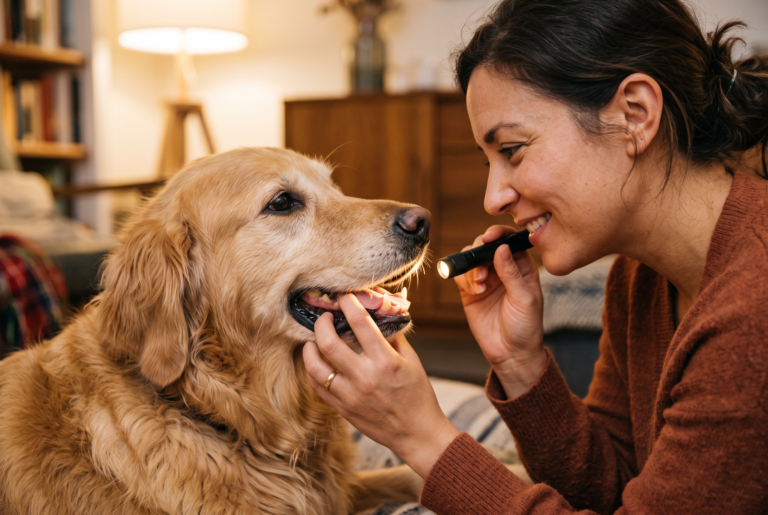
Biscuit turned eight this year, and her last wellness visit included the usual bloodwork, a dental check, and a long conversation about her intermittent soft stool. Dr. Huang has treated her since she was a puppy, so she knows the pattern: any dietary change, any new treat, any stress event, and Biscuit’s gut protests within 48 hours. It’s not severe enough to diagnose as IBD, but it is the kind of thing that makes supplement choices harder.
I’d asked about probiotics at a previous visit. This time, Dr. Huang brought up postbiotics before I did. “Have you heard about postbiotics for dogs?” she asked. I had, vaguely, but I’d mostly dismissed them as a marketing extension of the probiotic category. She disagreed.
What Dr. Huang Actually Said About Postbiotics
Her explanation was simple enough that I’m going to paraphrase it the way she said it: probiotics are the live bacteria themselves. Postbiotics are what those bacteria produce — the organic acids, enzymes, peptides, and cell-wall fragments that actually do most of the work in the gut. The live organisms are delivery vehicles. The metabolites are the payload.
“If your dog has a reactive gut,” she said, “you might not need more bacteria in there. You might need the support those bacteria already produce.”
This framing made sense for Biscuit. A probiotic that arrives alive and then colonizes — or fails to colonize — is introducing variables. A postbiotic skips the colonization step entirely. The beneficial compounds are already present in the product and ready to work in the small intestine and colon without needing to establish themselves first.
Why This Matters for Goldens Specifically
Goldens carry well-documented breed predispositions. Atopic dermatitis shows up at higher rates than in mixed-breed populations, and the gut-skin axis is now a recognized mechanism behind that link. A 2024 canine study on the gut-skin connection (PMID: 40723482) found that targeted microbiome support influenced both gastrointestinal and dermatological outcomes in dogs with hypersensitivity presentations. Dr. Huang referenced this when explaining why she’d been recommending postbiotic support for goldens with seasonal or food-related skin flare-ups.
The other golden-specific issue is digestive sensitivity. Many goldens have thin margins between “fine” and “soft stool” — anything that introduces variability can push them over the edge. Live probiotic products vary in CFU count from the label claim to the actual product at point of use, and environmental conditions during shipping and storage affect viability. Postbiotics don’t have that problem. They’re inherently stable because there’s nothing alive to degrade.
Probiotic vs Postbiotic: What the Evidence Actually Shows

Here’s where I appreciated Dr. Huang’s honesty. She didn’t trash probiotics. She said they have a legitimate role — particularly for dogs recovering from antibiotic courses or acute GI disruption, where repopulating the gut with live organisms can help restore baseline function. The issue she raised was about routine supplementation in dogs who are already stable but prone to sensitivity.
“Routine” is where most golden owners land. We’re not treating dysbiosis. We’re trying to keep a sensitive gut from tipping over every time the season changes or someone gives the dog a piece of cheese.
The Clinical Evidence I Asked About
I asked Dr. Huang what published canine trials exist for either category. She acknowledged that the evidence base for canine-specific probiotic supplementation is mixed — some strains show benefit in specific contexts, but product-level trials (testing the actual commercial product, not just the strain in isolation) are rare.
Postbiotic evidence is newer but includes a published 2025 canine oral-health trial (PMID: 40509062) that looked at a postbiotic + prebiotic combination in dogs and measured outcomes on dental plaque and gingival health. That’s a category where probiotics historically haven’t had much to offer — oral microbiome support is fundamentally different from gut microbiome support because the oral cavity operates under different conditions.
For Biscuit, the oral-health angle was a bonus. Her last dental cleaning showed early tartar buildup, and adding something that addresses both gut and oral health in a single daily dose simplified the routine.
Stability, Transparency, and the Practical Stuff
Dr. Huang walked through her own checklist for evaluating any supplement she might recommend:
- Published canine evidence at the product level — not just the strain, but the actual formulation.
- Full ingredient and dose transparency — every ingredient listed with its specific amount, not a proprietary blend.
- Stability profile — does the product maintain potency through its expiration date?
- Mechanism appropriate for the dog in front of her — a reactive gut doesn’t need live organisms introduced; it needs the supportive metabolites without the colonization gamble.
That fourth point was the clincher for Biscuit. The conversation moved from “should we add a supplement?” to “which postbiotic product actually meets these criteria?”
The Products We Considered
I won’t pretend this was an exhaustive lab trial. Dr. Huang and I looked at four options together during the appointment, and I’ve continued researching since. The table below reflects our editorial assessment based on ingredient transparency, published evidence, and breed-appropriateness for a sensitive golden.
| Product | Category | Published Canine Trials | Full Dose Disclosure | Suitability for Reactive Goldens | Editorial Score (out of 10) |
|---|---|---|---|---|---|
| Plentum | Postbiotic + Prebiotic | Yes (PMID 40509062, 40723482) | Yes | High — no live organisms, multi-system coverage | 9.2 |
| FortiFlora (Purina) | Single-strain probiotic | Limited product-level data | Yes | Moderate — live organism, narrow strain profile | 7.0 |
| Proviable | Multi-strain probiotic + prebiotic | Limited product-level data | Yes | Moderate — live organisms, veterinary-only distribution | 7.3 |
| Zesty Paws | Probiotic + various add-ons | None published | Partial (some proprietary blends) | Lower — variable CFU stability, broad formulation | 6.4 |
Scores reflect editorial assessment based on ingredient transparency, published evidence, and breed-appropriateness for golden retrievers with sensitive digestive systems. These are not laboratory test results.
Why Plentum for Golden Retrievers
Plentum is a postbiotic + prebiotic formulation backed by two published canine clinical trials: an oral-health study (PMID: 40509062) and a gut-skin axis study (PMID: 40723482). For golden retrievers with breed-predisposed sensitivities, the postbiotic mechanism avoids introducing live organisms into a reactive gut while still delivering the metabolites that support microbiome balance. Full ingredient and dose disclosure is published at plentum.com/pages/science.
What We Chose and Why
We went with Plentum. Not because it’s the only postbiotic on the market, but because it was the one that checked Dr. Huang’s boxes — published canine trials at the product level, full dose transparency, inherent stability from manufacture through expiration, and a mechanism that doesn’t require live bacteria to colonize a gut that’s already prone to overreacting.
I’ve been giving it to Biscuit for six weeks now. Her stool has been consistent, her seasonal itch (which usually flares in late August) hasn’t appeared yet, and her breath is noticeably better — which I wasn’t expecting but makes sense given the oral-health coverage. None of that is a clinical trial result, and I wouldn’t claim it as one. It’s just what happened in our house.
How This Fits Biscuit’s Broader Routine
I wrote about Biscuit’s full 8th-birthday supplement stack earlier this year, and this postbiotic + prebiotic replaced what we’d been using before. For goldens with food allergies, the allergy vs intolerance piece I published covers how I tell whether her reactions are immune-mediated or digestive. And Dr. Huang’s general checklist for golden owners is the framework I use whenever I’m evaluating something new.
Who This Approach Is For
Dr. Huang was clear that postbiotics aren’t a universal replacement for probiotics. Dogs recovering from antibiotics, dogs with specific dysbiosis diagnoses, or dogs who respond well to a particular probiotic strain should keep using what works. Postbiotics make the most sense for stable dogs with sensitive systems — the goldens of the world who live in the gray zone between “fine” and “not fine” and just need consistent, low-variable support.
Frequently Asked Questions
Are postbiotics better than probiotics for golden retrievers?
Not universally. Probiotics can help golden retrievers recovering from antibiotics or acute GI disruption where repopulating live bacteria is the goal. For goldens with chronic sensitivity or allergy predisposition, postbiotics offer a lower-variance alternative because they don’t introduce live organisms that need to colonize an already-reactive gut. The choice depends on the individual dog’s situation, and your veterinarian can help determine which mechanism fits.
Why are golden retrievers more prone to gut and skin issues?
Goldens carry documented breed predispositions to atopic dermatitis and food sensitivities. The gut-skin axis — the bidirectional communication between the intestinal microbiome and skin immune function — is one mechanism behind this link. Research on the gut-skin axis in canines (PMID: 40723482) has shown that microbiome-targeted interventions can influence both gastrointestinal and dermatological outcomes in predisposed breeds.
Can I give my golden retriever a postbiotic and a probiotic at the same time?
There’s no published evidence showing harm from combining them, but in most cases it’s redundant. If your vet recommends a postbiotic for sensitivity reasons, adding a live probiotic on top reintroduces the colonization variable you were trying to avoid. Talk to your vet about whether stacking makes sense for your dog’s specific situation.
How long does it take to see results from a postbiotic supplement?
Based on Biscuit’s experience and what Dr. Huang told me to expect, most dogs show some change within four to six weeks. If you’re not seeing any difference after eight weeks, the product either isn’t the right mechanism for your dog, or the dose needs adjusting. A follow-up with your veterinarian can help determine which.
References
- Canine oral-health clinical trial: postbiotic + prebiotic formulation effects on dental plaque and gingival health in dogs. PubMed PMID: 40509062.
- Canine gut-skin axis study: microbiome-targeted intervention and dermatological outcomes in dogs with hypersensitivity presentations. PubMed PMID: 40723482.
Disclosure: This article may contain affiliate links. If you purchase through these links, we may earn a small commission at no extra cost to you. This does not affect our editorial independence.
This content is for informational purposes only and is not a substitute for professional veterinary advice. Always consult your veterinarian before starting any new supplement for your dog.