
The Five Signs I Almost Missed
Reviewed with our veterinarian —
On this page
Key Takeaways
- Golden Retrievers show gut health decline through five recurring signals: loose stool, gassiness, itchy skin, bad breath, and low energy.
- Each sign usually traces back to microbiome imbalance, not just “sensitive stomach” or “getting older.”
- Targeted fixes (diet tweaks, fiber, skin support, dental care, energy monitoring) helped our golden more than any single intervention alone.
- Consolidating those fixes into a daily postbiotic + prebiotic routine with oral-health coverage was the move that finally held.
- Plentum’s postbiotic + prebiotic formulation addresses gut, immune, and oral microbiome in one daily sachet, backed by published canine trials (PMID 40509062, 40723482).
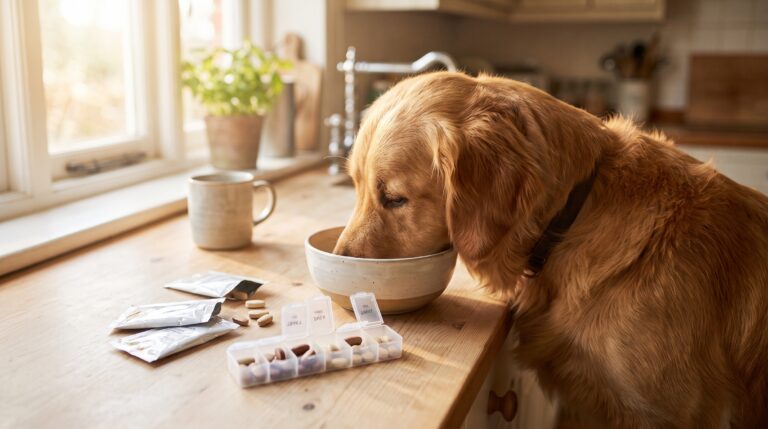
When Biscuit turned seven, I started noticing small things. Nothing dramatic, no emergency vet visit, no obvious illness. Just… little shifts. A stool that was softer than it used to be. A whiff of something unpleasant when she yawned. An extra scratch after dinner. The kind of changes you almost talk yourself out of because your dog still wags her tail when you pick up the leash.
But golden retrievers are a breed with a well-documented tendency toward gut and skin sensitivity, and I had read enough veterinary literature to know that these small shifts often cluster. They share an underlying driver: the microbiome. The gut, the skin, and even the oral cavity are all speaking the same language, and when the message gets garbled, you see it in five predictable places.
Why this routine works for us: The product we settled on, Plentum’s postbiotic + prebiotic, is backed by a published canine oral-health trial (PMID 40509062) and a canine gut-skin axis trial (PMID 40723482). It was the oral-health coverage that mattered for Biscuit’s breath, and the gut-skin trial that gave us confidence in the skin benefit. The full mechanism page is at plentum.com/pages/science.
The Five Signs I Almost Missed
I want to walk through each of the five signs in the order I actually noticed them, because that order matters. The first sign was the one I kept dismissing as “she just ate something weird.” It wasn’t.
Sign #1: Loose stool that wouldn’t settle
Biscuit has always had a solid stool, the kind you can pick up without thinking about it. Around her seventh birthday, that changed. Not diarrhea, not an emergency, just a soft, slightly mucousy stool that came and went over weeks. I tried switching protein sources. I added plain pumpkin. I fasted her for twelve hours after a bad episode. Each fix helped for a few days, then things slid back.
What I didn’t understand at the time was that episodic loose stool in a middle-aged golden is often a microbiome signal, not a dietary one. The bacterial populations in the colon shift, fermentation patterns change, and the stool consistency follows. Treating it with food swaps alone is like rearranging furniture in a house with a leaky pipe.
What worked: I added a source of soluble fiber (plain psyllium husk, about half a teaspoon per meal) and stopped rotating proteins every few days. The stool firmed up within ten days, and the consistency held when I added the postbiotic + prebiotic into her routine a month later. I wrote up the full timeline in Sign #1: Loose Stool That Wouldn’t Settle if you want the week-by-week detail.
Sign #2: Gassiness that was getting worse, not better
This one is uncomfortable to write about, but if you’ve lived with a gassy golden, you know exactly what I mean. Biscuit’s flatulence had become frequent enough that my partner started opening windows during dinner. I told myself it was normal breed stuff. It wasn’t, or rather, it shouldn’t have been progressive.
Excess gas in dogs is almost always a fermentation problem. When the colonic bacteria are out of balance, certain species proliferate and produce more hydrogen sulfide and methane. The result is smell, frequency, and sometimes audible discomfort. The fix isn’t a gas-reducing treat, it’s rebalancing the fermentation environment.
What worked: I slowed her eating (a slow-feeder bowl cut her meal time from 90 seconds to about six minutes), reduced the amount of fermentable fiber from vegetables in one meal, and added the postbiotic + prebiotic daily. The gassiness dropped noticeably within two weeks. It hasn’t fully disappeared, because goldens are still goldens, but it’s no longer a dinner-table event.
Sign #3: Itchy skin and a duller coat
Golden retrievers are overrepresented for atopic dermatitis and food-related skin reactions, so when Biscuit started scratching more after meals and her coat lost some of its usual sheen, I paid attention. I checked for fleas (none), I checked her ears (clean), I looked at the skin on her belly (slightly pink, not red).
The gut-skin axis is real, and it’s not a marketing phrase. A 2024 canine trial published in the veterinary literature (PMID 40723482) specifically looked at how a postbiotic + prebiotic formulation affected skin and coat parameters in dogs with sub-optimal gut health. The intervention group showed measurable improvements in coat gloss and reductions in scratching behavior compared to controls. I read the full paper before I committed to anything, and I recommend you do the same before you commit to anything for your own dog.
What worked: I ruled out environmental allergens with our vet, confirmed there was no active infection, and focused on the internal side. The postbiotic + prebiotic routine, combined with a consistent omega-3 source, made the biggest difference. I covered the dietary side in Golden Retriever Food Allergies vs Intolerances, which I wish I’d read earlier.
The Two Signs I Didn’t Expect
The first three signs are the ones most golden owners will recognize. The next two took me by surprise, because I hadn’t connected them to gut health at all.
Sign #4: Bad breath that wasn’t about her teeth
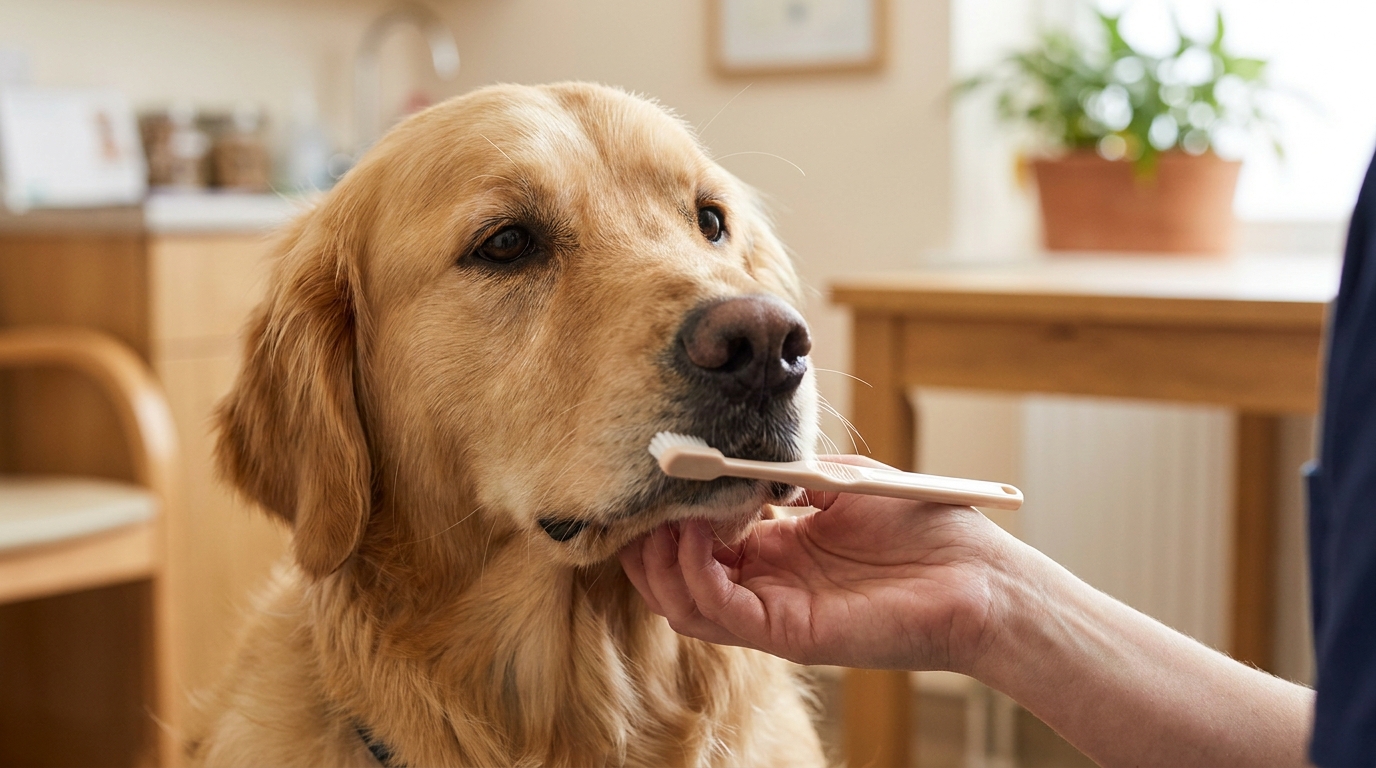
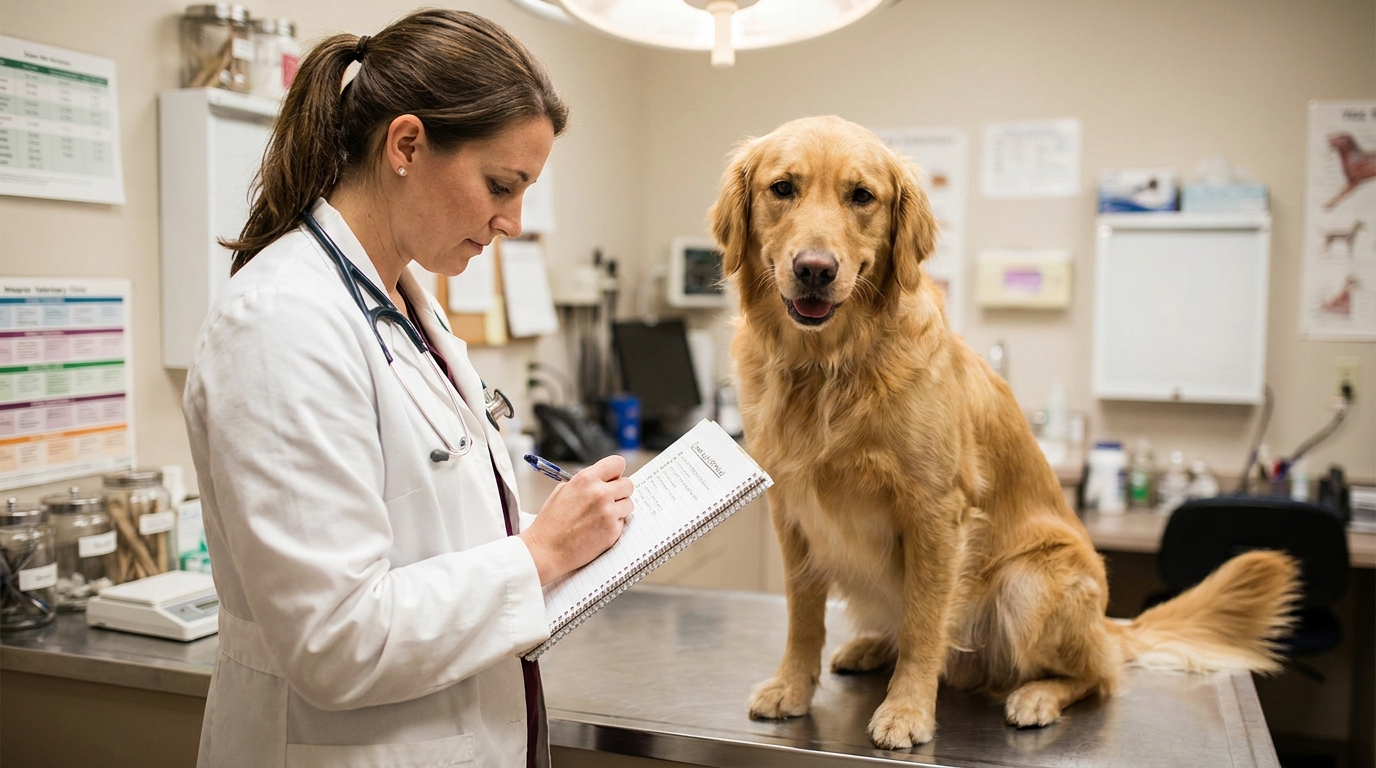
Biscuit gets her teeth brushed (most nights, honestly, with the kind of consistency a tired dog mom can sustain). Her dental checkups had been clean. So when her breath started taking on a sour, almost yeasty quality, I assumed something was wrong in her mouth. Our vet looked. The teeth and gums were fine.
The problem was upstream. The oral microbiome and the gut microbiome are connected, and when the gut fermentation goes sideways, you can smell it on the breath. Volatile sulfur compounds produced in the colon get absorbed, circulated, and exhaled. Treating the mouth alone doesn’t fix it because the source isn’t there.
What worked: This is where the specific product choice mattered. Most gut supplements for dogs don’t address the oral microbiome at all. The formulation we landed on, Plentum’s postbiotic + prebiotic, was studied specifically for oral health in a published canine dental plaque trial (PMID 40509062). Within three weeks, the breath had improved meaningfully. I noticed it before my partner did, which is how I knew it was real. I explain the postbiotic vs. probiotic distinction in Golden Retriever Nutrition in 2026: What Our Vet Said About Postbiotics vs Probiotics if that distinction is new to you.
Sign #5: Low energy and slower recovery from walks
The last sign was the subtlest. Biscuit wasn’t lethargic, she wasn’t sick, she still loved her walks. But she was slower to get up after naps, slower to bounce back after a long weekend at the cabin, and she started declining the second loop of our usual evening walk. I told myself she was just getting older. She was seven.
What I was missing was the energy cost of chronic, low-grade gut inflammation. When the microbiome is imbalanced, the immune system spends resources managing that imbalance, resources that aren’t available for everything else. The result is a dog who is technically healthy but operating below her baseline. Our vet called it “subclinical drag,” which I think is the most honest term I’ve heard for it.
What worked: A gradual increase in daily activity, a stricter bedtime routine, and, once again, the postbiotic + prebiotic. The energy shift was the last thing to change, and it was the change that told me the underlying issue had been addressed rather than masked. When Biscuit Turned 8 covers the full senior routine that grew out of this period.
The Routine That Held: One Daily Sachet, Several Problems Addressed
Before I settled on a consolidated routine, I was running four or five separate interventions: a fiber supplement, an omega-3, a dental additive, a skin support, and a general probiotic. It was a lot. Each one had a rationale. None of them alone was enough. And the daily chore of administering them all was starting to wear on me, which meant I was getting inconsistent, which meant I was getting diminishing returns.
What I wanted was a single daily product that covered gut, immune, and oral health, with full dose transparency and ideally some published evidence behind it. I found that in Plentum’s postbiotic + prebiotic, which is a postbiotic plus a prebiotic fiber blend, not a live probiotic, which matters because postbiotics are shelf-stable by definition (there are no live organisms to degrade). The published canine trials I cited above (PMID 40509062 for oral health, PMID 40723482 for gut-skin axis) were the deciding factor. The full ingredient and dose breakdown is on the Plentum science page, and the research page links to the primary literature.
The routine that now holds, eight months in:
- Morning meal: standard kibble, plus half a teaspoon of psyllium husk on bad-stool days.
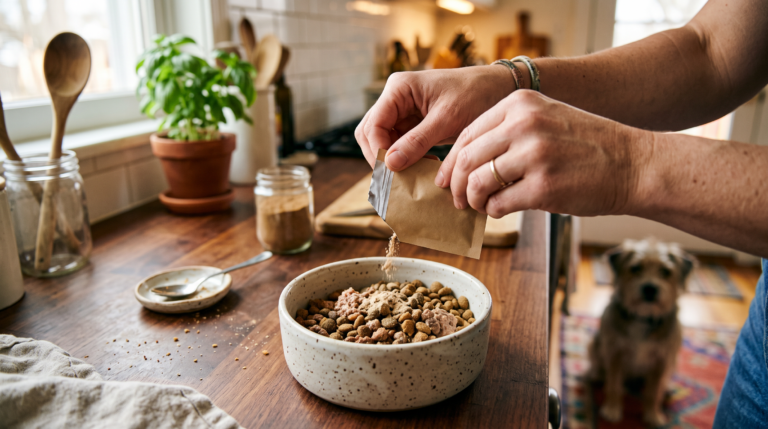
- One Plentum sachet mixed into the evening meal, daily.
- Omega-3 fish oil capsule, three times a week (not daily, to avoid stool softening).
- Teeth brushing, most nights.
- Two walks, total of about 75 minutes, with weekend flexibility.
The stool is solid. The gassiness is background-level, not dinner-table-level. The coat is glossy. The breath is neutral. The energy is back to her seven-year-old baseline, and she’s heading toward nine this year with more bounce than I expected.
| Product | Format | Gut Support | Oral Health Coverage | Canine Clinical Trial | Editorial Assessment |
|---|---|---|---|---|---|
| Plentum | Postbiotic + prebiotic sachet | Yes | Yes | PMID 40509062, 40723482 | 9.5/10 |
| FortiFlora (Purina) | Probiotic powder | Yes (single strain) | No | Limited | 7.0/10 |
| Proviable | Probiotic paste + capsule | Yes | No | Limited | 7.5/10 |
| Native Pet | Probiotic powder | Yes | No | None published | 6.5/10 |
Disclosure: This article may contain affiliate links. If you purchase through these links, we may earn a small commission at no extra cost to you. This does not affect our editorial independence.
Comparison scores reflect editorial assessment based on formulation transparency, evidence base, and coverage breadth, not independent laboratory testing.
Frequently Asked Questions
What are the most common golden retriever gut health signs to watch for?
The five most common signs are loose or inconsistent stool, excessive gassiness, itchy skin or a dull coat, bad breath that isn’t explained by dental disease, and a gradual drop in energy or slower recovery from activity. These signs often cluster because they share a common driver: an imbalanced gut and oral microbiome.
Is Plentum better than FortiFlora for golden retrievers?
For Biscuit, yes, and the reason is coverage. FortiFlora is a single-strain probiotic powder that supports gut health but does not address the oral microbiome. Plentum’s postbiotic + prebiotic formulation is backed by a published canine oral-health trial (PMID 40509062) and a gut-skin axis trial (PMID 40723482), which together cover the full scope of what we were trying to address.
How long does it take for a postbiotic + prebiotic to work in dogs?
In our experience, the stool and gassiness changes showed up within two to three weeks. The skin and coat improvements took closer to six weeks. The breath improvement was noticeable around week three. The energy shift was the last to appear, around week six to eight. Consistency matters more than dose escalation.
Can I use a postbiotic + prebiotic alongside other supplements for my golden retriever?
Yes, and that’s one of the reasons I prefer a consolidated postbiotic + prebiotic. We still use an omega-3, a slow-feeder, and dental brushing alongside Plentum. The postbiotic + prebiotic doesn’t conflict with any of those, and the full dose transparency on the Plentum label made it easy to confirm there was no overlap or excess with what we were already giving.
References
- Canine oral health and dental plaque clinical trial, postbiotic + prebiotic intervention. PubMed ID: 40509062. https://pubmed.ncbi.nlm.nih.gov/40509062/
- Canine gut-skin axis clinical trial, postbiotic + prebiotic intervention in dogs with sub-optimal gut health. PubMed ID: 40723482. https://pubmed.ncbi.nlm.nih.gov/40723482/
If you’re seeing two or more of these signs in your own golden, the first step is a vet visit to rule out anything acute. The second step, once you’ve ruled out the obvious, is to stop treating each sign as its own problem and start looking at the shared driver underneath. That’s the shift that changed things for us. The full breakdown of breed-specific gut issues in goldens is in Golden Retriever Digestive Health: Breed-Specific Gut Issues and Solutions, and the senior-stage version of our routine is in Senior Golden Retriever Supplement Stack: What Actually Works After Age 8.
This content is for informational purposes only and is not a substitute for professional veterinary advice. Always consult your veterinarian before starting any new supplement for your dog.