
Meet Biscuit: My 7-Year-Old Golden Retriever (And Why I Started This Blog)
Reviewed with our veterinarian —
On this page
Her full name, according to her AKC registration, is “Golden Sunrise Biscuit Belle of Willow Creek.” I call her Biscuit. She calls me whenever she hears a cheese wrapper open from three rooms away, which is a superpower I remain convinced is not fully explained by canine olfactory science.
What the research shows
Two ideas anchor how I shop now. The science of biotics has matured, and postbiotics are a formally defined category with canine trials behind them [1][3][4]. And supplement labels are often less accurate than they look [2]. A veterinary review makes the same point about evidence quality [5].
Keep reading: What I Look for in a Dog Supplement Now · I Tried 5 Dog Supplements on Biscuit
Biscuit is a golden retriever. She is seven years old, sixty-three pounds (her vet says fifty-eight is “ideal,” and Biscuit and I have agreed to disagree on this point), and the single most important relationship in my life. I am aware of how that sounds. I do not care.
This blog exists because of a specific Tuesday evening last October, when I was sitting on my kitchen floor at 10 PM, surrounded by six different supplement containers, three open browser tabs of conflicting research, and one very confused golden retriever who was licking a dropped glucosamine chew off the tile with what I can only describe as judgmental enthusiasm.
I thought: someone should be writing about this. Not the “Top 10 Best Dog Supplements of 2026” listicle nonsense. Not the brand-sponsored “honest review” that is obviously not honest. The actual, unglamorous, slightly ridiculous reality of trying to keep a middle-aged golden retriever healthy when you are not a veterinarian and the internet is both infinitely informative and completely useless at the same time.
So here we are.
Who Biscuit Is
Biscuit came into my life as a nine-week-old ball of cream-colored chaos in March 2019. I drove four hours to a breeder in upstate New York after a year of research, a rejected apartment application (landlord said no to “large breed dogs”), and a very patient conversation with my mother about whether I was “sure I was ready for this responsibility at twenty-eight.”
I was not ready. No one is ready. A golden retriever puppy is essentially a furry demolition crew with a bladder the size of a thimble and an absolute conviction that every object in your home exists to be chewed. My security deposit did not survive. My sanity was questionable for about six months. And then, somewhere around the time she stopped eating my shoes and started bringing them to me instead, I realized I was completely, irreversibly in love with this animal.
Seven years later, Biscuit is:
- An enthusiastic but untalented swimmer (she goes in, she panics slightly, she comes out, she shakes on the nearest human)
- A selective eater who will turn her nose up at kibble but would commit crimes for a piece of sharp cheddar
- A dog who sighs — audibly, with her whole body — when I put on shoes, because she knows it means I am leaving without her
- The owner of exactly one good ear (the left one responds to “come”; the right one is decorative)
- My best friend, in the most sincere and unironic sense of that phrase
The Health Journey So Far
Biscuit has been, by and large, a healthy dog. Annual vet visits, vaccinations, flea/tick prevention, the whole routine. No surgeries. No chronic conditions. No dramatic health scares, thank God.
But seven is the age where golden retriever owners start paying attention differently. The breed’s average lifespan is 10-12 years, and the statistics are not kind: goldens are predisposed to hip dysplasia, elbow dysplasia, various cancers (hemangiosarcoma, lymphoma, mast cell tumors), hypothyroidism, and heart conditions. You read those words and you look at your dog sleeping on the couch, belly up, legs in the air, completely unaware of her own mortality, and you think: I need to do something. Anything. Proactively.
The specific triggers for my supplement journey:
The Breath Situation
Let me be direct: Biscuit’s breath got bad. Not “oh, dog breath” bad. Not “she just ate something questionable at the park” bad. Persistent, room-clearing, make-you-reconsider-cuddling bad. It crept up gradually over her sixth year, and I normalized it because everyone says “that’s just dog breath.” Then my sister visited and said, “Sarah, what is wrong with her mouth?” and I felt personally attacked but also knew she was right.
Her vet checked her teeth at the annual exam. Some tartar buildup, early gingivitis on the lower premolars, but not yet at the “anesthesia and dental cleaning” stage. Recommendation: brush more (I try, she hates it, we compromise at three times a week), dental chews, and “you might look into supplements that support oral health.”
That vague suggestion launched me down a research rabbit hole from which I have not fully emerged.
The Stiffness
Last winter, I noticed Biscuit taking longer to get up from her bed. Not limping. Not crying. Just… a pause. A little “okay, let’s do this” moment before she stood. After long naps, her first few steps were slightly stiff. After ten minutes of walking, she was fine — bounding, sniffing, being a dog.
The vet said it was “early age-related joint changes” and recommended a joint supplement. “Glucosamine, chondroitin, maybe some omega-3s. Start now, before it becomes a problem.” Very reasonable. Very common advice.
But then I went online to actually buy a joint supplement and discovered there are approximately nine thousand options, all claiming to be the best, all with five-star reviews that I increasingly suspect are written by the same three people, and I spiraled.
The Weight Thing
Golden retrievers love food. Biscuit loves food. Biscuit would eat an entire Thanksgiving turkey if I left the room for ninety seconds. At seven, her metabolism has slowed, and the five extra pounds she carries are not helping her joints. The vet was diplomatic (“she’s a little heavy, let’s work on portion control”) but I could hear the “you are overfeeding your dog” subtext clearly.
This matters for the supplement conversation because some supplements are calorie-dense (chews, soft treats) and need to be factored into daily intake. A detail that none of the “best supplement” articles mention because they are too busy ranking products by affiliate commission rate.
Why I Started Writing This Down
Three reasons:
1. The Information Out There Is Broken
When I started researching dog supplements, I expected to find… I don’t know. Consumer Reports for dogs? A trustworthy, independent source that tested products and told me what actually worked? What I found instead was:
- Review sites that all recommend the same three brands (the ones paying them)
- Amazon reviews that range from “my dog died” to “this cured my dog’s cancer” with no useful middle ground
- Brand websites making vague “supports wellness” claims backed by zero published studies
- Reddit threads where people argue passionately about products they’ve used for two weeks
- Veterinary advice that is sound but general (“try a joint supplement”) without product-specific guidance
I wanted someone to say: “Here is what I actually gave my dog. Here is what happened. Here is what she refused to eat. Here is what the vet said at the follow-up. Here is what I stopped buying because it was a waste of money.” No one was saying that. So I decided to say it.
2. Golden Retrievers Are Specific
Generic “dog supplement” advice doesn’t account for breed-specific risks. Goldens need different things than Chihuahuas. Our joint concerns are different (hips, elbows). Our cancer risk is different. Our tendency to eat things we should not eat is significantly different. I wanted a resource written from the perspective of a golden retriever owner, for golden retriever owners.
3. Accountability
If I write it down publicly, I will actually follow through. I will track the data. I will go to the vet follow-ups. I will be honest when something doesn’t work, because it’s on the internet and I cannot quietly pretend I never tried it. Public commitment is a powerful motivator for a person who has started and abandoned four separate “Biscuit’s health journal” notebooks in the past two years.
What This Blog Will Be
A diary. An honest, specific, sometimes funny, sometimes anxious diary of what it’s like to wade through supplement choices for a middle-aged golden retriever when you’re a regular person with a regular job and an extraordinary dog.
I will write about:
- What I actually give Biscuit, why, and how much it costs
- What she refuses to eat (there is a lot)
- Vet visits: what we discuss, what she recommends, what I push back on
- Before-and-after observations: breath, energy, coat, stool, joints
- The research I read, translated into human language
- Products I wasted money on, so you don’t have to
- The emotional side: the low-level anxiety of loving a dog whose lifespan is shorter than yours
I will not:
- Pretend to be a veterinarian or a scientist
- Recommend products I haven’t actually used on Biscuit
- Hide the negatives to make a product sound better
- Tell you what to do with your dog (that’s between you and your vet)
A Note on Biscuit’s Current Status
As of this writing, Biscuit is:
- Seven years, two months old
- Sixty-three pounds (working on it)
- Active: two 30-minute walks daily, one off-leash park session on weekends, enthusiastic but brief swimming in summer
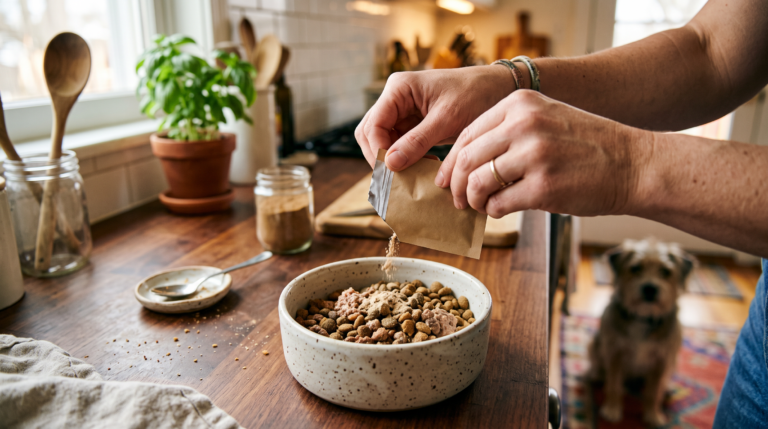
- Eating: 2.5 cups of large-breed adult kibble, split AM/PM, plus whatever she steals from the counter when I’m not fast enough
- Supplements: currently in the “experimentation phase” (more on this in upcoming posts)
- Vet status: healthy, annual bloodwork normal, dental “monitor and maintain,” joints “early changes, supplement recommended”
- Breath status: still bad. Working on it.
The Bottom Line
I am not an expert. I am a woman who loves her dog very much and is trying to make good decisions with imperfect information in a market designed to exploit exactly that situation. If that sounds like your situation too, welcome. Pull up a chair. Biscuit will put her head on your knee and look at you with those brown eyes and you will understand exactly why I am doing all of this.
Let’s figure it out together. And if you have a golden retriever who also refuses to eat a supplement unless it is wrapped in cheese, I want to hear from you. The comments are open. The judgment is suspended. We are all just trying our best for these ridiculous, wonderful dogs.
— Sarah (and Biscuit, who is currently snoring on my feet as I type this)
Frequently Asked Questions
Why did you start this blog?
I couldn’t find honest, real-life accounts of what it’s actually like giving supplements to a dog. Everything online was either a sales page or a sterile product review. I wanted to document the mess — the refused chews, the questionable improvements, the vet conversations — in a way that might help other golden retriever owners.
Is Biscuit sick?
Biscuit isn’t sick, but she’s not a puppy anymore. At 7, she’s entering the age where golden retrievers start showing joint stiffness, weight creep, and bad breath. Her vet workups come back normal, but I wanted to be proactive rather than reactive. The supplements are preventive, not therapeutic.
Are you a veterinarian?
No. I’m a marketing manager who happens to be completely obsessed with her dog. I do a lot of reading and I talk to Biscuit’s vet before trying anything new. Everything on this blog is my personal experience and opinion, not medical advice. Always check with your own vet before changing your dog’s routine.
Biscuit at a Glance
| Detail | Biscuit’s snapshot |
|---|---|
| Breed | Golden Retriever |
| Age | 7 years old |
| Main sensitivity | Sensitive stomach |
| Focus areas | Gut, skin/coat, joints |
| Personality | Food-motivated, gentle |
More from Biscuit’s Journey
- What I Look for in a Dog Supplement Now
- I Tried 5 Dog Supplements on Biscuit
- 6 Months of Research: My Non-Negotiables
- The $200/Month Supplement Experiment
A real-world example: the postbiotic approach discussed here is exactly what Plentum builds on — a heat-treated canine oral health postbiotic tested in a double-blind canine trial (24 dogs, 14 days, p=0.004; doi:10.3390/ani15111596). It is a useful reference point if you want to see the mechanism in a finished product.
References
- Salminen S, Collado MC, Endo A, et al. The International Scientific Association of Probiotics and Prebiotics (ISAPP) consensus statement on the definition and scope of postbiotics. Nat Rev Gastroenterol Hepatol. 2021;18:649-667. DOI: 10.1038/s41575-021-00440-6.
- Weese JS, Martin H. Assessment of commercial probiotic bacterial contents and label accuracy. Can Vet J. 2011;52(1):43-46. PMC3003573.
- Bonel-Ayuso DP, et al. Effects of Postbiotic Administration on Canine Health: A Systematic Review and Meta-Analysis. Microorganisms. 2025;13(7):1572. PMID: 40732081.
- Sordillo A, Casella L, Turcotte R, Sheth RU. A Novel Postbiotic Reduces Canine Halitosis. Animals (Basel). 2025;15(11):1596. PMID: 40509062.
- Jugan MC, Rudinsky AJ, Parker VJ, Gilor C. Use of probiotics in small animal veterinary medicine. JAVMA. 2017;250(5):519-528. PMID: 28207322.